Embryos aren’t female by ‘default’ after all, study shows

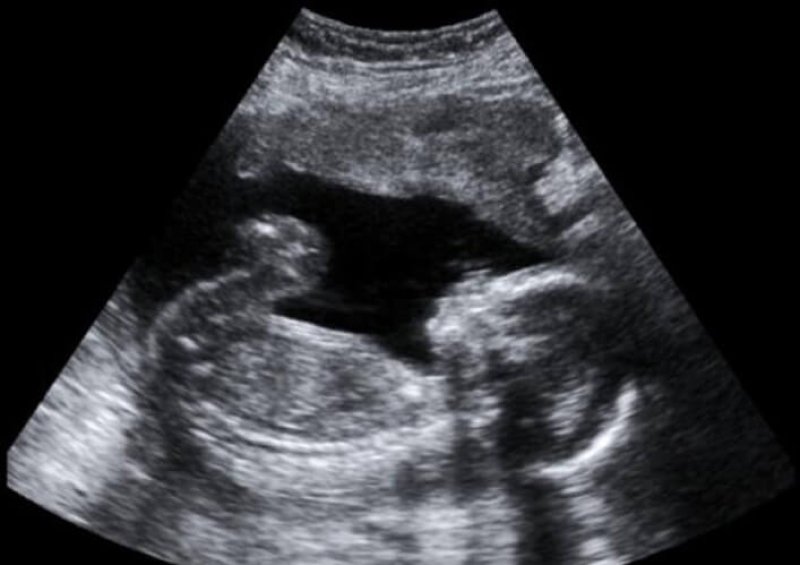
sonogram

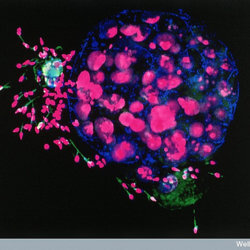
Every developing embryo, irrespective of its sex, at one point contains both male and female reproductive tracts, referred to as the wolffian duct and the müllerian duct, respectively. If the fetus produces testosterone and the anti-müllerian hormone (AMH) gene products from the Y chromosome — these molecules elicit cellular signaling events that lead to the destruction of the female müllerian ducts.

A new study published in Science by Humphrey Yao, Ph.D. challenges this age-old concept of the female pathway as “default” and shows that the development of femaleness is also an active process. The authors implicated a protein called COUP-TFII as a key player that is required to actively eliminate the wolffian duct in a developing female embryo in order to give it female characteristics.

This showed that, unlike what was earlier believed, male embryos are capable of developing male tubes in the absence of signals from testosterone and AMH, and that the development of female sex organs does not proceed by “default” but rather requires the coordinated action of specific signaling proteins. Although the study was conducted in mice, COUP-TFII is also produced by human embryos, making it highly likely that the pathway identified here may work the same way in humans.

The GLP aggregated and excerpted this blog/article to reflect the diversity of news, opinion, and analysis. Original post: It’s Hard Work Being a Boy (and, It Turns Out, a Girl)


{{ reviewsTotal }}{{ options.labels.singularReviewCountLabel }}
{{ reviewsTotal }}{{ options.labels.pluralReviewCountLabel }}
{{ options.labels.noReviewsLabel }}
{{ options.labels.newReviewButton }}
{{ userData.canReview.message }}

Related Articles

Infographic: Global regulatory and health research agencies on whether glyphosate causes cancer

Infographic: Global regulatory and health research agencies on whether glyphosate causes cancer

Does glyphosate—the world's most heavily-used herbicide—pose serious harm to humans? Is it carcinogenic? Those issues are of both legal and ...

Most Popular

Screenshot-2026-07-09-at-1.09.25-PM
Anti-vaccine myths rattle health care
ChatGPT-Image-Mar-10-2026-01_39_01-PM
Viewpoint—“Miracle molecule” debunked: Why acemannan supplements don’t work
Screenshot 2026-07-28 at 3.22
Hidden hunger: Climate change is speeding up the decline of important nutrients in our food
Screenshot 2026-07-22 at 1.38
Viewpoint: Are the U.S. and Europe headed towards a repudiation of agricultural biotechnology red tape?
Screenshot 2026-07-28 at 3.03
What is cyberchondria?
Screenshot 2026-07-28 at 2.04
Viewpoint: How AI supercharges conspiracy theories and oversimplifications to distort online health information
organic scaled
Facts & Fallacies podcast: Organic food cuts pesticide exposure? A response to Dr. Rhonda Patrick
png-terrace-Farm-asia
Europe’s tentative embrace of agricultural gene editing could revolutionize food production and health in Asia
ChatGPT-Image-May-26-2026-11_51_01-AM
Viewpoint: RFK, Jr.’s depressingly misguided (and litigator-funded) crusade against antidepressants
ChatGPT-Image-Jul-9-2026-11_33_49-AM
Viewpoint: High-dose resveratrol supplements to extend health and life? Don’t waste your money.
Screenshot-2026-07-27-at-3.23.14-PM
Prioritizing AI, robotics, and nuclear energy: Trump administration is guiding research funding away from independent universities to private companies
ChatGPT-Image-Jun-25-2026-12_23_17-PM
No, Bill Gates did not secretly engineer ticks to promote veganism
Screenshot 2026-07-28 at 3.43
Fat cat? GLP-1 weight loss drugs for animals are on the horizon
glp menu logo outlined

Get news on human & agricultural genetics and biotechnology delivered to your inbox.