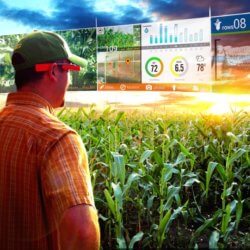
How the Midwest became the Silicon Valley of agriculture

Redbarn cornfield mist L

Matthew Crisp, president and CEO of Benson Hill Biosystems, [says] the rural zones of Midwestern America are proving fertile ground for a unique blend of science and technology.

Crisp said emerging companies look for three things when choosing a location: Infrastructure, talent, and money.

“St. Louis was really the only place that offered up those things for BensonHill,” he said….

The Midwest affords researchers in the field of plant genetics the opportunity to work in both “dry-wear” and “wet-wear,” he said, explaining the former involves the computer programing systems while the latter is the actual seed-work in greenhouses and fields. The Donald Danforth Plant Science Center’s 50,000-square feet of greenhouse space is a big plus, as well as the giant swaths of farmland throughout the region. “We’re in 13 different field sites for corn in the Midwest.”

Top universities with strong agriculture programs also dot the landscape, from Washington University in St. Louis to the University of Illinois-Champaign and University of Missouri at Columbia.

And venture capital funds are streaming in from both coasts, as well as from within the deep wellspring of wealth located in the Midwest itself.

The GLP aggregated and excerpted this article to reflect the diversity of news, opinion and analysis. Read full, original post: Is the Midwest a tech hub? In the ag sector, definitely!

{{ reviewsTotal }}{{ options.labels.singularReviewCountLabel }}
{{ reviewsTotal }}{{ options.labels.pluralReviewCountLabel }}
{{ options.labels.newReviewButton }}
{{ userData.canReview.message }}

Related Articles

Infographic: Global regulatory and health research agencies on whether glyphosate causes cancer

Infographic: Global regulatory and health research agencies on whether glyphosate causes cancer

Does glyphosate—the world's most heavily-used herbicide—pose serious harm to humans? Is it carcinogenic? Those issues are of both legal and ...

Most Popular

ChatGPT-Image-May-7-2026-12_16_37-PM-2
Viewpoint: Are cancer rates ‘skyrocketing’ as RFK, Jr. and MAHA claims? The evidence says mostly the opposite
Screenshot-2026-04-22-at-10.46.29-AM
Viewpoint: How to counter science disinformation? Science journalist offers 12 practical tips
Screenshot-2026-04-13-at-1.39.26-PM
Viewpoint: ‘Safer for children?’ Stonyfield yogurt under fire for deceptive organic marketing
png-pill-omega-Supp-fish-oil
Millions take omega-3 fish oil for brain health. New research suggests it may do the opposite.
ChatGPT-Image-May-12-2026-08_39_41-PM
GLP podcast: Big Pharma, Big Ag, Big Food—health harming industries or life-saving innovators?
Screenshot-2026-04-23-at-11.00.36-AM
Regulators' dilemma: Thalidomide, Metformin, and the cost of getting drug approvals wrong
Picture1-5
Science Disinformation Gap: The transatlantic battle over social media and censorship
ChatGPT-Image-May-13-2026-11_56_08-AM
After slashing global health aid by $19 Billion, Trump moves to tap $2.1 billion more—to cover shutdown costs
Screenshot-2026-05-08-at-3.40.33-PM
Seeds of power: China turns to genetic engineering to become global superpower
Picture1-1
Cooling the planet with balloons: Could a geoengineering gamble slow global warming?
ChatGPT Image May 12, 2026, 01_21_30 PM
How big health brands are funding online medical misinformation 
glp menu logo outlined

Get news on human & agricultural genetics and biotechnology delivered to your inbox.