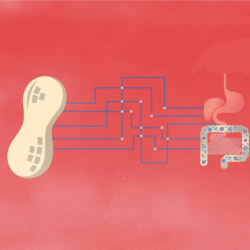
Hope for peanut allergy sufferers: Gene-silenced hypoallergenic nuts could save lives

Screen Shot at PM

Moving to the United States helped [Hortense Dodo, a food scientist and entrepreneur from Ivory Coast] reach her academic goals, but it also introduced her to a health problem that would become her career focus—life-threatening peanut allergies. These allergies are much more prevalent in industrialized nations than in the developing world, killing an estimated 150 people in the US per year, and causing many thousands more to suffer hives, breathing problems, and other reactions that can require hospitalization.

In her laboratory, Dodo experimented on standard peanuts using RNA interference technology (RNAi), which is a method of genetically engineering organisms by “silencing” the expression of certain proteins and traits. In this case, Dodo singled out three proteins that produce the most extreme reactions in allergy sufferers, known as Ara h1, Ara h2, and Ara h3, and was able to develop a patented process that eliminated the impact of those dangerous components.

By exposing the peanut to blood serum from people with allergies, and examining the response of antibodies to it, Dodo and her team can test the peanut’s hypoallergenic properties. The results have been extremely promising, inspiring Dodo to found her own biotechnology company, called IngateyGen, LLC, in order to bring her hypoallergenic peanut into the commercial sector.

Read full, original post: This Food Scientist Wants to Save Lives With a Hypoallergenic Peanut

Related Articles

Infographic: Global regulatory and health research agencies on whether glyphosate causes cancer

Infographic: Global regulatory and health research agencies on whether glyphosate causes cancer

Does glyphosate—the world's most heavily-used herbicide—pose serious harm to humans? Is it carcinogenic? Those issues are of both legal and ...

Most Popular

ChatGPT-Image-Aug-4-2026-10_15_14-AM
Viewpoint—A hard look at the Fauci diaries: Do they change what we know about COVID’s origins?
ChatGPT-Image-Mar-10-2026-01_39_01-PM
Viewpoint—“Miracle molecule” debunked: Why acemannan supplements don’t work
Picture1
Hiroshima at 81: America’s new nuclear bomb, a buried Iranian target, and a question no one wants to ask
ChatGPT-Image-Aug-4-2026-12_42_58-PM
Viewpoint: Fact-checking CNN interview with RFK, Jr. underscores the depth of his disinformation delusions
png livestock cow cattle a
Consumer skepticism about gene-edited milk is neither fixed nor particularly high—and falls even more if it’s priced lower
ChatGPT-Image-Jul-17-2026-09_50_27-AM
Viewpoint: How disease tracking and prevention has cratered under the Kennedy-Trump administration
ChatGPT-Image-Aug-4-2026-09_31_50-AM-2
Viewpoint: Could the U.S. become dependent on China to develop critical new genetic and drug therapies?
ChatGPT-Image-Aug-4-2026-07_52_00-PM
No liability for scientific due diligence: California Supreme Court rejects bizarre lawsuit faulting Gilead for fully evaluating HIV drug before release
ChatGPT-Image-Jul-31-2026-07_35_35-AM
Wikipedia has assembled an informative list of fake news websites from across the ideological spectrum
ChatGPT-Image-Aug-4-2026-02_05_46-PM
Does Congress have the guts to successfully challenge Trump’s politicization of science funding?
Screenshot-2026-07-31-at-10.52.03-AM
Love sweets and fatty foods? You can blame your genes, but there are ways to quell the obsessions
Screenshot-2026-07-17-at-1.34.59-PM
Poll: Vaccine hesitancy soars when patients distrust health providers and turn to social media
glp menu logo outlined

Get news on human & agricultural genetics and biotechnology delivered to your inbox.