Podcast: Geneticist Pamela Ronald on how GMO misinformation could hurt world’s poor

pamronald
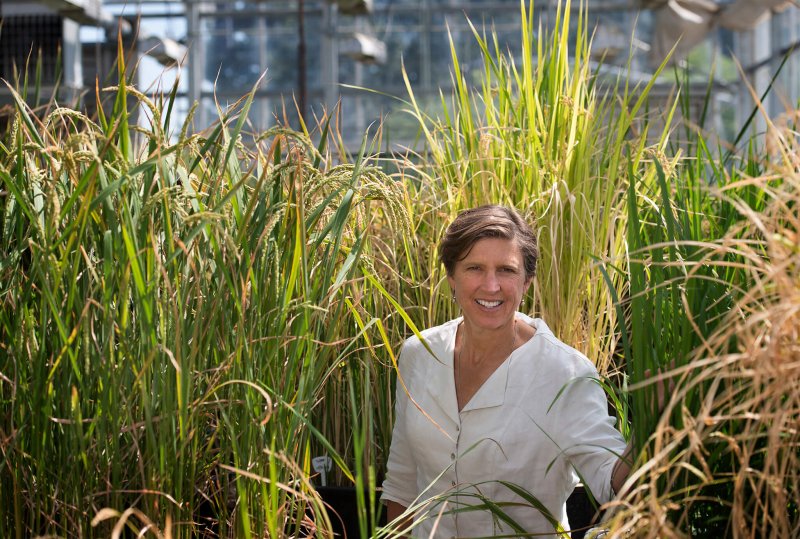
Image source: National Geographic

If you’ve heard that GMOs are bad, I want to introduce you to Pamela Ronald. A plant geneticist, Pamela co-authored the book Tomorrow’s Table: Organic Farming, Genetics and the Future of Food with her husband, Raoul Adamchak, who is an organic farmer.

Also known as “The Rice Whisperer,” Pamela is a Distinguished Professor at the University of California, Davis and Director of the Institute for Food and Agricultural Literacy. Her laboratory studies genes that make rice plants tolerant of environmental stress and resistant to disease.

In 2015, Pamela was selected by Scientific American as one of the world’s 100 most influential people in biotechnology and by Grist magazine as an innovator who will lead us toward a more sustainable future. Tomorrow’s Tablewas selected as one of the best books of 2008 by Seed Magazine and the Library Journal. Her 2015 TED talk has been viewed by nearly 1.5 million people and translated into 24 languages.

Pamela and I discuss how to navigate through the confusing landscape of genetically modified or genetically engineered crops and why science matters when sifting through the politics and perceptions that surround food information today.  You’ll learn about the challenges that farmers face as the Non-GMO labeling movement affects consumer choices.

Read full, original post: Podcast episode 089: Tomorrow’s Table – Pam Ronald

{{ reviewsTotal }}{{ options.labels.singularReviewCountLabel }}
{{ reviewsTotal }}{{ options.labels.pluralReviewCountLabel }}
{{ options.labels.noReviewsLabel }}
{{ options.labels.newReviewButton }}
{{ userData.canReview.message }}

Related Articles

Infographic: Global regulatory and health research agencies on whether glyphosate causes cancer

Infographic: Global regulatory and health research agencies on whether glyphosate causes cancer

Does glyphosate—the world's most heavily-used herbicide—pose serious harm to humans? Is it carcinogenic? Those issues are of both legal and ...

Most Popular

ChatGPT-Image-Mar-10-2026-01_39_01-PM
Viewpoint—“Miracle molecule” debunked: Why acemannan supplements don’t work
ChatGPT-Image-Jul-10-2026-12_21_03-PM
Viewpoint: Is there new evidence that the animal deworming drug ivermectin decreases the risk of Covid and cancer? Don’t waste your money.
Picture1
Hiroshima at 81: America’s new nuclear bomb, a buried Iranian target, and a question no one wants to ask
Screenshot-2026-07-09-at-1.09.25-PM
Anti-vaccine myths rattle health care
leeteam
How Kennedy and his family could pocket millions from Merck’s $50 million vaccine injury settlement that he oversaw
Screenshot-2026-07-30-at-3.07.42-PM
Controversy over WNBA star Sophie Cunningham’s comment opposing trans females in women’s sports reinvigorates the culture wars
Screenshot-2026-07-30-at-2.30.35-PM
Climate scientists claim conservative activists are promoting ‘lies’ that Europe’s summer heatwaves are far from unusual
ChatGPT-Image-Jun-25-2026-12_23_17-PM
No, Bill Gates did not secretly engineer ticks to promote veganism
ChatGPT Image Jul 29, 2026, 05_50_04 PM
Fear, science, and the law: If talc powder is unlikely to cause cancer and J&J was winning in court, why did it pay more than $5.5 billion to settle?

Sorry. No data so far.

glp menu logo outlined

Get news on human & agricultural genetics and biotechnology delivered to your inbox.