Treating alpha thalassemia major with prenatal blood transfusions, bone marrow transplant

ELLIANA jumbo v
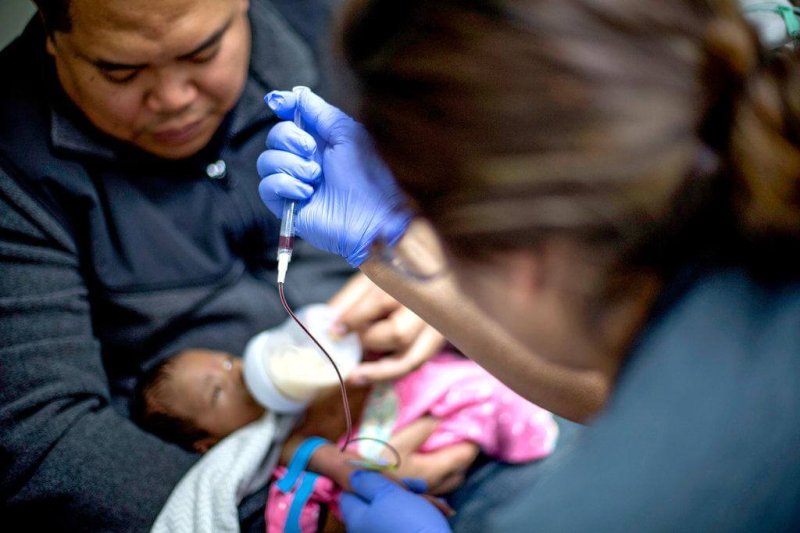
Drawing blood from Elianna, who still needs a blood transfusion every three weeks. Image credit Bryan Meltz

In the three months before she was even born, Elianna Constantino received five blood transfusions and a bone-marrow transplant. All were given with a needle passed through her mother’s abdomen and uterus, into the vein in her umbilical cord.

Elianna, born Feb. 1 with a robust cry and a cap of gleaming black hair, has a genetic disease that usually kills a fetus before birth. The condition, alpha thalassemia major, leaves red blood cells unable to carry oxygen around the body, causing severe anemia, heart failure and brain damage.

The transfusions in the womb kept her alive, but only treated her illness. The bone-marrow transplant has the potential to cure it.

If the treatment works, it could open the door to using bone-marrow transplants before birth to cure not just Elianna’s blood disease but also sickle cell anemia, hemophilia and other hereditary disorders.

So far for Elianna, in her first three months, there has been no obvious benefit from the transplant. Like all children with her blood disorder, she needs a transfusion every three weeks.

But tests have found some of her mother’s stem cells in her blood. Whether they will start to help her is unknown. If they do not, her parents could eventually opt for a bone-marrow transplant to cure the disease and free her from a lifetime of transfusions.

Read full, original post: Five Blood Transfusions, One Bone Marrow Transplant — All Before Birth

{{ reviewsTotal }}{{ options.labels.singularReviewCountLabel }}
{{ reviewsTotal }}{{ options.labels.pluralReviewCountLabel }}
{{ options.labels.newReviewButton }}
{{ userData.canReview.message }}

Related Articles

Infographic: Global regulatory and health research agencies on whether glyphosate causes cancer

Infographic: Global regulatory and health research agencies on whether glyphosate causes cancer

Does glyphosate—the world's most heavily-used herbicide—pose serious harm to humans? Is it carcinogenic? Those issues are of both legal and ...

Most Popular

ChatGPT-Image-Mar-10-2026-01_39_01-PM
Viewpoint—“Miracle molecule” debunked: Why acemannan supplements don’t work
ChatGPT-Image-Jun-25-2026-12_23_17-PM
No, Bill Gates did not secretly engineer ticks to promote veganism
ChatGPT-Image-Jun-19-2026-04_11_20-PM
Daubert for Dummies—Scientific Reliability in U.S. Courts: Daubert, Rule 702, and Made-for-Litigation Evidence
ChatGPT-Image-Jun-17-2026-10_52_43-AM
Anguished parents, doctors in tears: Utah’s long measles outbreak takes a toll
Screenshot-2026-06-22-at-9.04.46-PM
Kennedy's nutrition prescription for medical schools: Real problem, bad cure
Screenshot-2026-06-15-at-1.55.27-PM
America's trust in Trump-Kennedy's CDC health recommendations is plunging
ChatGPT-Image-Jun-15-2026-11_51_00-AM-4
Viewpoint: As the International Association for Research on Cancer loses influence, activists and trial lawyers scramble to protect a lucrative playbook
Screenshot-2026-06-05-at-2.12.30-PM
Some plants can poison you. So how did humans figure out what is safe to eat?

Sorry. No data so far.

glp menu logo outlined

Get news on human & agricultural genetics and biotechnology delivered to your inbox.