Neonicotinoid insecticides negatively impact bumblebee queen health, lab study finds

MRJZSR Z RULKZTLSZ LRZ LSZ HSZSHPRZHQRJZHZ L ZULXRCZSR LKROZYL LSZ LXZTL RLHIZ LERLHKR L R
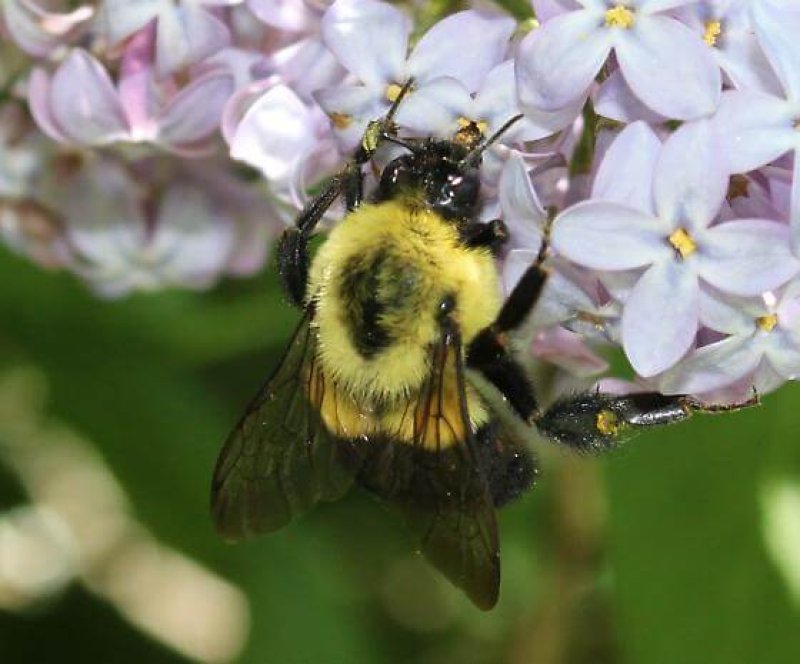
Image credit: Tammy Mayer/BugGuide

In a study published today in Proceedings of the Royal Society B, researchers at the University of California, Riverside found that environmental threats are piling onto the stress faced by nest-building bumblebee queens.

Led by Hollis Woodard, an assistant professor of entomology, the team found that exposure to a widely used insecticide and a poor diet negatively impacted bumblebee queens’ health and work, which could have dramatic consequences on an already dwindling pollinator group.

Woodard’s team tested the effects of temporary or sustained exposure to the neonicotinoid imidacloprid and a single-source pollen diet on queens’ mortality, activity, and ability to establish healthy nests.

They showed bumblebee queens were far less active and six times more likely to die during sustained exposure (37 days) to the pesticide, which could be somewhat mitigated by a shorter exposure of 17 days. The surviving exposed bees also produced only a third of the eggs and a fourth of the larvae of untreated queens.

Woodard said the data support the idea that use of neonicotinoid insecticides in the U.S. should be reconsidered. The member states of the European Union recently agreed to ban neonicotinoids from all fields by the end of 2018 due to the serious danger they pose to bees.

Editor’s note: Read the full study (behind paywall)

Read full, original post: Environmental threats put bumblebee queens under pressure

{{ reviewsTotal }}{{ options.labels.singularReviewCountLabel }}
{{ reviewsTotal }}{{ options.labels.pluralReviewCountLabel }}
{{ options.labels.newReviewButton }}
{{ userData.canReview.message }}

Related Articles

Infographic: Global regulatory and health research agencies on whether glyphosate causes cancer

Infographic: Global regulatory and health research agencies on whether glyphosate causes cancer

Does glyphosate—the world's most heavily-used herbicide—pose serious harm to humans? Is it carcinogenic? Those issues are of both legal and ...

Most Popular

ChatGPT-Image-Mar-10-2026-01_39_01-PM
Viewpoint—“Miracle molecule” debunked: Why acemannan supplements don’t work
Screenshot 2025-07-30 at 10.48
Can gene editing eliminate Down syndrome? Scientists have done it in lab-grown cells
Screenshot 2026-05-26 at 10.15
Viewpoint: Double standard—Why does the wellness industry get a free pass while Big Healthcare is treated as morally suspect?
ChatGPT-Image-Jun-4-2026-01_27_58-PM
Viewpoint—N.A.D.+: Why Gwenyth Paltrow’s heralded anti-aging supplement doesn’t work
downsyndrome_compilation_MID_1
CRISPR breakthrough that can remove the chromosome responsible for Down syndrome raises ethical questions
ChatGPT-Image-May-26-2026-07_51_21-AM-2
Viewpoint: There are more than 1,000 chemicals in a cup of coffee—including many substances that can cause cancer. Why isn’t it banned?
tick-DNA
GLP podcast: Spread meat allergy with gene-edited ticks? Bioethicists pose vile ‘thought experiment’
Screenshot-2026-06-03-at-1.24.46-PM
Challenging anti-GMO disinformation: Why genetically-tweaked crops offer bushels of benefits

Sorry. No data so far.

glp menu logo outlined

Get news on human & agricultural genetics and biotechnology delivered to your inbox.