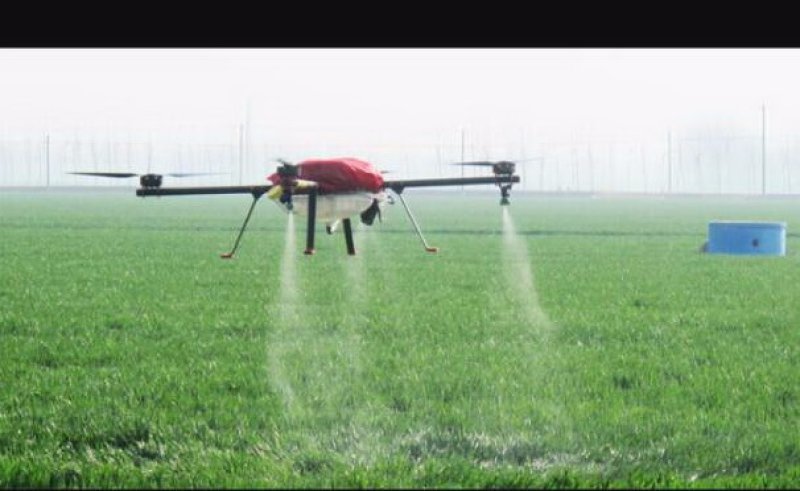
Ghanaian farmers enlist drones to combat fall armyworm invasion

dronespray
Credit: Myjoyonline

Farmers at Janga in the West Mamprusi municipality of the Northern Region [in Ghana] are learning how to use drones and other newly introduced chemicals meant to fight an invasion of fall armyworms in the area. The intervention comes at a time when the worms have wreaked havoc on maize and rice farms.

The exercise was scheduled in response to a recent report by the Daily Graphic that the pest had resurfaced in the Nanumba South District and West Mamprusi municipality, destroying hectares of farms.

RMG Ghana Limited, an agro-input company, which organized the …. exercise …. took farmers through the use of drones, recommended time to spray, and how to apply pesticides that could help fight the worms.

The drones sprayed a hectare of farmland within 15 minutes, compared to the manual knapsack sprayer which often took about three hours to spray the same area of land.

[J]ust 10 minutes after spraying with the new pesticide…. the worms and other insects that were feasting on the crops died and fell off.

Editor’s note: This article was originally published on a foreign news website. This summary has been edited for clarity.

Read full, original article: Drones, new chemicals introduced to fight army worms

{{ reviewsTotal }}{{ options.labels.singularReviewCountLabel }}
{{ reviewsTotal }}{{ options.labels.pluralReviewCountLabel }}
{{ options.labels.newReviewButton }}
{{ userData.canReview.message }}

Related Articles

Infographic: Global regulatory and health research agencies on whether glyphosate causes cancer

Infographic: Global regulatory and health research agencies on whether glyphosate causes cancer

Does glyphosate—the world's most heavily-used herbicide—pose serious harm to humans? Is it carcinogenic? Those issues are of both legal and ...

Most Popular

Screenshot 2026-05-26 at 10.15
Viewpoint: Double standard—Why does the wellness industry get a free pass while Big Healthcare is treated as morally suspect?
ChatGPT-Image-Jun-4-2026-11_49_36-AM-2
‘You don’t understand Tolkien’: Skeptic Pope trolls tech giants about the exaggerated, risk-less benefits of AI
ChatGPT-Image-Jun-4-2026-01_27_58-PM
Viewpoint—N.A.D.+: Why Gwenyth Paltrow’s heralded anti-aging supplement doesn’t work
Screenshot-2026-06-03-at-1.24.46-PM
Challenging anti-GMO disinformation: Why genetically-tweaked crops offer bushels of benefits
Screenshot 2025-07-30 at 10.48
Can gene editing eliminate Down syndrome? Scientists have done it in lab-grown cells
downsyndrome_compilation_MID_1
CRISPR breakthrough that can remove the chromosome responsible for Down syndrome raises ethical questions
ChatGPT-Image-Mar-10-2026-01_39_01-PM
Viewpoint—“Miracle molecule” debunked: Why acemannan supplements don’t work
Screenshot-2026-06-04-at-12.05.08-PM
Cases of brain inflammation surge as U.S. measles pandemic approaches 2000
tick-DNA
GLP podcast: Spread meat allergy with gene-edited ticks? Bioethicists pose vile ‘thought experiment’
ChatGPT Image May 26, 2026, 08_42_17 AM (1)
Viewpoint: Greenpeace and poison: How environmental advocacy groups rely on compliant (and often ignorant) journalists to spread disinformation and spark litigation
ChatGPT-Image-May-26-2026-07_51_21-AM-2
Viewpoint: There are more than 1,000 chemicals in a cup of coffee—including many substances that can cause cancer. Why isn’t it banned?

Sorry. No data so far.

glp menu logo outlined

Get news on human & agricultural genetics and biotechnology delivered to your inbox.