Searching for ALS genes in Appalachian Mountain family trees

Slitz DRK x
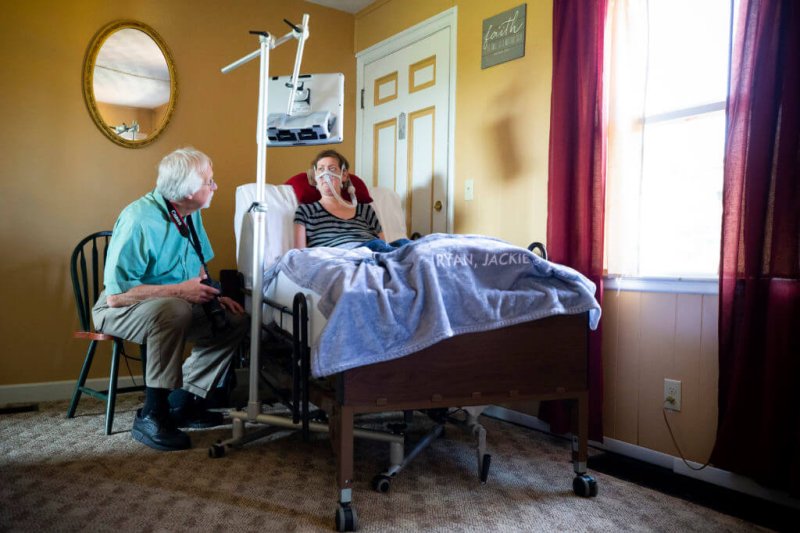
Dr. Edward Kasarskis visits ALS patient Jackie Sutton at her home in Somerset, Ky. Image credit: Alex Slitz/STAT

With patient visits along the way, [Dr. Edward Kasarskis and Debby Taylor would] be tracing, in reverse, the path of the families’ ALS-causing genetic mutation back to one of its sources near the Cumberland Gap. The region is thick with myth — and, consequently, tourists, who come to hike and inspect dioramas of their forebears wending through an opening in the mountains to settle the Western frontier. The researchers’ interest is a little different: This corner of Appalachia runs thicker with a particular form of inherited ALS than almost anywhere else.

[Kasarskis] hopes that his [family tree]-guided road trips might yield a treatable target, something to take advantage of these advances. After every expedition, he and Taylor drive whatever blood they’ve managed to collect — if any — back to Lexington, to biochemist Haining Zhu’s lab.

First, they’re looking at the FUS gene, which can, in concert with each person’s clinical history, tell the team [if the person could have ALS]. Later, Zhu plans to widen his scope. He’s hoping to find other snippets of DNA that modify how the body deals with that genetic error in FUS, determining whether or not someone gets the disease. “If it’s environmental, then it’s a totally different ballgame,” said Zhu. “That’s much more difficult to figure out. So we’re operating under the hypothesis that there is a genetic factor.”

Read full, original post: An Appalachian odyssey: Hunting for ALS genes along a sprawling family tree

{{ reviewsTotal }}{{ options.labels.singularReviewCountLabel }}
{{ reviewsTotal }}{{ options.labels.pluralReviewCountLabel }}
{{ options.labels.newReviewButton }}
{{ userData.canReview.message }}

Related Articles

Infographic: Global regulatory and health research agencies on whether glyphosate causes cancer

Infographic: Global regulatory and health research agencies on whether glyphosate causes cancer

Does glyphosate—the world's most heavily-used herbicide—pose serious harm to humans? Is it carcinogenic? Those issues are of both legal and ...

Most Popular

Screenshot-2026-05-01-at-1.29.41-PM
Viewpoint: What happens when whole grains meet modern food manufacturing? Labels don’t tell the whole story.
S
As vaccine rejectionism spreads, measles may be taking a more dangerous turn
Screenshot 2026-05-06 at 2.56
Singularity crisis ahead? Can super babies save us from rogue AI geniuses?
Screenshot-2026-05-06-at-2.07.43-PM
Manufacturing a conspiracy: The timeline of how  the White House embraced the fringe claim that scientists are being mysteriously murdered
Screenshot-2026-04-20-at-2.26.27-PM
Viewpoint — Food-fear world: The latest activist scientists campaign: Cancer-causing additives
Screenshot-2026-04-30-at-2.19.37-PM
5 myths about summer dehydration that could damage your health — or even kill you
Screenshot-2026-03-13-at-12.14.04-PM
The FDA wants to make many popular prescription drugs OTC—a great idea. Here’s why it’s unlikely to happen
Screenshot-2026-04-12-135256
Bixonimania: The fake disease scam that AI swallowed whole
Screenshot 2026-05-06 at 12.49
Immortal dragons: The quest to ‘make death optional’
Screenshot-2026-04-03-at-11.15.51-AM
Paraben panic: How a flawed study, media hype, and chemophobia convinced the public of the danger of one of the safest classes of preservatives
glp menu logo outlined

Get news on human & agricultural genetics and biotechnology delivered to your inbox.