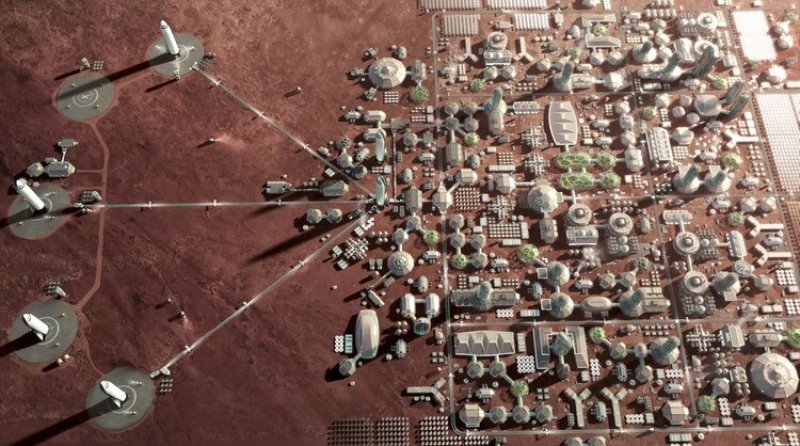
3 reasons Mars colonization might be a bad idea

Screen Shot at AM
Image credit: SpaceX

I wanted to look at the case against Mars; three reasons humans should leave the red planet alone.

[T]he first argument against human travel to Mars: contamination. If humans do eventually land on Mars, they would not arrive alone. They would carry with them their earthly microbes. Trillions of them. There is a real risk that some of these microbes could find their way onto the surface of Mars and, in doing so, confuse – perhaps irreversibly so – the search for Martian life.

Of course, one easy way to minimise the risk of contamination is to send robots to Mars instead of humans – the second argument against a manned trip to Mars.

Robots have several inherent advantages. They are much cheaper than humans because they don’t require a vast support infrastructure to provide things like water, food and breathable air.

The most polarising issue in the Mars debate is arguably the tension between those dreaming of a second home and those prioritising the one we have now.

The billions – if not trillions – of dollars needed to colonise Mars could, for example, be better spent investing in renewable forms of energy to address climate change.

And of course, if we have not figured out how to deal with problems of our own making here on Earth, there is no guarantee that the same fate would not befall Mars colonists.

Read full, original post: The case against Mars colonization

{{ reviewsTotal }}{{ options.labels.singularReviewCountLabel }}
{{ reviewsTotal }}{{ options.labels.pluralReviewCountLabel }}
{{ options.labels.newReviewButton }}
{{ userData.canReview.message }}

Related Articles

Infographic: Global regulatory and health research agencies on whether glyphosate causes cancer

Infographic: Global regulatory and health research agencies on whether glyphosate causes cancer

Does glyphosate—the world's most heavily-used herbicide—pose serious harm to humans? Is it carcinogenic? Those issues are of both legal and ...

Most Popular

ChatGPT-Image-May-7-2026-12_16_37-PM-2
Viewpoint: Are cancer rates ‘skyrocketing’ as RFK, Jr. and MAHA claims? The evidence says mostly the opposite
ChatGPT-Image-May-13-2026-11_56_08-AM
After slashing global health aid by $19 Billion, Trump moves to tap $2.1 billion more—to cover shutdown costs
Screenshot-2026-04-22-at-10.46.29-AM
Viewpoint: How to counter science disinformation? Science journalist offers 12 practical tips
ChatGPT-Image-May-12-2026-08_39_41-PM
GLP podcast: Big Pharma, Big Ag, Big Food—health harming industries or life-saving innovators?
png-pill-omega-Supp-fish-oil
Millions take omega-3 fish oil for brain health. New research suggests it may do the opposite.
Screenshot-2026-04-23-at-11.00.36-AM
Regulators' dilemma: Thalidomide, Metformin, and the cost of getting drug approvals wrong
Screenshot-2026-02-20-at-10.48.04-AM
Deepfakes raise profound ethical questions in science
Picture1-5
Science Disinformation Gap: The transatlantic battle over social media and censorship
Picture1-1
Cooling the planet with balloons: Could a geoengineering gamble slow global warming?
Screenshot-2026-05-08-at-3.40.33-PM
Seeds of power: China turns to genetic engineering to become global superpower
ChatGPT-Image-May-12-2026-01_41_42-PM
Viewpoint: ‘Measles is a canary in the healthcare coal mine’: Challenging RFK, Jr.’s scare campaign
donut-decorated-with-e-food-additives-tablets
RFK, Jr. is targeting chemical food additives. What does science tell us?
glp menu logo outlined

Get news on human & agricultural genetics and biotechnology delivered to your inbox.