‘Incredibly rare’ extinct Siberian horse to be cloned

ancient foal video
Image credit: a.akamaihd.net/Youtube

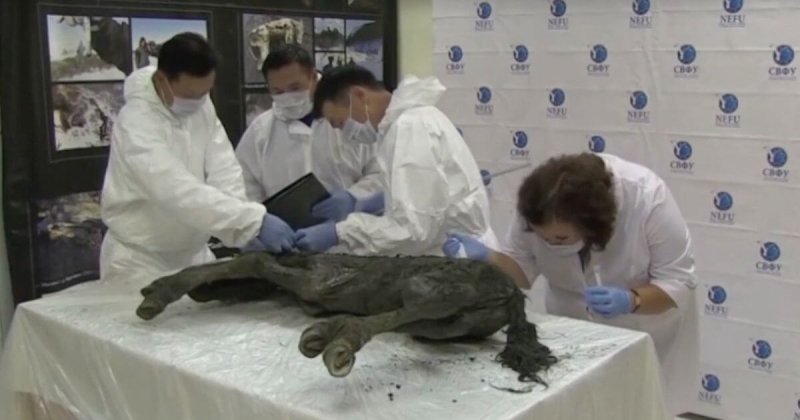
Scientists recently extracted an almost perfectly preserved prehistoric baby horse from the permafrost of Siberia’s “Mouth of Hell” crater in Yakutia. At potentially 40,000 years old, researchers praised the “incredibly rare” ancient find.

Now, scientists from Russia and South Korea are trying to clone the mysterious baby horse, The Siberian Times has reported. But a key figure in the mission is well-known for fabricating scientific evidence.

Although he was once considered a pioneer in the realm of stem cell research, [researcher Woo Suk] Hwang is perhaps best known for violating study ethics and falsifying some of his findings. In the mid-2000s he admitted to using eggs from paid donors in a groundbreaking study that claimed to reap stem cells from a cloned human embryo. Much of his data was later exposed as fake.

Hwang plans to use a modern horse as a surrogate mother for a cloned Equus lenensis embryo, The Times reported. Just one cell, he said, is needed for the clone.

‘If we have one live cell, we can multiply it and get as many embryos as we need…[and] if we get the living cell from the ancient tissue it will be unique by itself, because no one [has] managed to do this before,” he told the publication.

Read full, original post: Scientists are trying to clone an ancient horse discovered in Siberia’s ‘Mouth of Hell’ crater

{{ reviewsTotal }}{{ options.labels.singularReviewCountLabel }}
{{ reviewsTotal }}{{ options.labels.pluralReviewCountLabel }}
{{ options.labels.newReviewButton }}
{{ userData.canReview.message }}

Related Articles

Infographic: Global regulatory and health research agencies on whether glyphosate causes cancer

Infographic: Global regulatory and health research agencies on whether glyphosate causes cancer

Does glyphosate—the world's most heavily-used herbicide—pose serious harm to humans? Is it carcinogenic? Those issues are of both legal and ...

Most Popular

ChatGPT-Image-Mar-10-2026-01_39_01-PM
Viewpoint—“Miracle molecule” debunked: Why acemannan supplements don’t work
afb-a-b
As the EU loosens restrictions on agricultural gene editing, it remains years behind the rest of the world on equally-safe GMO foods
ChatGPT-Image-Jul-8-2026-12_32_48-PM
Viewpoint: SCOTUS strikes a blow against junk science in Bayer glyphosate case. Will it deter mass tort litigators?

ChatGPT-Image-Jul-7-2026-01_57_55-PM
Viewpoint: Europe’s rejection of air conditioning is the poster child for misunderstanding how to mitigate the impact of climate change
Screenshot-2026-07-10-at-2.02.54-PM
Viewpoint: In abortion-restricting Florida, misinformation abounds when Republican congresswoman faces an ectopic pregnancy
ChatGPT-Image-Jun-25-2026-12_23_17-PM
No, Bill Gates did not secretly engineer ticks to promote veganism
Screenshot-2026-07-10-at-3.10.50-PM
Snake-oil cures throughout history
Screenshot-2026-07-10-at-3.25.10-PM
Using AI for health questions? Here are 4 tips for the most accurate answers.
Screen-Shot-at-PM-pe-vra-kipgaprbdo-vd-ms-jpule-n-jqqaxf-l-e
Viewpoint: Will new breeding techniques help make European agriculture more competitive?
Screenshot-2026-07-10-at-12.55.21-PM
Cancer health facts are particularly susceptible to online misinformation
ChatGPT-Image-Jul-1-2026-03_33_49-PM
‘Alternative’ cancer treatments that could kill you
Screenshot-2026-07-08-at-2.14.27-PM
Belief in unproven dietary regimes, vitamins, and crank therapies is putting patients’ health in danger and increasing the risk of getting cancer
ChatGPT-Image-Jun-30-2026-10_27_31-AM
Viewpoint: Europe clears the way for gene-edited crops — but fear-driven restrictions still slow their full potential
glp menu logo outlined

Get news on human & agricultural genetics and biotechnology delivered to your inbox.