Organic farming’s positive impact on bees may be ‘overestimated,’ new study suggests

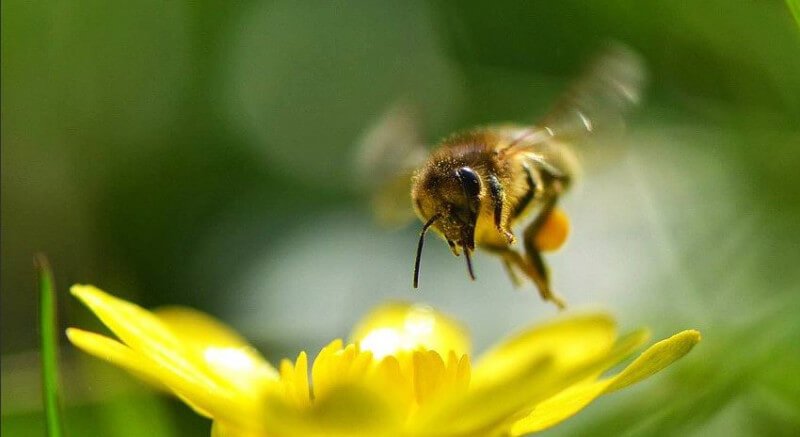
bee
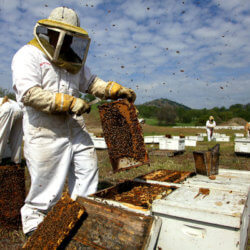
Image: Friends of the Earth Europe

Intensive agricultural landscapes can be hostile for bees due to a lack of floral and nesting resources, and due to management-related stress such as pesticide use and soil tillage …. We studied the effects of farming intensity (organic vs. conventional, number of insecticide applications) and availability of semi-natural habitats at the field and landscape scale on pollinator visits and pollen delivery to pumpkin in Germany.

…

In contrast to our expectations, local management (organic farming and field-bordering seminatural habitats) had no significant effects on pollinator visits and consequently on pollen delivery. This may be owing to the large foraging ranges of honey and bumble bees in combination with the high attractiveness of pumpkin flowers.

…

The number of insecticide applications did not differ significantly between organic and conventional management in our study. However, management varied strongly within organic farming. Organic fields managed according to the EU-Eco regulation 834/2007 had more insecticide applications than conventional fields and organic fields managed by rules from organic associations, which ban insecticides completely ….
…

Overall, the positive effects of organic farming on beneficial insects may have been overestimated owing to studies only including farms under very strict organic management without any pesticide use.

Read full, original article: Dominance of cropland reduces the pollen deposition from bumble bees

Related Articles

Infographic: Global regulatory and health research agencies on whether glyphosate causes cancer

Infographic: Global regulatory and health research agencies on whether glyphosate causes cancer

Does glyphosate—the world's most heavily-used herbicide—pose serious harm to humans? Is it carcinogenic? Those issues are of both legal and ...

Most Popular

ChatGPT-Image-Mar-10-2026-01_39_01-PM
Viewpoint—“Miracle molecule” debunked: Why acemannan supplements don’t work
ChatGPT-Image-Sep-10-2026-10_36_07-AM
Viewpoint: Even lousy scientific articles can shield authors when they hype dubious health claims and products
sorghum farmers in kenya FARMERS TREND
Here are all the ways CRISPR gene editing is transforming Africa’s staple crops—and there’s a lot more innovation to come
Screenshot-2026-10-01-at-11.21.27-AM
Vaccine hesitancy, like malaria, surges globally, topping 35% in some countries
ChatGPT-Image-Sep-30-2026-01_11_07-PM
How U.S. teamed with Russia to block global human AI weapons oversight
ChatGPT-Image-Sep-30-2026-01_25_34-PM
Blood tests for Alzheimer’s? The latest grifter, social media scam.
ChatGPT-Image-Sep-21-2026-03_15_09-PM
Viewpoint: Chipotle-inspired lesson: 10,000 sick customers suggest that processed foods can be safer than fresh ones
ChatGPT-Image-Sep-30-2026-01_38_36-PM
Viewpoint: Died “with measles” vs. died “from measles”: RFK, Jr.’s dangerously subversive word games
ChatGPT-Image-Sep-29-2026-12_16_42-PM
Social media influencers are driving food misinformation across Europe
Screenshot-2026-09-28-at-1.16.38-PM
Defying public perceptions, U.S. cancer deaths plunged 35% since 1991
glp menu logo outlined

Get news on human & agricultural genetics and biotechnology delivered to your inbox.