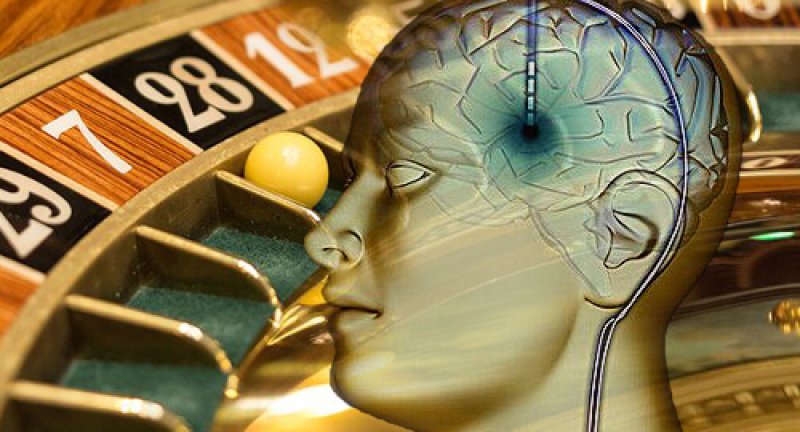
‘Risky decisions’ and why our brains make it so easy for us to gamble

deep brain stimulation problem gambling
Image credit: Calvin Ayre

new study by a team from Johns Hopkins University appears to have identified a region of the brain that plays a critical role in risky decisions. Published September 20 in Current Biology, the authors analyzed the behavior of rhesus monkeys, who share similar brain structure and function to our own. And like us, they are risk-takers, too.

First the authors trained two monkeys to “gamble” against a computer to win drinks of water. Then they had to choose between a 20 percent chance of receiving 10 milliliters of water versus a far more reliable 80 percent chance of getting only three milliliters. The monkeys overwhelmingly took the gamble.

Previous work has shown a brain region called the supplementary eye field (SEF) is, along with regulating eye movements, also involved in decision-making. When the authors suppressed SEF activity by cooling the region with an external metal plate—a process that is harmless and reversible—the monkeys were 30 to 40 percent less likely to make risky bets.


“We do not understand the risk-taking network in the brain well enough to think about therapeutic implications,” [co-author Veit Stuphorn] says. “But as our understanding increases, there is hope for better behavioral interventions based on a better understanding of the factors that drive risky decisions. And in the long run possibly direct interventions in the form of brain stimulation.”

Read full, original post: “Gambling Brain” Studies Make Clear Why It’s Hard to Stop Rolling the Dice

{{ reviewsTotal }}{{ options.labels.singularReviewCountLabel }}
{{ reviewsTotal }}{{ options.labels.pluralReviewCountLabel }}
{{ options.labels.newReviewButton }}
{{ userData.canReview.message }}

Related Articles

Infographic: Global regulatory and health research agencies on whether glyphosate causes cancer

Infographic: Global regulatory and health research agencies on whether glyphosate causes cancer

Does glyphosate—the world's most heavily-used herbicide—pose serious harm to humans? Is it carcinogenic? Those issues are of both legal and ...

Most Popular

d-b
Blocked arteries, kidney stones, nausea, constipation, fatigue: Long list of health problems caused by too much vitamin D 
Screenshot-PM-24
Viewpoint: The herbicide glyphosate isn’t perfect. Banning it would be far worse.
79d03212-2508-45d0-b427-8e9743ff6432
Viewpoint: The Casey Means hustle—Wellness woo opportunism dressed up as medical wisdom
ChatGPT-Image-Apr-30-2026-12_21_05-PM-2
The tech billionaires behind the immortality movement
ChatGPT-Image-Mar-27-2026-11_27_05-AM
The myths of “process”: What science says about the “dangers’ of synthetic products and ultra-processed foods
ChatGPT-Image-Apr-30-2026-05_00_48-PM
Wellness grifter physician turned wellness influencer out as surgeon general nominee
ChatGPT-Image-Mar-10-2026-01_39_01-PM
Viewpoint—“Miracle molecule” debunked: Why acemannan supplements don’t work

Sorry. No data so far.

glp menu logo outlined

Get news on human & agricultural genetics and biotechnology delivered to your inbox.