Ancient spearheads raise new questions about North America’s first inhabitants

bd e c image
Image credit: Eagle
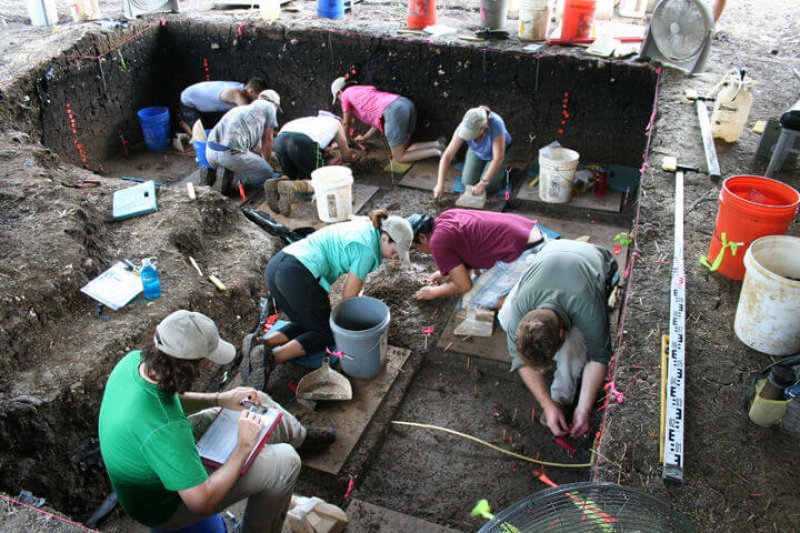
[A]rchaeologists have uncovered evidence of a human settlement stretching back as far as 15,500 years: hammer stones and broken knives, fragments of fractured tools. And now, scientists say, the Buttermilk Creek complex has offered up the oldest known spearheads in North America.

The new “projectile points,” reported [October 24] in the journal Science Advances, come in two unusual shapes — a fact that geologist Mike Waters, who oversaw the excavation, found both “bizarre” and “really exciting.” The find adds to the evidence that the first people arrived in the Americas earlier than researchers thought, even as it raises new questions about who those people were and how they made their epic migration into the continent.

[T]he archaeologists uncovered two perfectly preserved artifacts: One triangular point, which resembles a predator’s sharp tooth, and one lobe-shaped projectile with a tapered, or “stemmed,” bottom. With these whole points as models, Waters’s team was able to make sense of the 10 additional fragments they collected. They seemed subtly but significantly different from Clovis and other toolmaking traditions — neither a clear ancestor to the later technology, nor an obvious competitor.

Were the Clovis people descendants of these early inhabitants who came up with a new toolmaking technique? Or did they migrate separately into the continent before scattering their tools across the Americas?

“We’re just beginning to answer that,” Waters said.

Read full, original post: Continent’s oldest spear points provide new clues about the first Americans

{{ reviewsTotal }}{{ options.labels.singularReviewCountLabel }}
{{ reviewsTotal }}{{ options.labels.pluralReviewCountLabel }}
{{ options.labels.newReviewButton }}
{{ userData.canReview.message }}

Related Articles

Infographic: Global regulatory and health research agencies on whether glyphosate causes cancer

Infographic: Global regulatory and health research agencies on whether glyphosate causes cancer

Does glyphosate—the world's most heavily-used herbicide—pose serious harm to humans? Is it carcinogenic? Those issues are of both legal and ...

Most Popular

ChatGPT-Image-May-7-2026-12_16_37-PM-2
Viewpoint: Are cancer rates ‘skyrocketing’ as RFK, Jr. and MAHA claims? The evidence says mostly the opposite
Screenshot-2026-04-22-at-10.46.29-AM
Viewpoint: How to counter science disinformation? Science journalist offers 12 practical tips
Screenshot-2026-04-13-at-1.39.26-PM
Viewpoint: ‘Safer for children?’ Stonyfield yogurt under fire for deceptive organic marketing
Picture1-14
When superbugs threaten vulnerable children: Can AI help solve antibiotic resistance?
Picture1-1
Cooling the planet with balloons: Could a geoengineering gamble slow global warming?
Screenshot-2026-04-23-at-11.00.36-AM
Regulators' dilemma: Thalidomide, Metformin, and the cost of getting drug approvals wrong
ChatGPT-Image-May-12-2026-08_39_41-PM
GLP podcast: Big Pharma, Big Ag, Big Food—health harming industries or life-saving innovators?
bigstock opioids on chalkboard with rol
GLP podcast: 'Safe injection sites': enabling drug addiction or saving lives?

Sorry. No data so far.

glp menu logo outlined

Get news on human & agricultural genetics and biotechnology delivered to your inbox.