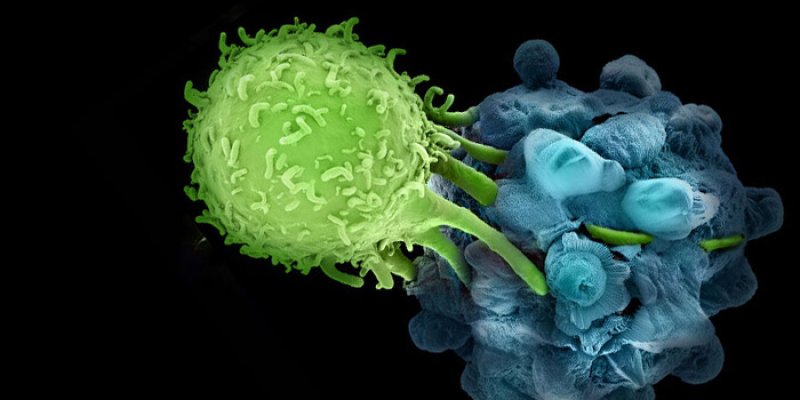
Our usual defence against disease is our immune system. It does an excellent job of sorting out what doesn’t belong in the body and attacking it – except when it comes to cancer. For 100 years, the reasons behind that apparent failure were a mystery. Jim Allison’s [immunotherapy] breakthrough was the realisation that the immune system wasn’t ignoring cancer. Instead, cancer was taking advantage of tricks that shut down the immune system. But what if you could block those tricks and unleash the immune system’s killer T-cells against the disease?
The trick Allison’s immunology lab at the University of California, Berkeley, found involved a protein on the T-cell called CTLA-4. When stimulated, CTLA-4 acted like a circuit breaker on immune response. These brakes, which he called checkpoints, kept the cell killers from going out of control and trashing healthy body cells. Cancer took advantage of those brakes to survive and thrive. In 1994, the lab developed an antibody that blocked CTLA-4.
…
What they had found would eventually win the Nobel. It would also fly in the face of what every practising oncologist had been taught about cancer and how to fight it.

…
Seven years after the approval of [the] first checkpoint inhibitor, there are reportedly 940 “new” cancer immunotherapeutic drugs being tested in the clinic by more than half-a-million cancer patients in more than 3,000 clinical trials, with over 1,000 more in the preclinical phase.
Read full, original post: A cure for cancer: how to kill a killer