When will our universe reach the point of maximum entropy? And what other possibilities exist for our universe in the far future?
…
For our Earth around the Sun (or whatever’s left of it), it will take somewhere in the ballpark of 1030 years for us to spiral into the central mass of our Solar System. Over enough time, everything will either collapse into a leftover mass or get ejected so that it’s all by its lonesome in the abyss of empty space.
…
[A]fter approximately 10120 years, the heaviest-mass black holes in the Universe finally complete their evaporation process. The Universe, now, is cold, empty, and devoid of bound structures.
…
Everything will be cooled down to as close to absolute zero as the laws of quantum physics allow, and that is the state of maximum entropy of the Universe. We will, at long last, have achieved our “heat death,” as there’s no longer any available energy capable of doing work.
The only ways out are if dark energy is something other than a cosmological constant, if black holes actually turn out to be a gateway to another Universe, or there’s new, undiscovered physics that will change this seemingly-inevitable fate.
…
If we take the laws of physics and the rules of the Universe at face value, the slow, gradual death of everything in the Universe is our ultimate fate.
When European researchers recently announced a new technique that could potentially replace chemical pesticides with a natural “vaccine” for crops, it sounded too good to be true.
…
And yet emerging technologies — including plant vaccines, gene editing (as distinct from genetic engineering), and manipulation of plant-microbe partnerships — hold out the tantalizing promise that it may yet be possible to farm more sustainably and boost yields at the same time.
…
CRISPR gene editing technology, Science magazine’s 2015 Breakthrough of the Year, has already begun to put altered crops in the field, and the pace of introductions is likely to accelerate. It’s a more palatable alternative to genetic engineering, which has faced regulatory limits and a “frankenfood” reputation because it introduces genes of one species into another. Gene editing, by contrast, isn’t transgenic. Instead, using a technology called CRISPR/Cas9, scientists precisely and inexpensively snip minute genetic sequences from the genome of an organism, or add in sequences from another individual of the same species. Such organisms contain nothing that could not in theory have resulted from natural breeding, and they have so far entered the market without regulatory delays.
Drinking will shorten your life, according to a study that suggests every glass of wine or pint of beer over the daily recommended limit will cut half an hour from the expected lifespan of a 40-year-old.
Those who think a glass of red wine every evening will help keep the heart healthy will be dismayed. The paper, published in the Lancet medical journal, says five standard 175ml glasses of wine or five pints a week is the upper safe limit – about 100g of alcohol, or 12.5 units in total. More than that raises the risk of stroke, fatal aneurysm (a ruptured artery in the chest), heart failure and death.
The risks for a 40-year-old of drinking over the recommended daily limit were comparable to smoking, said one leading scientist. “Above two units a day, the death rates steadily climb,” said David Spiegelhalter, Winton professor for the public understanding of risk at the University of Cambridge.
…
There is still a small benefit to drinking, which has been much flagged in the past. It does reduce the chance of a non-fatal heart attack. But, said Dr Angela Wood, from the University of Cambridge, lead author of the study, “this must be balanced against the higher risk associated with other serious – and potentially fatal – cardiovascular diseases.”
Golden Rice was declared safe for consumption by Canada recently. This has huge implications for the rest of the world, where Golden Rice can be vital resource in tackling vitamin A deficiency and malnutrition.
…
This approval comes after a robust scientific assessment done by scientists with expertise in molecular biology, microbiology, toxicology, chemistry, and nutrition.
…
The assessment results showed that Golden Rice had the same nutritional property as other commercially available rice varieties, except for the increased provitamin A levels. Further, it displayed no new risk to human health and has no potential to create or amplify allergies.
Unlike Health Canada’s robust scientific assessment, the claims of anti-GM advocacy groups fall short of credibility, as they have been in the past.
The approval of Golden Rice by Health Canada is a lethal blow to one of the many myths that are propagated by anti-GM activists. Developing countries should seize the momentum by declaring Golden Rice safe for consumption in their respective countries.
Hundreds of people with kidney cancer could be spared surgery with a DNA test that can identify whether tumours are likely to be highly aggressive or relatively harmless, scientists say.
…
While some kinds of kidney cancer grow and metastasise around the body with lethal speed, others do not appear to pose much of a threat. At present it is extremely difficult for doctors to tell the difference between the two. Researchers in London, however, have identified the genetic signatures that show what path each tumour is likely to follow.
…
The problem is that tumours are like small societies made up of numerous genetically different cell types. By conducting a population census of the cancer, researchers can predict whether it will remain stable or whether a particularly aggressive type of cell will take over.
The breakthrough is especially promising for the 4,000 or so patients a year who are found to have thumb-sized tumours called small renal masses. Tim O’Brien, a senior surgeon on the team, estimates that in up to half of these cases there is no need to cut out the lump.
…
“We are learning from the history of these tumours to be better able to predict the future. This is profoundly important, because it means we can hopefully predict the pattern the cancer will take for each individual patient,” [said researcher Harpal Kumar].
An analyst at Goldman Sachs asked a troubling question…about gene therapy.
“Is curing patients a sustainable business model?”
In social media, reactions were quick and sharp. “Cold and immoral.” “Capitalism at its finest.”
But the Goldman analyst has a point. It’s tricky to make a sustained profit from one-shot cures. For at least one big drug maker, the answer to Goldman’s question is no.
We just saw GlaxoSmithKline sell off its pipeline of gene therapies for rare disease to a London startup called Orchard Therapeutics for a 20 percent stake in the young company. The treatments Glaxo didn’t want were bona fide miracles: one-and-done cures.
…
The economic problem is that companies can run out of patients as they’re cured. Or they may not have enough of them in the first place, if the gene therapies treat exceedingly rare diseases.
For instance, only a couple of dozen kids each year in the US and Europe are diagnosed with the type of “bubble boy” disease that Strimvelis treats, called ADA-SCID. So even at a price of $665,000, Glaxo didn’t see that the drug was going to be much of a business.
…
“I think society has to find a balance between the extraordinary value we are bringing and a sustainable business model,” [Orchard CEO Mark Rothera] said. “There is a balancing act.”
[Regenerative agriculture’s] guiding principle is not just to farm sustainably — that implies mere maintenance of what might, after all, be a degraded status quo — but to farm in such a way as to improve the land. The movement emphasizes soil health and, specifically, the buildup of soil carbon. This happy coincidence is one reason that carbon-farming advocates repeatedly describe their project as a “win-win.” Society could theoretically remove carbon from the atmosphere and store it in the earth, and at the same time enhance the fortunes of farmers and the overall stability of the nation’s food supply.
…
Critics of regenerative agriculture say that it can’t be adopted broadly and intensively enough to matter — or that if it can, the prices of commodities might be affected unfavorably. Mark Bradford, a professor of soils and ecosystem ecology at Yale, questions what he sees as a quasi-religious belief in the benefits of soil carbon. The recommendation makes sense intuitively, he told me. But the extent to which carbon increases crop yield hasn’t been quantified, making it somewhat “faith-based.”
William Schlesinger, an emeritus soil scientist at Duke, points out that “regenerative” practices might inadvertently cause emissions to rise elsewhere. If you stop tilling to increase soil carbon, for example, but use more herbicides because you have more weeds, then you probably haven’t changed your overall emissions profile, he says. He thinks the climate-mitigation potential of carbon farming has been greatly oversold.
[In the 1990s], gene therapy — defined as the technique of using and manipulating genes in order to treat or prevent diseases — wasn’t as established as it is today and wasn’t recognised as enough of a threat to be listed as a banned practice in sport. But it soon became known that gene therapies could one day be used for much more than disease.
…
With the injection of external [erythropoietin, a protein that increases oxygenation], elite athletes — often cyclists — have been enhancing performance for years, but authorities have caught on. Anti-doping controls can now detect external EPO efficiently through blood and urine tests.
…
Another way to dope an athlete’s genes is through CRISPR, or CRISPR-Cas9, a technique that allows geneticists to edit specific parts of a person’s genome by removing or altering sections of DNA — also known as gene editing.
The technique is rapidly developing, leading to a World Anti-Doping Agency announcement in October that it was expanding its “gene-doping” ban to “gene editing agents designed to alter genome sequences and/or the transcriptional or epigenetic regulation of gene expression.”
…
Asked what it is doing to monitor and test athletes for gene doping, the International Olympic Committee did not comment directly but said, “We have nothing to add to the section on gene doping in [World Anti-Doping Agency’s] prohibited list.”
Time is money. This time-worn axiom of business school courses and the corporate world is also particularly applicable to the regulatory world. The time required for technology development firms to receive regulatory approval for a genetically modified (GM) crop, and thus the ability to commercialize the technology, has consistently increased over the past two decades. Jaffe (2005) reported that in spite of no new traits being regulated, the United States Department of Agriculture (USDA) consultation process had more than doubled over the first decade of GM crop regulation.
…
[W]e strongly assert that efforts to streamline GM crop approval processes are a worthwhile endeavor. The legal consequences of GM regulatory lag are significant and ongoing. Unless action is taken to address these consequences, a rapidly decelerating approvals process could grind to a complete halt. Negotiations may be difficult, and a modest goal of streamlining approvals may be a long way from the end goal of synchronous approvals, but the status quo is not a viable option. The development and operation of the PCT provide a model worth pursuing with some vigour.
For some people, a daily aspirin can prevent future cardiac problems. For others, they glean no such benefit. Some people are ‘steroid responders’ and are deeply affected by steroid-class treatments such as prednisone. Others don’t respond to the same degree.
Why? Genetics.
Being human means being a part of the human condition, which is a nice way of saying that probability governs almost everything, and the dice rolls that don’t work out our way we still need to deal with and adapt to. Not everything can be predicted or treated. The vast number of combinations and permutations underlying genetics makes uncertainty part of the equation, and frankly, different people having different genes is what makes society interesting. Even response to sham treatments–the placebo effect itself — seems to have some basis in differential genetics between different people.
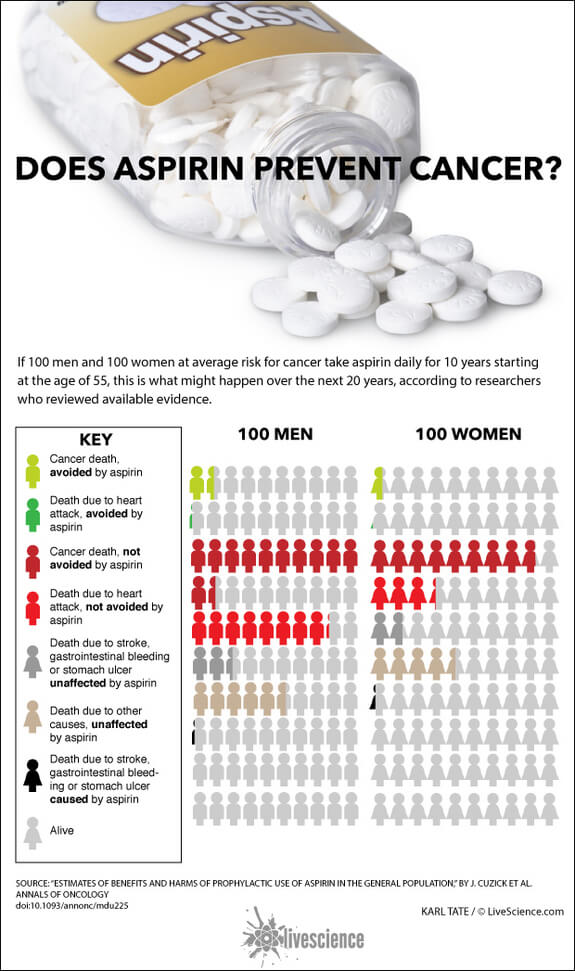
For a sense of how seemingly-similar people can be affected differently by a simple medication, take a look at the below infographic from Live Science:
Click image for larger version.
The first thing to notice is that the graphic requires several colors and shades—this immediately means that there isn’t a unitary or binary effect with aspirin — something differential is going on. If you look at the left-side box labeled ‘Key,’ you’ll see exactly what each color refers to in the tally on the right side. There are cases of cancer and heart attack both avoided and not avoided by taking aspirin, stroke, GI bleeding, and ulcers both unaffected and caused by aspirin, other deaths uninfluenced by aspirin, and of course those remaining alive.
Taking any medication brings with it side effects, and in many cases side effects are merely co-occurring physiological effects related to how the treatment is affecting the body. For example, taking pseudoephedrine (Sudafed etc.) for a runny nose includes potential side effects of increased heart rate, anxiety, and hypertension. But those are treatment effects because pseudophedrine’s ability to reduce hyperemia and edema and therefore influence a runny nose is directly because it acts on the adrenergic system which includes nervous system stimulation and constriction of blood vessels.
If we turn our attention back to the aspirin graphic — every treatment is a balance of risk-to-benefit (part of swinging this balance much more favorably to the ‘benefit’ side is the promise of precision and personalized medicine). What we’re actually looking at in this image then is the actual architecture of genetic differencesplaying out and underlying the patients who had been treated with aspirin. No treatment has a totally predictable set of outcomes, and realizing that not everyone will experience the same result helps with more informed decision-making.
If you take several studies like this and dissect them, you would see similar patterns of medication benefit, medication risks, and non-responders. Not every medication works for every person, and not every person gets a significant side effect from taking a medication. These differences in experience are results based largely on genetics. Of course, a medication may not help because of other reasons—unmeasured factors such as diet, activity level, smoking, and other lifestyle habits. Some of these factors can overwhelm the positive benefit of any treatment—but even some of these behaviors are connectable to genetics – the genetics of metabolism, addiction, and so forth. So if you think you’re not getting the same benefit from an over-the-counter medicine you’ve taken that others are getting, you just might be right.
Ben Locwin is a behavioral neuroscientist and astrophysicist with a masters in business, and a researcher on the genetics of human disease. BIO. Follow him on Twitter @BenLocwin.
Poisonous carcinogens called Aflatoxins can be produced when food crops are infected by certain species of the fungus Aspergillus. Consumers in the developed world are largely protected from exposure to these dangerous natural compounds through pest control and product screening. Unfortunately, in the developing world, aflatoxins are frequent contaminants in staple foodstuffs such as maize and groundnuts (peanuts).
There is new hope for a solution to this vexing health issue based on a recent collaboration between groups of scientists in the US and in India. They have developed peanut cultivars that are nearly immune to aflatoxin contamination. This breakthrough was achieved by combining the effects of plant “defensins” to limit infections by the fungus, and “host induced gene silencing” using inhibitory RNAs that interfere with toxin production by any of the fungus that does manage to infect. These peanut lines can now be cultivated and crossed with the existing varieties to extend this protection, particularly in the areas of sub-Saharan Africa and Southeast Asia where peanuts are a key part of the locally grown food supply.
I spoke with Dr. Dilip Shah of the Danforth Center whose group contributed the “defensin” genes. Most plants have genes to make these small proteins (or peptides), but the defensins in peanut are not able to stop infections by Aspergillus when the developing, underground seedpods are injured through drought and other stress. Shah found different defensin peptides in alfalfa and Mediterranean clover that are effective against Aspergillus. The genes for those peptides were transferred into the improved peanut lines. This class of peptides is already a common part of our diet, and there are no reports of these proteins being allergens.
Dr. Dilip Shah of the Danforth Center
The additional strategy of using small RNAs to specifically shut down the pathogen’s ability to make the toxin is an approach that has also recently been demonstrated to be effective in corn. Once again, small RNAs like this are common in foods.
By combining two tactics, these researchers have developed a solution that is both more effective and likely more robust. A similar approach could be taken for other crops like corn and tree nuts that can be contaminated with aflatoxins.
This potential public health breakthrough has been made possible because of the tools and knowledge-base of modern molecular genetics. The next steps beyond this “genetic engineering” phase of the project will require some funding of conventional breeding to move the trait into varieties that are well suited to the specific needs of the mostly small-holder farmers who produce groundnuts. There will also need to be time and funding to navigate the testing and approvals processes for a “GMO” crop. Hopefully those and other barriers can be minimized so that millions of people can soon be freed from the well-documented risks that come from consuming aflatoxin-contaminated food. Now that the technical breakthrough is complete, this becomes both a logistical and a social justice challenge.
Steve Savage is an agricultural scientist (plant pathology) who has worked for Colorado State University, DuPont (fungicide development), Mycogen (biocontrol development), and for the past 13 years as an independent consultant. His blog is Applied Mythology. Follow him on Twitter @grapedoc
A well-organized, highly curated database of genetic data from millions of people is a potential goldmine for drug company researchers and other scientists.
…
Aiming at a more mainstream audience, companies like 23andMe introduced a new vision: charging a modest amount for analysis along with interpretations aimed at ancestry, health, or pure curiosity. A 23andMe report is $99, or $199 for a deluxe version that includes health information.
…
[Sequencing for the masses] turns the market on its head. In this vision, DNA data is treated a lot like other personal digital information: If it’s collected in bulk, anonymized, and aggregated, it can be mined for value. […] These little startups and university-based projects pay you for your data, either with cash or with new knowledge.
…
The latest project at the startup DNAsimple is also meant to entice families to create pools of data that can be extremely valuable for genetic research. Beginning later this month, DNAsimple will offer the family members a report about their ancestry and traits — so you could learn whether you share a baldness pattern with your uncle, or whether you really have your mother’s eyes. If it takes off, it might even set a lower price for DNA data: A swap of information for more information, with no money exchanged at all.
The GLP aggregated and excerpted this blog/article to reflect the diversity of news, opinion, and analysis. Read full, original post:How Much is Your DNA Worth?
Night owls may be more fun at parties, but a preference for staying out late may come with some serious drawbacks, suggests a new study published this week in Chronobiology International. Namely, it might increase your chances of dying early. Researchers looked data from a large, ongoing population study of UK residents, known as the UK Biobank Study. Around a half a million participants enrolled in the study from 2006 to 2010 and have had their health tracked ever since.
…
Over 10,000 of those people died during the study period. And compared to people who described themselves as definite morning people, night owls were about 10 percent more likely to have died. More than that, night owls were also just generally unhealthier.
…
Though the current study can’t answer the question of why this might be the case, other research has found that night owls are more likely to eat poorly, act impulsively, use drugs like alcohol, and experience “social jetlag,” otherwise known as waking up at noon on the weekends when you don’t have to get to work.
…
Much of the stress that comes from being a night owl might simply come down to their internal body clocks, or circadian rhythm, not aligning with the rest of the world.
Biologists at the University of California San Diego have developed a method of manipulating the genes of an agricultural pest that has invaded much of the United States and caused millions of dollars in damage to high-value berry and other fruit crops.
Research led by Anna Buchman in the lab of Omar Akbari, a new UC San Diego insect genetics professor, describes the world’s first “gene drive” system—a mechanism for manipulating genetic inheritance—in Drosophila suzukii, a fruit fly commonly known as the spotted-wing drosophila.
As reported April 17 in the Proceedings of the National Academy of Sciences, Buchman and her colleagues developed a gene drive system termed Medea (named after the mythological Greek enchantress who killed her offspring) in which a synthetic “toxin” and a corresponding “antidote” function to dramatically influence inheritance rates with nearly perfect efficiency.
“We’ve designed a gene drive system that dramatically biases inheritance in these flies and can spread through their populations,” said Buchman. “It bypasses normal inheritance rules. It’s a new method for manipulating populations of these invasive pests, which don’t belong here in the first place.”
German Agriculture Minister Julia Kloeckner on [April 17] said she was finalizing a draft regulation to end use of the weed-killer glyphosate in household gardens, parks and sports facilities, and to set “massive” limits for its use in agriculture.
…
Chancellor Angela Merkel’s conservatives and the centre-left Social Democrats (SPD) agreed in February to systematically and significantly limit its use, with the goal of entirely ending use of products that contain it, but set no timeframe.
“I am planning a regulatory draft as a first building block in the strategy to minimize use of glyphosate,” said Kloeckner, a member of Merkel’s Christian Democrats (CDU). She said the proposal would be vetted by other ministries, but set no deadline for when Germany would end use of the weed-killer.
German Environment Minister Svenja Schulze, a Social Democrat, welcomed Kloeckner’s proposal as a first step to ending use of the chemical, saying her goal remained to eliminate its use by the end of the legislative session in autumn 2021.
…
Kloeckner said … she planned “massive restrictions” on the use of glyphosate in agriculture, with exemptions for areas that were prone to erosion and could not be worked with heavy machinery.
With current advances in biology, we can’t afford to avoid the topic any longer. It is high time the international community turn its focus to the security and governance of biological research. This is an urgent issue, because whenever a proof of concept, technological breakthrough, or scientific game changer is found to have unexpected military utility, it can significantly alter the balance of incentives and disincentives to comply with [Biological Weapons Convention] obligations. The question is, how do we guard against experiments or lines of inquiry that lead some researchers to pursue the kind of edge that contravenes international norms and legal frameworks?
…
Part of the work has to be done by governments and policymakers focused on international security, and should include strengthening norms against misuse and supporting humanitarian policies; modernizing the BWC to counter its growing irrelevance; increasing capacities to defend against and investigate allegations of misuse; and building transparency, confidence, and trust in biodefence programs.
…
[T]he funders who support research, the scientists who conduct it, and the publishers who approve and communicate it should be required to prove the absence of danger.
…
Guarding against deliberate misuse of biology is a tall order for the international community and national policymakers. On the other hand, it is not an impossible task given political will.
Editor’s note: Filippa Lentzos is a senior research fellow at King’s College London, jointly appointed in the Department of Global Health and Social Medicine and the Department of War Studies.
[W]hy is the computer good at certain tasks whereas the brain is better at others? Comparing the computer and the brain has been instructive to both computer engineers and neuroscientists.
…
[T]he brain can perform at most about a thousand basic operations per second, or 10 million times slower than the computer.
…
The calculations performed by the brain, however, are neither slow nor imprecise. For example, a professional tennis player can follow the trajectory of a tennis ball after it is served at a speed as high as 160 miles per hour, move to the optimal spot on the court, position his or her arm, and swing the racket to return the ball in the opponent’s court, all within a few hundred milliseconds.
…
[T]he brain also employs massively parallel processing, taking advantage of the large number of neurons and large number of connections each neuron makes. For instance, the moving tennis ball activates many cells in the retina called photoreceptors, whose job is to convert light into electrical signals. These signals are then transmitted to many different kinds of neurons in the retina in parallel.
…
As neuroscientists uncover more secrets about the brain (increasingly aided by the use of computers), engineers can take more inspiration from the working of the brain to further improve the architecture and performance of computers.
Editor’s note: Liqun Luo is a professor of neurobiology at Stanford University
Industrial agriculture and biotech interests have built entire campaigns saying that we “need” genetically engineered organisms to “feed the world” as we head towards 9 billion people and a “doubling of global food demand”.
But it’s just not true, despite all of the effort and money put into having us believe it.
…
Most of the GMOs in use today aren’t even primary food crops that feed the world — like rice, wheat, roots and tubers, pulses, and fruits and vegetables. Instead, most of the world’s GMO farm fields are growing things like feed corn (not sweet corn that we eat, but feedcorn that is used for making animal feed, high-fructose corn syrup, and corn ethanol), soybeans (mainly for animal feed), cotton, and canola. Very few of the GMO crops in use today are feeding the world’s poor; instead, they are crops used in the world’s wealthier countries, mainly to fatten animals, make unnecessary biofuels and food additives, or make cheap clothing.
If GMOs really were going to “feed the world,” we would grow GMO crops poor people actually eat. But where’s the profit in that?
Editor’s note: Jonathan Foley is an environmental scientist and Executive Director of the California Academy of Sciences