Why a decline in mortality rates among very old people may be ‘an illusion’

sfit fitlongevity py x
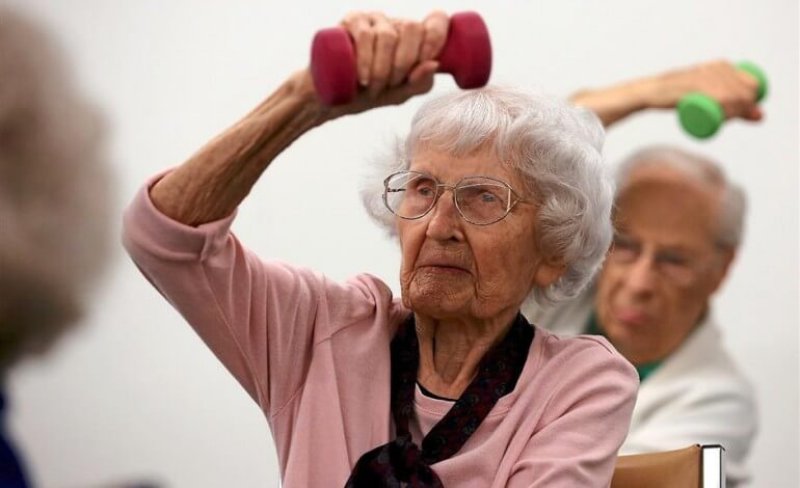
At 101, Betty Streifling, is just another active old person living in Loma Linda, California. Image credit: TNS

An intriguing phenomenon has emerged in recent years: among very old people, the rate at which people die appears to decline when they get past a certain age.

Not so fast, says a new study by Saul Newman in PLoS Biology. Newman looked at the data and found something quite different: it’s all just a mistake.

[W]e don’t have very good birth records for people over 100 years old. They were born a long time ago, when record keeping wasn’t always so good. What if there are a few errors?

[L]et’s imagine a set of people whose true ages are off by 5 years in either direction. (I know that’s a lot, but bear with me.) By the age of 100, as Newman points out, virtually no one is alive from the cohort that underestimated their age; these are people who have a true age of 105. But many more will be alive from those who overestimated their age; these are the 95-year-olds who think they’re 100.

Newman’s paper points out that if only a few people are overestimating their age, this can cause mortality rates to flatten or decelerate–or at least they appear to decelerate, because these people aren’t really as old as we (or they) think they are.

In other words, the decline in mortality is simply an illusion.

Read full, original post: What’s the limit of the human lifespan? And what do World War I veterans have to do with it?

{{ reviewsTotal }}{{ options.labels.singularReviewCountLabel }}
{{ reviewsTotal }}{{ options.labels.pluralReviewCountLabel }}
{{ options.labels.newReviewButton }}
{{ userData.canReview.message }}

Related Articles

Infographic: Global regulatory and health research agencies on whether glyphosate causes cancer

Infographic: Global regulatory and health research agencies on whether glyphosate causes cancer

Does glyphosate—the world's most heavily-used herbicide—pose serious harm to humans? Is it carcinogenic? Those issues are of both legal and ...

Most Popular

ChatGPT-Image-Jun-9-2026-01_11_37-PM
Turmeric supplements: More risks than benefits
Screenshot-2026-06-05-at-2.12.30-PM
Some plants can poison you. So how did humans figure out what is safe to eat?
ChatGPT-Image-Mar-10-2026-01_39_01-PM
Viewpoint—“Miracle molecule” debunked: Why acemannan supplements don’t work
Screenshot-2026-06-17-at-9.44.03-AM
Viewpoint: Embryos are becoming the newest battleground of love, loss, and legal uncertainty
ChatGPT-Image-Jun-14-2026-09_41_44-AM-2
Viewpoint—‘The gleeful efficiency of an arsonist’: Administration’s health and science research cuts are ‘sabotaging’ America’s future
ChatGPT-Image-Jun-11-2026-01_15_03-PM
Selective Pressure, Selective Silence
wuhan institute of virology main entrance
​​COVID lab leak? Making a case that the Wuhan market origins theory is wrong
ChatGPT Image May 26, 2026, 08_42_17 AM (1)
Viewpoint: Greenpeace and poison: How environmental advocacy groups rely on compliant (and often ignorant) journalists to spread disinformation and spark litigation
ChatGPT-Image-May-18-2026-12_06_18-PM-2
Defying death: The immortality movement goes mainstream

Sorry. No data so far.

glp menu logo outlined

Get news on human & agricultural genetics and biotechnology delivered to your inbox.