Brain implants could soon join fight against severe depression

2-14-2019 mood zap inline
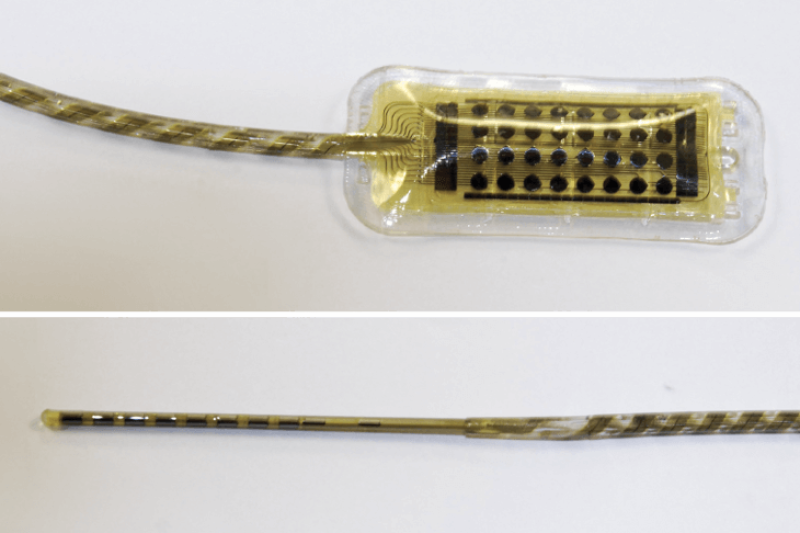
Some electrical arrays that researchers at the University of California, San Francisco are testing sit on the surface of the brain (top); others penetrate deep into brain tissue (bottom). Image credit: K. Sellers/UCSF

With powerful computational methods, scientists have recently zeroed in on some key features of depressed brains. Those hallmarks include certain types of brain waves in specific locations, like the one just behind and slightly above the eyes. Other researchers are focused on how to correct the faulty brain activity that underlies depression.

A small, implantable device capable of both learning the brain’s language and then tweaking the script when the story gets dark would be an immensely important clinical tool. Of the 16.2 million U.S. adults with severe depression, about a third don’t respond to conventional treatments.

Among brain regions, the orbitofrontal cortex may be one of the top networkers. It has links to diverse brain systems, many of which may be important for mood.


“We need to have a smarter approach, rather than, ‘Put it in, turn it on and leave it on,’” says Darin Dougherty, a psychiatrist at Massachusetts General Hospital in Boston who is working on new stimulation methods. A system that can change its behavior depending on the patient’s needs would ultimately enable better levels of control, he says, by “driving the system in real time and steering it.”

Read full, original post: Brain-zapping implants that fight depression are inching closer to reality

{{ reviewsTotal }}{{ options.labels.singularReviewCountLabel }}
{{ reviewsTotal }}{{ options.labels.pluralReviewCountLabel }}
{{ options.labels.newReviewButton }}
{{ userData.canReview.message }}

Related Articles

Infographic: Global regulatory and health research agencies on whether glyphosate causes cancer

Infographic: Global regulatory and health research agencies on whether glyphosate causes cancer

Does glyphosate—the world's most heavily-used herbicide—pose serious harm to humans? Is it carcinogenic? Those issues are of both legal and ...

Most Popular

Credit: ACSH
Viewpoint: Who and what’s to blame for the surge in vaccine-preventable diseases?
ChatGPT-Image-May-28-2026-12_56_54-PM
Viewpoint: Vaccines' non-specific effects? The ‘shoddy’ Danish couple whose 'research’ inspires RFK, Jr.’s health delusion
ChatGPT Image Jun 3, 2026, 03_14_43 PM
Viewpoint: How Earthjustice became the poster child for the abuse of special interest activist funding
Organic-Produce
Viewpoint: Why you should ignore organic food advocates’ advice to avoid ‘pesticide soaked’ conventional fruits and vegetables
Screenshot-2026-06-08-at-11.05.51-AM
Can vaping lead to cancer? New ‘association study’ raises questions of “links"
Screenshot-2026-06-08-at-10.19.30-AM
‘Natural’ wellness supplements linked to liver injury
Screenshot-2026-06-05-at-2.12.30-PM
Some plants can poison you. So how did humans figure out what is safe to eat?
Screenshot-2026-06-05-at-3.30.20-PM
Republican lawmakers spread misinformation claiming solar farms permanently destroy potato farms
Screenshot 2025-07-30 at 10.48
Can gene editing eliminate Down syndrome? Scientists have done it in lab-grown cells
edb7f6d7-2370-418f-9578-74e29678e35c
Facts & Fallacies Podcast: Nicotine vaping—public health miracle, or risk to children? Professor Cliff Douglas
ChatGPT-Image-Jun-5-2026-01_17_48-PM
GLP-1 weight-loss drugs may reshape our desires and emotions
glp menu logo outlined

Get news on human & agricultural genetics and biotechnology delivered to your inbox.