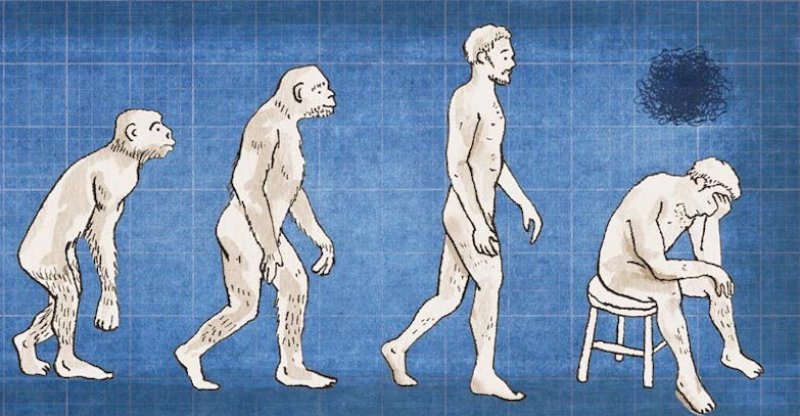
‘Good Reasons for Bad Feelings’: Understanding evolution’s role in anxiety, depression and making us human

evolution b
[In] the thought-provoking Good Reasons for Bad Feelings, [evolutionary] psychiatrist Randolph Nesse offers insights that radically reframe psychiatric conditions.

In his view, the roots of mental illnesses, such as anxiety and depression, lie in essential functions that evolved as building blocks of adaptive behavioural and cognitive function. Furthermore, like the legs of thoroughbred racehorses — selected for length, but tending towards weakness — some dysfunctional aspects of mental function might have originated with selection for unrelated traits, such as cognitive capacity.

The future success of clinical psychiatry might depend on an evolutionary framework being integrated with whole-genome sequence-data analysis; this could help to identify mutations predisposing people to mental illness. Given the small contributions of individual genes and the diverse mechanisms involved, this will demand analysis of the genomes of hundreds of thousands of people. As a result of the extensive and often paradoxical entanglement of genetic networks, future treatments might, by necessity, require mental circuits to be engineered to release them from hard-wired evolutionary constraints.

As Good Reasons for Bad Feelings boldly posits, many of the core dysfunctional components of mental illness ultimately help to make us human.

Read full, original post: The biological basis of mental illness

{{ reviewsTotal }}{{ options.labels.singularReviewCountLabel }}
{{ reviewsTotal }}{{ options.labels.pluralReviewCountLabel }}
{{ options.labels.newReviewButton }}
{{ userData.canReview.message }}

Related Articles

Infographic: Global regulatory and health research agencies on whether glyphosate causes cancer

Infographic: Global regulatory and health research agencies on whether glyphosate causes cancer

Does glyphosate—the world's most heavily-used herbicide—pose serious harm to humans? Is it carcinogenic? Those issues are of both legal and ...

Most Popular

Screenshot-2026-05-01-at-1.29.41-PM
Viewpoint: What happens when whole grains meet modern food manufacturing? Labels don’t tell the whole story.
ChatGPT-Image-Mar-27-2026-11_47_30-AM-2
FDA’s expedited drug reviews are hailed in some quarters but other approval practices are problematic
ChatGPT-Image-Apr-13-2026-02_20_22-PM
Viewpoint: Misinformation infodemic? Why assessing evidence is so challenging 
Farmers can talk to plants
Farmers are a major source of misinformation—about farming
S
As vaccine rejectionism spreads, measles may be taking a more dangerous turn
What explains Homo sapiens’ huge brains? Ancient climate change played a role
Viewpoint: Internal White House documents detail administration’s strategy to undermine climate science
Screenshot-2026-04-20-at-2.26.27-PM
Viewpoint — Food-fear world: The latest activist scientists campaign: Cancer-causing additives
ChatGPT-Image-May-7-2026-11_28_04-AM-2
‘Conflict entrepreneurs’ are driving disinformation and shaping public opinion
bigstock opioids on chalkboard with rol
GLP podcast: 'Safe injection sites': enabling drug addiction or saving lives?
ChatGPT-Image-May-6-2026-03_41_05-PM
‘Protecting the integrity of science’: Kennedy’s FDA blocks release of taxpayer-funded studies finding COVID and shingles vaccines safe
Screenshot 2026-05-06 at 2.19
Vaccine shootout at the CDC 
circular-bioeconomy-should-focus-on-sustainable-wellbeing
GLP podcast: What's wrong with 'doomsday' environmentalism? It's false.
Screenshot-2026-05-06-at-2.07.43-PM
Manufacturing a conspiracy: The timeline of how  the White House embraced the fringe claim that scientists are being mysteriously murdered

Sorry. No data so far.

glp menu logo outlined

Get news on human & agricultural genetics and biotechnology delivered to your inbox.