Engineered ‘self-limiting’ insect could suppress soybean looper, ‘exponential’ threat to US crops

chrysodeixis includens
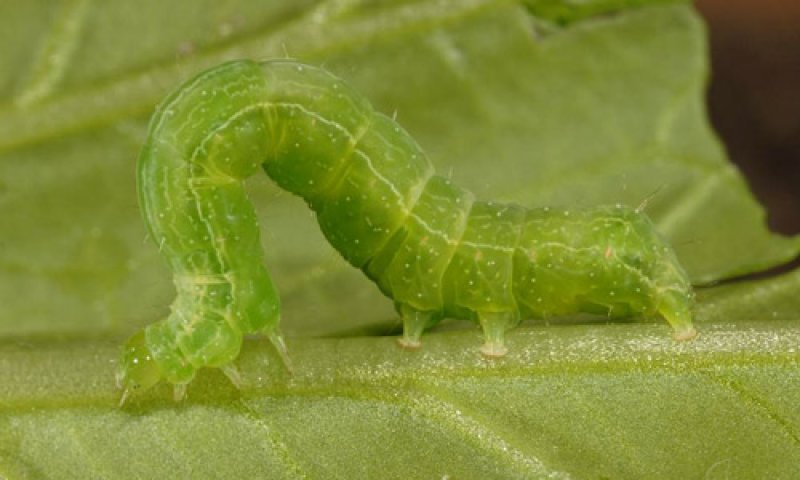
Soybean looper larva making its signature looping motion. Image: Lyle J. Buss, University of Florida

Oxitec Ltd., a UK-based biotechnology company that pioneered the use of biologically-engineered insects to control disease-spreading mosquitoes and crop-destroying agricultural pests….has announced the signing of a new multi-year development agreement with a collaborator to develop a self-limiting soybean looper (Chrysodeixis includens) to suppress this damaging agricultural pest that is found throughout the Americas.

Soybean looper threatens a variety of crops, primarily soybeans as well as cotton, sweet potatoes, peanuts, lettuce, herbs, tomato, tobacco, and others. It has been historically difficult to control due to growing insecticide resistance. Additionally, individual adult females can lay up to 700 eggs each in their lifetime, allowing a small number of insects to exponentially grow in a very short time span.

Oxitec’s self-limiting approach utilizes proprietary and precision genetics to embed self-limiting properties in agricultural pests, mosquitoes and other insects, providing farmers with safe and effective tools for combating crop-destroying and disease-carrying insects.

“Soybean looper threatens crops in the Americas, especially in Brazil and the US, where current control tools are under pressure. It is necessary to rapidly deploy new, safe and targeted technologies,” said Grey Frandsen, Chief Executive Officer at Oxitec. “Our targeted biologically-based approach offers the opportunity to suppress this major agricultural pest, prevent widespread crop losses and, perhaps most importantly, complement the newest generations of other valuable pest control methods.”

Read full, original article: Oxitec Signs New Multi-year Development Agreement to Apply 2nd Generation Technology to Control Soybean Looper


{{ reviewsTotal }}{{ options.labels.singularReviewCountLabel }}
{{ reviewsTotal }}{{ options.labels.pluralReviewCountLabel }}
{{ options.labels.newReviewButton }}
{{ userData.canReview.message }}

Related Articles

Infographic: Global regulatory and health research agencies on whether glyphosate causes cancer

Infographic: Global regulatory and health research agencies on whether glyphosate causes cancer

Does glyphosate—the world's most heavily-used herbicide—pose serious harm to humans? Is it carcinogenic? Those issues are of both legal and ...

Most Popular

Screenshot-2026-05-01-at-1.29.41-PM
Viewpoint: What happens when whole grains meet modern food manufacturing? Labels don’t tell the whole story.
S
As vaccine rejectionism spreads, measles may be taking a more dangerous turn
Screenshot 2026-05-06 at 2.56
Singularity crisis ahead? Can super babies save us from rogue AI geniuses?
Screenshot-2026-03-13-at-12.14.04-PM
The FDA wants to make many popular prescription drugs OTC—a great idea. Here’s why it’s unlikely to happen
Screenshot-2026-05-06-at-2.07.43-PM
Manufacturing a conspiracy: The timeline of how  the White House embraced the fringe claim that scientists are being mysteriously murdered
Screenshot-2026-05-01-at-11.56.24-AM
‘Science moves forward when people are willing to think differently’: Memories of DNA maverick Craig Venter
Screenshot-2026-04-30-at-2.19.37-PM
5 myths about summer dehydration that could damage your health — or even kill you
Screenshot-2026-04-20-at-2.26.27-PM
Viewpoint — Food-fear world: The latest activist scientists campaign: Cancer-causing additives
Screenshot-2026-04-03-at-11.15.51-AM
Paraben panic: How a flawed study, media hype, and chemophobia convinced the public of the danger of one of the safest classes of preservatives
images
The never-ending GMO debate: Pros and cons
Screenshot-2026-04-12-135256
Bixonimania: The fake disease scam that AI swallowed whole
glp menu logo outlined

Get news on human & agricultural genetics and biotechnology delivered to your inbox.