New test accurately estimates bee exposure to neonicotinoid insecticides, study claims

H A
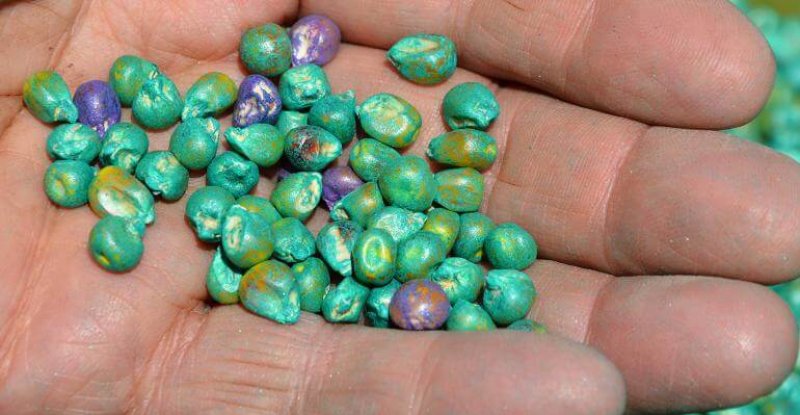
Seeds treated with neonicotinoid insecticides. Image source: The Farmer

Bee populations are declining, and neonicotinoid pesticides continue to be investigated — and in some cases banned — because of their suspected role as a contributing factor. However, limitations in sampling and analytical techniques have prevented a full understanding of the connection. Now, researchers describe in the ACS journal Environmental Science & Technology a new approach to sample neonicotinoids and other pesticides in plants, which could explain how bees are exposed to the substances.

[Editor’s note: To learn more, read: ‘Gold standard’ assessing neonicotinoids: Field bee hive studies find pesticides not major source of health issues.]

Neonicotinoids are water-soluble insecticides that are applied to seeds or foliage. But non-target organisms such as pollinating bees can also be exposed to the substances, mainly through residues in nectar and pollen of flowering plants, which bees use to make honey.

Most studies to-date have relied on correlating the presence of neonicotinoid residues in plant samples with bee declines. A few studies have measured total neonicotinoids in plants but laborious methods were used. Jay Gan and colleagues wanted to develop a simpler, more direct way to monitor neonicotinoids in living plants that would capture spatial and temporal movement of the insecticides.

The researchers developed a new type of solid-phase microextraction (SPME) probe, a device that can track concentration changes over time in biological systems. SPME probes use a fiber coated with a liquid or solid to quickly extract analytes from a sample. The team developed an SPME probe that they inserted into plants through a needle, allowing repeated sampling of seven neonicotinoids in plant sap. The method was demonstrated in lettuce and soybean plants, with each sampling taking only 20 minutes.

The analytes were then recovered from the probe and analyzed. This procedure allowed the researchers to quantify neonicotinoids in plants and study their movement and distribution throughout the plants over time. This method could be used to monitor movement of pesticides into flowers, nectar and pollen to pinpoint where and when maximal pesticide exposure occurs for bees and other pollinators, the researchers note.

Original article: Plant probe could help estimate bee exposure to neonicotinoid insecticides

{{ reviewsTotal }}{{ options.labels.singularReviewCountLabel }}
{{ reviewsTotal }}{{ options.labels.pluralReviewCountLabel }}
{{ options.labels.noReviewsLabel }}
{{ options.labels.newReviewButton }}
{{ userData.canReview.message }}

Related Articles

Infographic: Global regulatory and health research agencies on whether glyphosate causes cancer

Infographic: Global regulatory and health research agencies on whether glyphosate causes cancer

Does glyphosate—the world's most heavily-used herbicide—pose serious harm to humans? Is it carcinogenic? Those issues are of both legal and ...

Most Popular

ChatGPT-Image-Mar-10-2026-01_39_01-PM
Viewpoint—“Miracle molecule” debunked: Why acemannan supplements don’t work
file-f-d-d-
Facts & Fallacies Podcast: Europe's AC debacle underscores fatal flaw in green activism
Screenshot 2025-09-17 at 12.41
Misinformation alert: No, glyphosate use in Canadian forests is not spurring more wildfires
ChatGPT-Image-Jul-9-2026-02_39_22-PM
Viewpoint: Polyphenols or NAD+ supplements to combat aging: No, Gwenyth Paltrow and followers, don’t waste your money.
ChatGPT-Image-Jul-8-2026-12_32_48-PM
Viewpoint: SCOTUS strikes a blow against junk science in Bayer glyphosate case. Will it deter mass tort litigators?
Screenshot 2026-07-11 094410
Growing animal muscle and fat cells inside rice grains and calling it beef: One of numerous genetically engineered products shaking up our ecosystem
ChatGPT-Image-Jul-6-2026-02_25_26-PM
40 million Americans take glucosamine. If you have memory loss, it could accelerate cognitive decline.
afb-a-b
As the EU loosens restrictions on agricultural gene editing, it remains years behind the rest of the world on equally-safe GMO foods
ChatGPT-Image-Jul-7-2026-01_57_55-PM
Viewpoint: Europe’s rejection of air conditioning is the poster child for misunderstanding how to mitigate the impact of climate change
ChatGPT-Image-Jul-17-2026-12_42_10-PM
Viewpoint: RFK, Jr. is setting up a panel to compensate people who claim they were injured by a COVID vaccine–no proof needed 
ChatGPT-Image-Jun-25-2026-12_23_17-PM
No, Bill Gates did not secretly engineer ticks to promote veganism
ChatGPT-Image-Jun-17-2026-03_29_08-PM
Viewpoint: What’s the impact of the U.S. abandoning support for global health?
ChatGPT-Image-Jul-1-2026-03_33_49-PM
‘Alternative’ cancer treatments that could kill you
glp menu logo outlined

Get news on human & agricultural genetics and biotechnology delivered to your inbox.