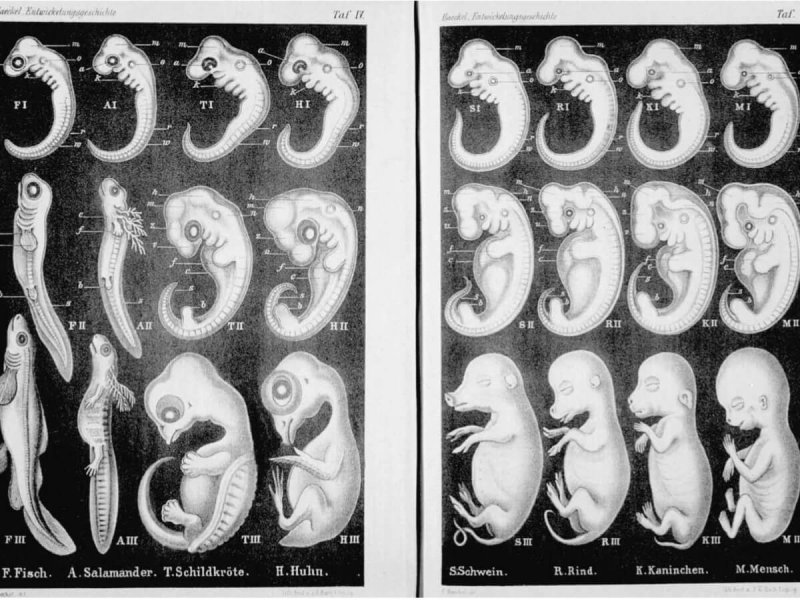
Geneticist Dr Kat Arney takes a closer look at some of the most controversial images in embryology—Ernst Haeckel’s illustrations of early embryos from species ranging from fish to human.
Born in 1834, Haeckel was a German zoologist with a flair for illustration, and a knack for creating incredibly detailed and widely shared scientific images. But do his infamous embryo drawings really show the true picture of early development?
Haeckel used these images to support the concept that ‘ontogeny recapitulates phylogeny’. This is the idea that the changes in shape and structure of human embryos in the womb recapitulate their evolutionary history. One infamous example depicts human embryos passing through a ‘fish’ stage because they seem to have gills at one point during early development, reflecting our ancient fish-like ancestors.
However, Haeckel’s pictures attracted controversy from the moment they were published. His peers pointed out that the same embryos had been re-used in some of the images, leading to accusations of fraud. Although the argument died down over the next century, the air of suspicion surrounding Haeckel and his embryo drawings never really went away.
In 1997, the journal Science published an article entitled Haeckel’s Embryos: Fraud Rediscovered, claiming that Haeckel had intentionally misrepresented embryological development. British embryologist Michael Richardson was quoted in it as saying, “It looks like it’s turning out to be one of the most famous fakes in biology.”
Although Haeckel created his drawings using the best tools and technology that was available at the time, modern techniques reveal that there are several inaccuracies. However, it would be a disservice to his many contributions to science to brand him a fraud.
The images may be inaccurate, but the fundamental point that the illustrations are showing is correct: the more closely related two species are in evolution, the more similar their early-stage embryos will appear.

There is a close connection between development and evolution, or ‘evo-devo’ as it’s sometimes known. In short, our evolutionary history is written in our developmental genes, and it’s a history that we can trace right the way back to the very first vertebrates.
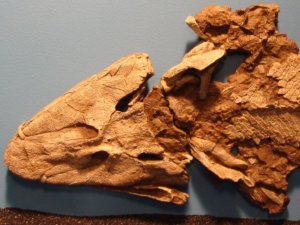
By way of example, Arney also looks at the story of Tiktaalik – a 375-million-year-old fossil discovered in northern Canada in 2004 by Professor Neil Shubin and his colleagues. According to Shubin, author of the book Your Inner Fish, Tiktaalik represents our oldest ‘fishapod’ ancestor, forming the missing link between fish and land-dwelling tetrapods.
Full transcript, links and references available online at GeneticsUnzipped.com
Genetics Unzipped is the podcast from the UK Genetics Society, presented by award-winning science communicator and biologist Kat Arney and produced by First Create the Media. Follow Kat on Twitter @Kat_Arney, Genetics Unzipped @geneticsunzip, and the Genetics Society at @GenSocUK
Listen to Genetics Unzipped on Apple Podcasts (iTunes) Google Play, Spotify, or wherever you get your podcasts