Space-grown lettuce a hit with astronauts, and nutritionally identical to its earthly counterpart

space station red romaine lettuce exlarge

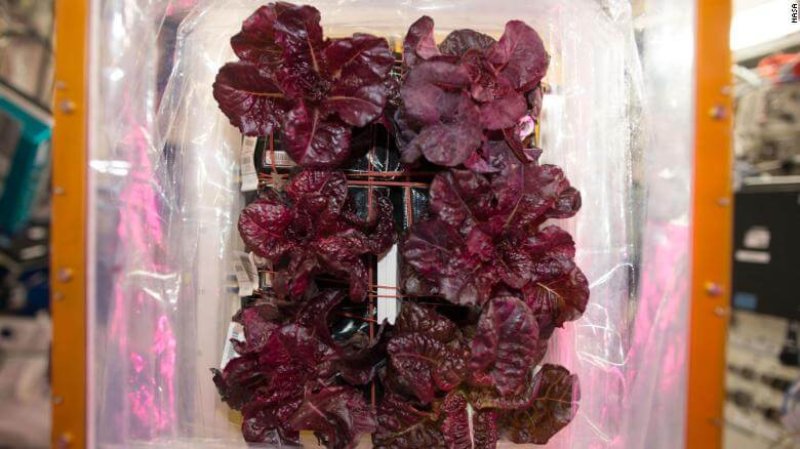
The astronauts floated around, expressing delight as they tasted something entirely unexpected in space. “Awesome! Tastes good! I like that! It’s fresh!” they said, between bites of the “Outredgeous” red romaine lettuce. It was the first time astronauts were able to enjoy the fruits of their labor after growing produce from seeds and harvesting it.

Research about the lettuce experiment, which began in 2014, published [March 6] in the journal Frontiers in Plant Science to herald that space lettuce isn’t just tasty, it’s also safe to eat.

Researchers analyzed the red romaine lettuce crops from 2014 to 2016 and determined that lettuce grown in space is …. free of disease-causing microbes and as nutritious as lettuce grown on Earth.

The first experiment happened in May 2014, not long after NASA’s first-ever Vegetable Production Systems growth chambers were delivered to the space station. The results from that first harvest were frozen and sent back to Kennedy Space Center for analysis.

Since then, a multitude of greens have been grown on the space station, and astronauts have been consuming some of the fruits of their space labor on the station ever since.


Read the original post

{{ reviewsTotal }}{{ options.labels.singularReviewCountLabel }}
{{ reviewsTotal }}{{ options.labels.pluralReviewCountLabel }}
{{ options.labels.newReviewButton }}
{{ userData.canReview.message }}

Related Articles

Infographic: Global regulatory and health research agencies on whether glyphosate causes cancer

Infographic: Global regulatory and health research agencies on whether glyphosate causes cancer

Does glyphosate—the world's most heavily-used herbicide—pose serious harm to humans? Is it carcinogenic? Those issues are of both legal and ...

Most Popular

ChatGPT-Image-Mar-10-2026-01_39_01-PM
Viewpoint—“Miracle molecule” debunked: Why acemannan supplements don’t work
afb-a-b
As the EU loosens restrictions on agricultural gene editing, it remains years behind the rest of the world on equally-safe GMO foods
ChatGPT-Image-Jul-8-2026-12_32_48-PM
Viewpoint: SCOTUS strikes a blow against junk science in Bayer glyphosate case. Will it deter mass tort litigators?
Screenshot-2026-07-10-at-2.02.54-PM
Viewpoint: In abortion-restricting Florida, misinformation abounds when Republican congresswoman faces an ectopic pregnancy
ChatGPT-Image-Jul-7-2026-01_57_55-PM
Viewpoint: Europe’s rejection of air conditioning is the poster child for misunderstanding how to mitigate the impact of climate change
Screenshot-2026-07-10-at-3.10.50-PM
Snake-oil cures throughout history
ChatGPT-Image-Jun-25-2026-12_23_17-PM
No, Bill Gates did not secretly engineer ticks to promote veganism
Screen-Shot-at-PM-pe-vra-kipgaprbdo-vd-ms-jpule-n-jqqaxf-l-e
Viewpoint: Will new breeding techniques help make European agriculture more competitive?
Screenshot-2026-07-10-at-12.55.21-PM
Cancer health facts are particularly susceptible to online misinformation
Screenshot-2026-07-10-at-3.25.10-PM
Using AI for health questions? Here are 4 tips for the most accurate answers.
ChatGPT-Image-Jul-1-2026-03_33_49-PM
‘Alternative’ cancer treatments that could kill you
Screenshot-2026-07-08-at-11.25.14-AM
AI being mobilized to target misinformation about vaccines–on AI
d a ca e c c beb x
Facts & Fallacies podcast: The 'woke' crusade against anthropology? Dr. Elizabeth Weiss
glp menu logo outlined

Get news on human & agricultural genetics and biotechnology delivered to your inbox.