‘Not alone’: 3 different human ancestors may have lived together in South Africa 2 million years ago

file hwtgkd
Credit: Matthew V. Caruana

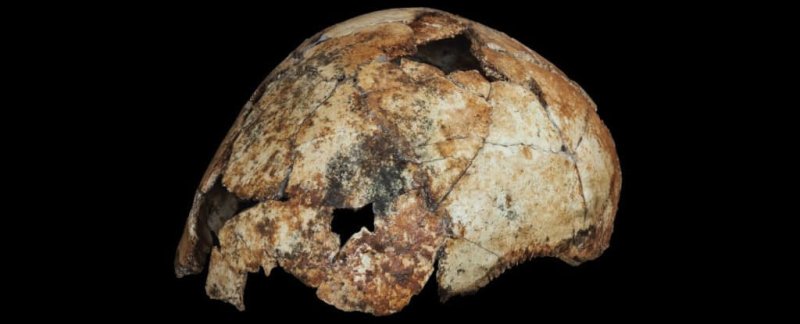
An international team, including Arizona State University researcher Gary Schwartz, have unearthed the earliest known skull of Homo erectus, the first of our ancestors to be nearly human-like in their anatomy and aspects of their behavior.

Years of painstaking excavation at the fossil-rich site of Drimolen, nestled within the Cradle of Humankind (a UNESCO World Heritage site … in South Africa), has resulted in the recovery of several new and important fossils.

Additional fossils recovered from Drimolen belong to a different species — in fact, a different genus of ancient human altogether — the more heavily built, robust human ancestor Paranthropus robustus, known to also occur at several nearby cave sites preserving fossils of the same geological age. A third, distinctive species, Australopithecus sediba, is known from two-million-year old deposits of an ancient cave site virtually down the road from Drimolen.

“Unlike the situation today, where we are the only human species, two million years ago our direct ancestor was not alone,” said project director and lead researcher from La Trobe University in Australia, Andy Herries.

“What is really exciting is the discovery that during this same narrow time slice, at just around two million years ago, there were three very different types of ancient human ancestors roaming the same small landscape,” said Schwartz.


Read the original post

{{ reviewsTotal }}{{ options.labels.singularReviewCountLabel }}
{{ reviewsTotal }}{{ options.labels.pluralReviewCountLabel }}
{{ options.labels.noReviewsLabel }}
{{ options.labels.newReviewButton }}
{{ userData.canReview.message }}

Related Articles

Infographic: Global regulatory and health research agencies on whether glyphosate causes cancer

Infographic: Global regulatory and health research agencies on whether glyphosate causes cancer

Does glyphosate—the world's most heavily-used herbicide—pose serious harm to humans? Is it carcinogenic? Those issues are of both legal and ...

Most Popular

ChatGPT-Image-Jul-22-2026-09_13_07-AM
Viewpoint—The Strategic Litigation boom: Understanding the tightening coalition among NGOs, foundations, journalists, and tort lawyers
How to Include More Strawberries in Your Diet
Strawberries are berries—and 35 other surprising food and drink myths
close up arabica coffee farmer s hands picking beans plant his farm colombia
Viewpoint: Why do so many ‘mainstream’ and ‘respected’ media outlets exaggerate climate change threats?
diversity
We are entering a new era of personalized medicine—if you’re white
Screenshot-2026-07-07-at-12.55.44-PM
Viewpoint: Yes, we can adapt to a changing climate without devastating the environment and the economy
ChatGPT-Image-May-22-2026-10_26_09-AM
Trump-RFK, Jr. National Science Board firings: Accountability vs. partisan meddling
ChatGPT-Image-Mar-10-2026-01_39_01-PM
Viewpoint—“Miracle molecule” debunked: Why acemannan supplements don’t work
organic scaled
Facts & Fallacies podcast: Organic food cuts pesticide exposure? A response to Dr. Rhonda Patrick
Screenshot 2026-07-22 at 10.25
Science brain drain escalates as Trump purge extends to USDA
ChatGPT-Image-Jul-6-2026-02_25_26-PM
40 million Americans take glucosamine. If you have memory loss, it could accelerate cognitive decline.
using genetics to reverse aging
Is the longevity obsession a new form of ageism?
Screenshot-2026-07-01-at-2.49.48-PM
Dr. TikTok and male fertility: Viral claims tout GLP-1 drugs as fertility boosters. What does the science say?
kratom
Viewpoint: Kratom ‘supplement’ crisis: DEA sits on its hands while patient addictions to this ineffective drug  rise

Sorry. No data so far.

glp menu logo outlined

Get news on human & agricultural genetics and biotechnology delivered to your inbox.