Ancient tool technology passed down for thousands of generations by extinct human species, study says

bb homo erectus inline mobile
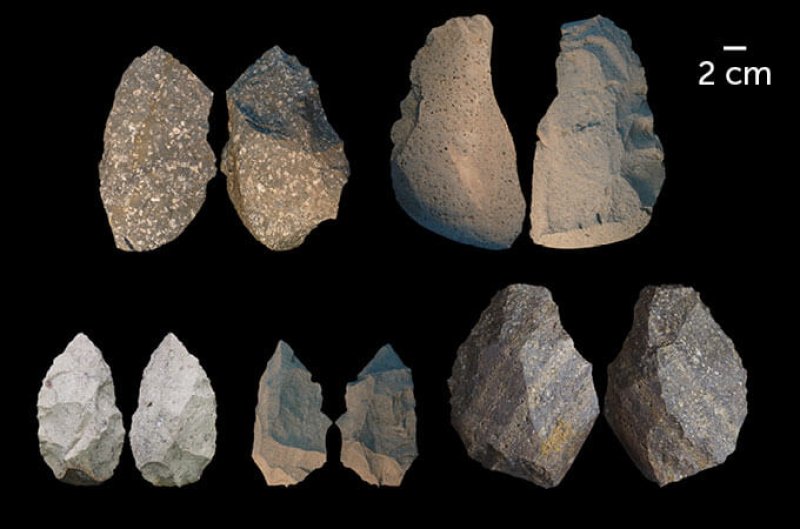
A Homo erectus braincase found near these double-edged stone implements (each shown from both sides) contributes to evidence that these now-extinct hominids created tools requiring considerable skill and planning as well as simple cutting instruments. Credit: Michael Rogers/Southern Connecticut State University

When it comes to extinct human species, Neanderthals tend to hog the spotlight. But another group of early humans, Homo erectus, is equally deserving of our love and attention.

Skull fragments from two individuals were recently uncovered in Gona, Afar, Ethiopia, alongside associated stone tools—a rarity in archaeology. Even rarer is the discovery of stone tools hailing from two different technological traditions, a finding that’s upsetting a conventional notion that associates single human species with single stone tool technologies.

Of relevance to the new study, the authors reference Mode 1 tools, in which several pieces are knapped off a stone to produce sharp edges, and Mode 2 tools, which are more complex, having all sides flaked off to produce a pear-shaped hand-axe.

“The fact that the Mode 2 tradition seems to be conserved over such a long time, and over long distances, raises questions about the functionality of Mode 2 stone tools, strength of cultural traditions, and the degree of interactions between wide-ranging groups,” [researcher Michael] Rogers told Gizmodo. “It’s remarkable that the Mode 2 tradition was passed down successfully over thousands of generations, especially in light of the variability that we are now seeing in the paleoanthropological records.”


Read the original post

{{ reviewsTotal }}{{ options.labels.singularReviewCountLabel }}
{{ reviewsTotal }}{{ options.labels.pluralReviewCountLabel }}
{{ options.labels.newReviewButton }}
{{ userData.canReview.message }}

Related Articles

Infographic: Global regulatory and health research agencies on whether glyphosate causes cancer

Infographic: Global regulatory and health research agencies on whether glyphosate causes cancer

Does glyphosate—the world's most heavily-used herbicide—pose serious harm to humans? Is it carcinogenic? Those issues are of both legal and ...

Most Popular

Screenshot-2026-05-01-at-1.29.41-PM
Viewpoint: What happens when whole grains meet modern food manufacturing? Labels don’t tell the whole story.
S
As vaccine rejectionism spreads, measles may be taking a more dangerous turn
ChatGPT-Image-Apr-13-2026-02_20_22-PM
Viewpoint: Misinformation infodemic? Why assessing evidence is so challenging 
Screenshot-2026-04-20-at-2.26.27-PM
Viewpoint — Food-fear world: The latest activist scientists campaign: Cancer-causing additives
ChatGPT-Image-Mar-27-2026-11_47_30-AM-2
FDA’s expedited drug reviews are hailed in some quarters but other approval practices are problematic
Screenshot-2026-03-13-at-12.14.04-PM
The FDA wants to make many popular prescription drugs OTC—a great idea. Here’s why it’s unlikely to happen
bigstock opioids on chalkboard with rol
GLP podcast: 'Safe injection sites': enabling drug addiction or saving lives?
circular-bioeconomy-should-focus-on-sustainable-wellbeing
GLP podcast: What's wrong with 'doomsday' environmentalism? It's false.
Farmers can talk to plants
Farmers are a major source of misinformation—about farming
Screenshot-2026-04-12-135256
Bixonimania: The fake disease scam that AI swallowed whole

Sorry. No data so far.

glp menu logo outlined

Get news on human & agricultural genetics and biotechnology delivered to your inbox.