Thank bugs for red velvet cake? How Cochineal insects became a sustainable source of food dye

cochineal colour e
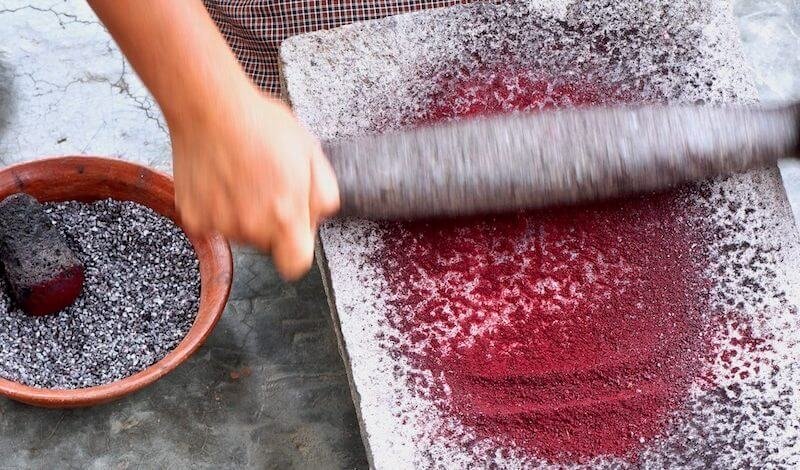
Cochineal bugs being crushed to make dye. Credit: Haute Culture

A surprising amount of the food we consume contains various compounds to add color. Marshmallows look white, but they contain blue coloring (to keep them from growing less bright as they sit on shelves). Starbucks uses food coloring in its strawberry drinks. And frozen meat, like fish and crab meat, contains red food coloring to make it more appealing.

But where do we get this food coloring from? In the case of many red dyes, it comes from an unexpected source:

The crushed bodies of a Central and South American insect, called the Cochineal.

Follow the latest news and policy debates on sustainable agriculture, biomedicine, and other ‘disruptive’ innovations. Subscribe to our newsletter.

In order to repel other insects, birds, or other creatures that may find it to be a tasty snack, the Cochineal produces a nasty-tasting compound called carminic acidโ€ฆ If you harvest a bunch of these bugs, crush them up, and dunk them in an acidic solution, the carminic acid can be extracted. When extracted and processed through mixing with salts, the result is carmine dye, which is a brilliant, vibrant red color.
(You may also recognize this color under other names, including Cochineal extract, Natural Red 4, E120, or Crimson Lake.)

Thankfully, these bugs grow and reproduce quickly, since it can take 70,000 individual Cochineal insects to produce a pound of Carmine Red dye!


Read the original post

{{ reviewsTotal }}{{ options.labels.singularReviewCountLabel }}
{{ reviewsTotal }}{{ options.labels.pluralReviewCountLabel }}
{{ options.labels.newReviewButton }}
{{ userData.canReview.message }}

Related Articles

Infographic: Global regulatory and health research agencies on whether glyphosate causes cancer

Infographic: Global regulatory and health research agencies on whether glyphosate causes cancer

Does glyphosateโ€”the world's most heavily-used herbicideโ€”pose serious harm to humans? Is it carcinogenic? Those issues are of both legal and ...

Most Popular

ChatGPT-Image-May-7-2026-12_16_37-PM-2
Viewpoint: Are cancer rates โ€˜skyrocketingโ€™ as RFK, Jr. and MAHA claims? The evidence says mostly the opposite
Screenshot-2026-04-22-at-10.46.29-AM
Viewpoint: How to counter science disinformation? Science journalist offers 12 practical tips
ChatGPT-Image-May-12-2026-08_39_41-PM
GLP podcast: Big Pharma, Big Ag, Big Foodโ€”health harming industries or life-saving innovators?
png-pill-omega-Supp-fish-oil
Millions take omega-3 fish oil for brain health. New research suggests it may do the opposite.
Screenshot-2026-04-23-at-11.00.36-AM
Regulators' dilemma: Thalidomide, Metformin, and the cost of getting drug approvals wrong
Screenshot-2026-04-13-at-1.39.26-PM
Viewpoint: โ€˜Safer for children?โ€™ Stonyfield yogurt under fire for deceptive organic marketing
Picture1-5
Science Disinformation Gap: The transatlantic battle over social media and censorship
Picture1-1
Cooling the planet with balloons: Could a geoengineering gamble slow global warming?
Screenshot-2026-05-08-at-3.40.33-PM
Seeds of power: China turns to genetic engineering to become global superpower
ChatGPT-Image-May-12-2026-01_41_42-PM
Viewpoint: โ€˜Measles is a canary in the healthcare coal mineโ€™: Challenging RFK, Jr.โ€™s scare campaign
glp menu logo outlined

Get news on human & agricultural genetics and biotechnology delivered to your inbox.