If we are kind to one another, it’s usually because we have ulterior motives. If we are good, it’s only because we have managed to control and transcend our innate selfishness and brutality.
This bleak view of human nature is closely associated with the science writer Richard Dawkins, whose book The Selfish Gene became popular because it fitted so well with (and helped to justify) the competitive and individualistic ethos of late 20th-century societies.
Like many others, Dawkins justifies his views with reference to the field of evolutionary psychology. Evolutionary psychology theorises that present-day human traits developed in prehistoric times, during what is termed the “environment of evolutionary adaptedness”.
This is usually seen as a period of intense competition, when life was a kind of Roman gladiatorial battle in which only the traits that gave people a survival advantage were selected and all others fell by the wayside. And because people’s survival depended on access to resources – think rivers, forests and animals – there was bound to be competition and conflict between rival groups, which led to the development of traits like racism and warfare.
This seems logical. But in fact the assumption it’s based on — that prehistoric life was a desperate struggle for survival — is false.
Prehistoric abundance
It’s important to remember that in the prehistoric era, the world was very sparsely populated. So it’s likely there was an abundance of resources for hunter-gatherer groups.
According to some estimates, around 15,000 years ago, the population of Europe was only 29,000, and the population of the whole world was less than half a million. With such small population densities, it seems unlikely that prehistoric hunter-gatherer groups had to compete against each other or had any need to develop ruthlessness and competitiveness, or to go to war.
Indeed, many anthropologists now agree that war is a late development in human history, arising with the first agricultural settlements.
Contemporary evidence
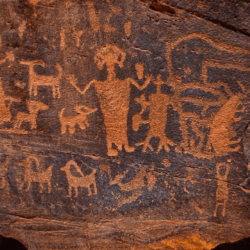
There’s also significant evidence from contemporary hunter-gatherer groups who live in the same way as prehistoric humans. One of the striking things about such groups is their egalitarianism.
As the anthropologist Bruce Knauft has remarked, hunter-gatherers are characterised by “extreme political and sexual egalitarianism”. Individuals in such groups don’t accumulate their own property and possessions. They have a moral obligation to share everything. They also have methods of preserving egalitarianism by ensuring that status differences don’t arise.
The !Kung of southern Africa, for example, swap arrows before going hunting and when an animal is killed, the credit does not go to the person who fired the arrow, but to the person who the arrow belongs to. And if a person becomes too domineering or arrogant, the other members of the group ostracise them.



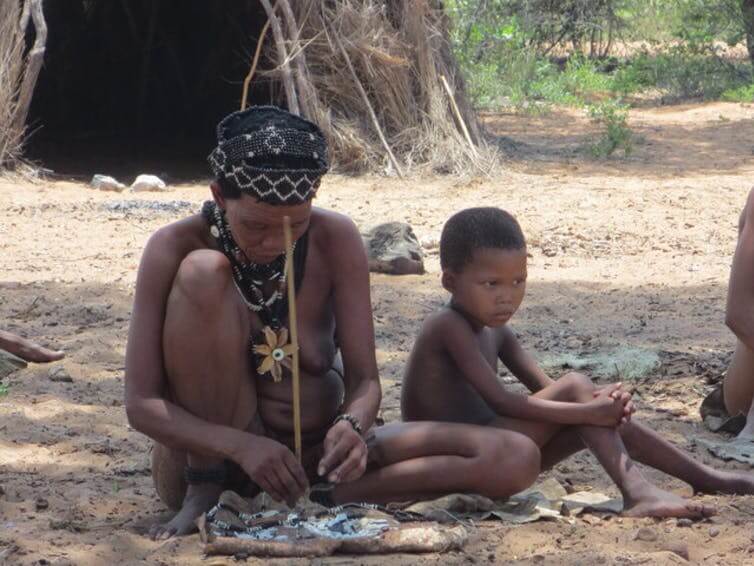
Typically in such groups, men have no authority over women. Women usually choose their own marriage partners, decide what work they want to do and work whenever they choose to. And if a marriage breaks down, they have custody rights over their children.
Many anthropologists agree that such egalitarian societies were normal until a few thousand years ago, when population growth led to the development of farming and a settled lifestyle.
Altruism and egalitarianism
In view of the above, there seems little reason to assume that traits such as racism, warfare and male domination should have been selected by evolution – as they would have been of little benefit to us. Individuals who behaved selfishly and ruthlessly would be less likely to survive, since they would have been ostracised from their groups.
It makes more sense then to see traits such as cooperation, egalitarianism, altruism and peacefulness as natural to human beings. These were the traits that have been prevalent in human life for tens of thousands of years. So presumably these traits are still strong in us now.
Of course, you might argue that if this is case, why do present day humans often behave so selfishly and ruthlessly? Why are these negative traits so normal in many cultures? Perhaps though these traits should be seen as the result of environmental and psychological factors.
Research has shown repeatedly that when the natural habitats of primates are disrupted, they tend to become more violent and hierarchical. So it could well be that the same thing has has happened to us, since we gave up the hunter-gatherer lifestyle.
In my book The Fall, I suggest that the end of the hunter-gatherer lifestyle and the advent of farming was connected to a psychological change that occurred in some groups of people. There was a new sense of individuality and separateness, which led a new selfishness, and ultimately to hierarchical societies, patriarchy and warfare.
At any rate, these negative traits appear to have developed so recently that it doesn’t seem feasible to explain them in adaptive or evolutionary terms. Meaning that the “good” side of our nature is much more deep-rooted than the “evil” side.
Steve Taylor is the author of several best-selling books on psychology and spirituality, including The Leap and his new book Spiritual Science. He is a senior lecturer in psychology at Leeds Beckett University and the current chair of the Transpersonal Section of the British Psychological Society. Find Steve on Twitter @SMTaylorauthor
A version of this article was originally published at the Conversation and has been republished here with permission. The Conversation can be found on Twitter @ConversationUS