Could Ethiopia make or break the future of GM crops in Africa?

Credit: Cornell Alliance for Science

I have followed with interest the recent controversy around plantings of transgenic crops in Ethiopia. Until 2015, the country took a vocal stand against genetically modified (GM) crops, underlined by its strict proclamation on biosafety in 2009… Six years later, the country loosened its restrictions in an amended proclamation.

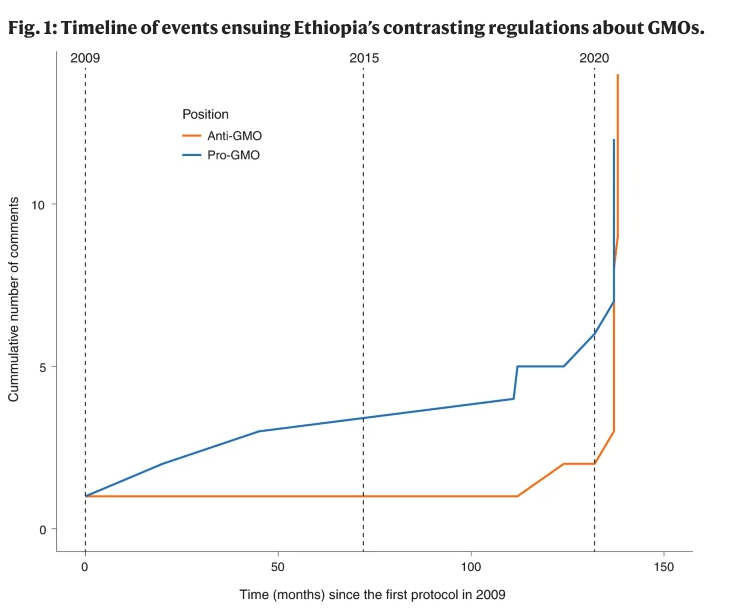
In a recent report, the US Department of Agriculture (USDA) recognized Ethiopia’s commitment to implementing the amended protocol. Although debates about gene-modified organisms (GMOs) in Ethiopia started immediately after the first prohibitive proclamation in 2009, they were low-key and mostly pro-GMO (Fig. 1). Severe criticisms against GMOs exploded following USDA’s accolades for Ethiopia’s relaxation of rules.

Follow the latest news and policy debates on sustainable agriculture, biomedicine, and other ‘disruptive’ innovations. Subscribe to our newsletter.

Anti-GMO efforts may not necessarily force the government to reinstate its strict biosafety regulation of 2009. Nonetheless, campaigns decrying GM crops can influence public perceptions, which in turn can lead to changes in policy, stalling the uptake, implementation and application of biotech products. In addition, misinformation and competing interests inevitably complicate how biotech research fairs in Ethiopia (and elsewhere in Africa).
…. If such campaigns succeed, not only GMOs but also other advances in biotech will face an uphill battle.  If, by contrast, Ethiopian scientists and enthusiastic technocrats can rise above the mudslinging, take a pragmatic case-by-case approach to crop approvals and build biosafety infrastructure that accommodates new agricultural technologies, the country can realize its potential as a springboard for the advancement of biotechnology R&D on this continent.


Read the original post

{{ reviewsTotal }}{{ options.labels.singularReviewCountLabel }}
{{ reviewsTotal }}{{ options.labels.pluralReviewCountLabel }}
{{ options.labels.noReviewsLabel }}
{{ options.labels.newReviewButton }}
{{ userData.canReview.message }}

Related Articles

Infographic: Global regulatory and health research agencies on whether glyphosate causes cancer

Infographic: Global regulatory and health research agencies on whether glyphosate causes cancer

Does glyphosate—the world's most heavily-used herbicide—pose serious harm to humans? Is it carcinogenic? Those issues are of both legal and ...

Most Popular

ChatGPT-Image-Mar-10-2026-01_39_01-PM
Viewpoint—“Miracle molecule” debunked: Why acemannan supplements don’t work
Screenshot 2025-09-17 at 12.41
Misinformation alert: No, glyphosate use in Canadian forests is not spurring more wildfires
Screenshot 2026-07-11 094410
Growing animal muscle and fat cells inside rice grains and calling it beef: One of numerous genetically engineered products shaking up our ecosystem
ChatGPT-Image-Jun-25-2026-12_23_17-PM
No, Bill Gates did not secretly engineer ticks to promote veganism
file-f-d-d-
Facts & Fallacies Podcast: Europe's AC debacle underscores fatal flaw in green activism
ChatGPT-Image-Jul-9-2026-02_39_22-PM
Viewpoint: Polyphenols or NAD+ supplements to combat aging: No, Gwenyth Paltrow and followers, don’t waste your money.
ChatGPT-Image-Jul-7-2026-01_57_55-PM
Viewpoint: Europe’s rejection of air conditioning is the poster child for misunderstanding how to mitigate the impact of climate change
afb-a-b
As the EU loosens restrictions on agricultural gene editing, it remains years behind the rest of the world on equally-safe GMO foods
Screenshot 2026-07-16 at 8.49
Pete Hegseth’s bizarre Viagra commercial as Trump administration endorses ‘hormone replacement therapy’

Sorry. No data so far.

glp menu logo outlined

Get news on human & agricultural genetics and biotechnology delivered to your inbox.