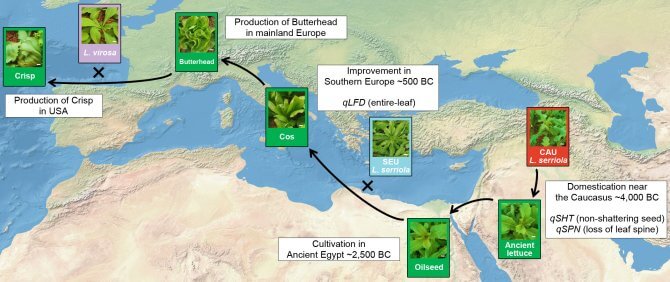
Try to imagine a collection of 2500 different types of lettuce: approximately 1500 varieties that were ever grown by farmers somewhere in the world and roughly 1000 populations of wild lettuce plants from roadsides and nature reserves. Then try to imagine the DNA being collected from all these types of lettuce and used to determine how the lettuce on our plate came to be.
The first wild plants were modified for cultivation 6000 years ago in the Caucasus. These first lettuces were only suitable for harvesting seeds to extract oil, and the ancient Greek and Romans further bred these plants (at that time, they still had thorns on the leaves) to be used as leafy vegetables. And the story told by the DNA continues, up to the Americans that needed properties from wild varieties to change soft, smooth butter lettuce into hard, puckered iceberg lettuce.
…
As it turns out, the modern varieties of cultivated lettuces mostly resemble their wild predecessor Lactuca serriola from the Caucasus.

Analysis of the relationship between the DNA information and traits of the cultivated lettuces shows that rigorous selection took place for traits that were desirable for production and consumption, the “domestication traits” like the absence of spines and thorns, which resulted in reduced diversity in the regions of the DNA where the genes for these traits are located.