Space wine: How sending grapevines into orbit could protect the wine industry from devastating impacts of climate change

Credit: WineLand
Credit: WineLand

[A] group of scientists is cultivating the next generation of mutant grapes, which they hope will be resistant to shocks like frost, disease, and drought.ย 

The mission, code name CANES, is an unlikely-sounding partnership between the French aerospace startup Space Cargo Unlimited, the University of Bordeauxโ€™s prestigious wine science institute (ISVV), vine grower Mercier, and the European Space Agency.ย 

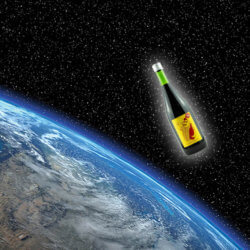
On March 6, 2020, the team took 320 shoots cut from local vines in the winter months before takeoffโ€”all were alive but in hibernationโ€”and launched them aboard a SpaceX Falcon 9 rocket to the International Space Station.

[T]hey were subjected to microgravity and super-accelerated particles known as cosmic raysโ€”radiation that can surge amid solar flares or in distant supernovae. Splash-landing to earth off the coast of Florida in January, the experiment was an attempt to jump-start evolution itself by pushing vines to their limits in an environment so extreme and hostile that genetic mutations and new behaviors are induced.
Follow the latest news and policy debates on sustainable agriculture, biomedicine, and other ‘disruptive’ innovations. Subscribe to our newsletter.

The objective, [researcher Stรฉphanie Cluzet] says, is to gather the โ€œmaximum informationโ€ available to discover what changes are hidden inside the cells of the plants. โ€œWe want to decipher their secrets.”ย 

Read the original post

{{ reviewsTotal }}{{ options.labels.singularReviewCountLabel }}
{{ reviewsTotal }}{{ options.labels.pluralReviewCountLabel }}
{{ options.labels.newReviewButton }}
{{ userData.canReview.message }}

Related Articles

Infographic: Global regulatory and health research agencies on whether glyphosate causes cancer

Infographic: Global regulatory and health research agencies on whether glyphosate causes cancer

Does glyphosateโ€”the world's most heavily-used herbicideโ€”pose serious harm to humans? Is it carcinogenic? Those issues are of both legal and ...

Most Popular

Screenshot-2026-05-01-at-1.29.41-PM
Viewpoint: What happens when whole grains meet modern food manufacturing? Labels donโ€™t tell the whole story.
S
As vaccine rejectionism spreads, measles may be taking a more dangerous turn
Screenshot 2026-05-06 at 2.56
Singularity crisis ahead? Can super babies save us from rogue AI geniuses?
Screenshot-2026-05-06-at-2.07.43-PM
Manufacturing a conspiracy: The timeline of howย  the White House embraced the fringe claim that scientists are being mysteriously murdered
Screenshot-2026-04-20-at-2.26.27-PM
Viewpoint โ€” Food-fear world: The latest activist scientists campaign: Cancer-causing additives
Screenshot-2026-04-30-at-2.19.37-PM
5 myths about summer dehydration that could damage your health โ€” or even kill you
Screenshot-2026-03-13-at-12.14.04-PM
The FDA wants to make many popular prescription drugs OTCโ€”a great idea. Hereโ€™s why itโ€™s unlikely to happen
Screenshot-2026-04-12-135256
Bixonimania: The fake disease scam that AI swallowed whole
Screenshot-2026-05-01-at-11.56.24-AM
โ€˜Science moves forward when people are willing to think differentlyโ€™: Memories of DNA maverick Craig Venter
ChatGPT-Image-May-6-2026-03_41_05-PM
โ€˜Protecting the integrity of scienceโ€™: Kennedyโ€™s FDA blocks release of taxpayer-funded studies finding COVID and shingles vaccines safe
Screenshot-2026-04-03-at-11.15.51-AM
Paraben panic: How a flawed study, media hype, and chemophobia convinced the public of the danger of one of the safest classes of preservatives
glp menu logo outlined

Get news on human & agricultural genetics and biotechnology delivered to your inbox.