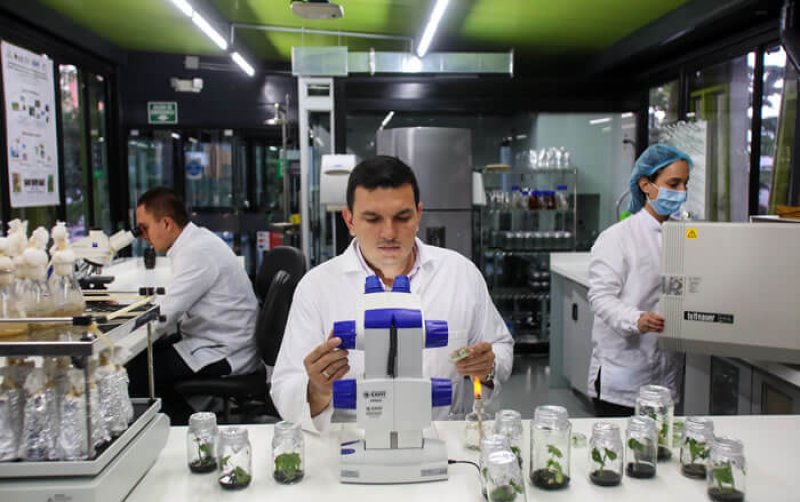

In products as common as wine, beer, cotton, flowers and others from the food sector such as soybeans and corn, but also in pharmaceutical generation areas such as insulin or vaccines, you can find the technology of transgenesis. It is about the genetic modification of organisms (GMOs) or better known as transgenics, an issue on which EAFIT researchers have been working for six years with the aim of expanding the frontier of knowledge and contributing to issues such as agricultural production and food safety.
Since 2015, for example, EAFIT researchers began to work on the genetic improvement of the sacha inchi and the castor, two plants with high potential for the development of the Baja Cauca Antioqueño [a region of Colombia], since they contain fatty acids with industrial applications — in the case of the castor — and for human consumption, sacha inchi.
In order to develop transgenic seeds, which would help food sovereignty in the future, the academic sector can contribute to biotechnological development taking into account that each region of the planet has its varieties.





In this regard, [lead researcher Professor Diego Villanueva] highlights the contributions of transgenic research to achieve the objectives of sustainable development by recalling that global warming is an imminent challenge and agriculture suffers greatly from this phenomenon. “As the temperature increases, a fundamental resource such as water becomes scarce, as ecosystems heat up, pests also move around and many diseases appear because their vectors move,” he says.
[Editor’s note: This article was originally published in Spanish and has been translated and edited for clarity.]