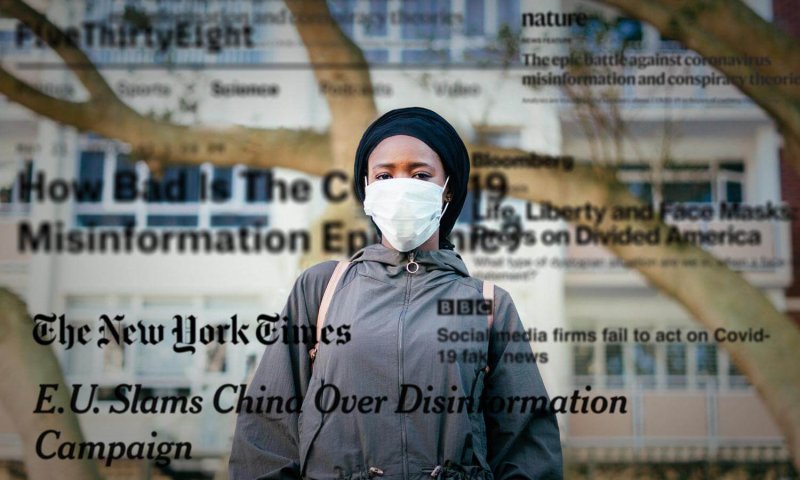
COVID misinformation epidemic: Nearly 80% of Americans believe or are unsure about at least one false claim about the coronavirus

Credit: Union of Concerned Scientists

Misinformation about health care topics is nothing new, but social media, the polarization of news sources, and the pace of scientific development on COVID-19 have all contributed to an environment that makes it easier than ever for ambiguous information, misinterpretation, and deliberate disinformation to spread.

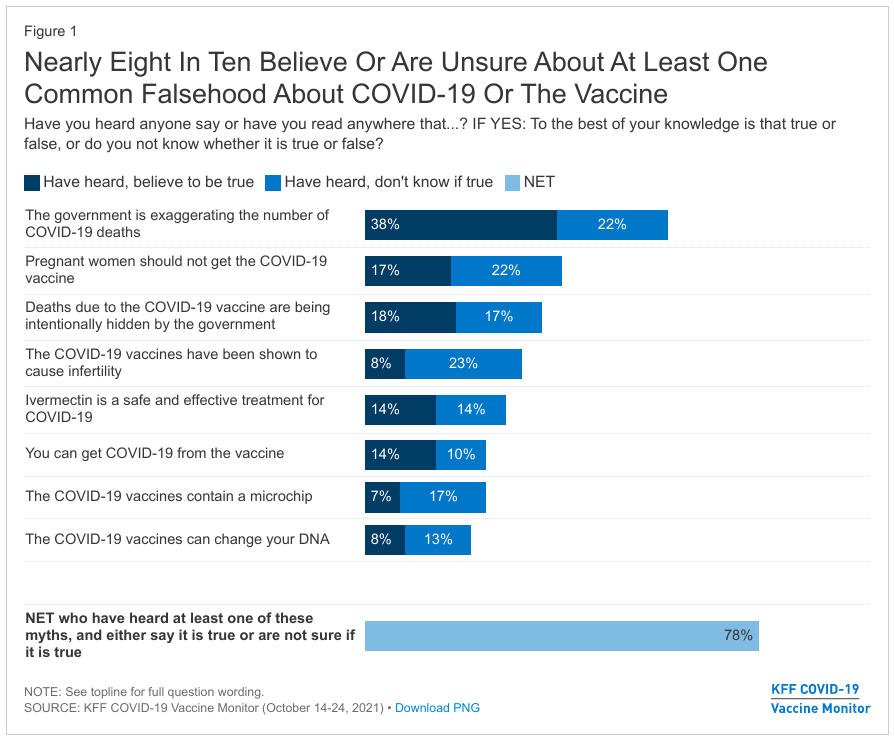
We find in the latest Vaccine Monitor that belief in pandemic-related misinformation is widespread, with 78% of adults saying they have heard at least one of eight different false statements about COVID-19 and that they believe it to be true or are unsure if it is true or false. One-third (32%) of all adults believe or are uncertain about at least four false statements. 

Belief in COVID-19 misinformation is correlated with both vaccination status and partisanship, with unvaccinated adults and Republicans much more likely to believe or be unsure about false statements compared to vaccinated adults and Democrats.

Follow the latest news and policy debates on sustainable agriculture, biomedicine, and other ‘disruptive’ innovations. Subscribe to our newsletter.

These findings suggest a challenge for reaching people with accurate information about COVID-19. While that challenge is particularly acute when it comes to reaching those who remain unvaccinated, the partisan divisions in misinformation and trusted news sources also have implications for those who are vaccinated, as we have reported a growing partisan divide in intention to get COVID-19 booster shots, even among the fully vaccinated.

This is an excerpt. Read the original post here.

{{ reviewsTotal }}{{ options.labels.singularReviewCountLabel }}
{{ reviewsTotal }}{{ options.labels.pluralReviewCountLabel }}
{{ options.labels.newReviewButton }}
{{ userData.canReview.message }}

Related Articles

Infographic: Global regulatory and health research agencies on whether glyphosate causes cancer

Infographic: Global regulatory and health research agencies on whether glyphosate causes cancer

Does glyphosate—the world's most heavily-used herbicide—pose serious harm to humans? Is it carcinogenic? Those issues are of both legal and ...

Most Popular

Screenshot-2026-04-13-at-1.39.26-PM
Viewpoint: ‘Safer for children?’ Stonyfield yogurt under fire for deceptive organic marketing
Screenshot-2026-04-22-at-10.46.29-AM
Viewpoint: How to counter science disinformation? Science journalist offers 12 practical tips
ChatGPT-Image-May-7-2026-12_16_37-PM-2
Viewpoint: Are cancer rates ‘skyrocketing’ as RFK, Jr. and MAHA claim? The evidence says mostly the opposite
Picture1-14
When superbugs threaten vulnerable children: Can AI help solve antibiotic resistance?
ChatGPT-Image-May-12-2026-08_39_41-PM
GLP podcast: Big Pharma, Big Ag, Big Food—health harming industries or life-saving innovators?
ChatGPT-Image-May-7-2026-12_32_36-PM
Viewpoint: The state of U.S. vaccine policy? Dismal nationally, but some states are stepping up.
Screenshot-2026-04-23-at-11.00.36-AM
Regulators' dilemma: Thalidomide, Metformin, and the cost of getting drug approvals wrong
Picture1-1
Cooling the planet with balloons: Could a geoengineering gamble slow global warming?
bigstock opioids on chalkboard with rol
GLP podcast: 'Safe injection sites': enabling drug addiction or saving lives?
ChatGPT-Image-May-7-2026-01_23_27-PM-2
Viewpoint: Will AI democratize personalized cancer treatment or fuel medical misinformation?
Defense_Secretary_Ash_Carter_tours_the_Microsoft_Cybercrime_Center_in_Seattle_March_3_2016
How criminals are using AI to target social media users and steal their money and confidential data
RFKjr-Tech-Vax-Misinfo
As U.S. officials spread medical misinformation, scientists fact check online
glp menu logo outlined

Get news on human & agricultural genetics and biotechnology delivered to your inbox.