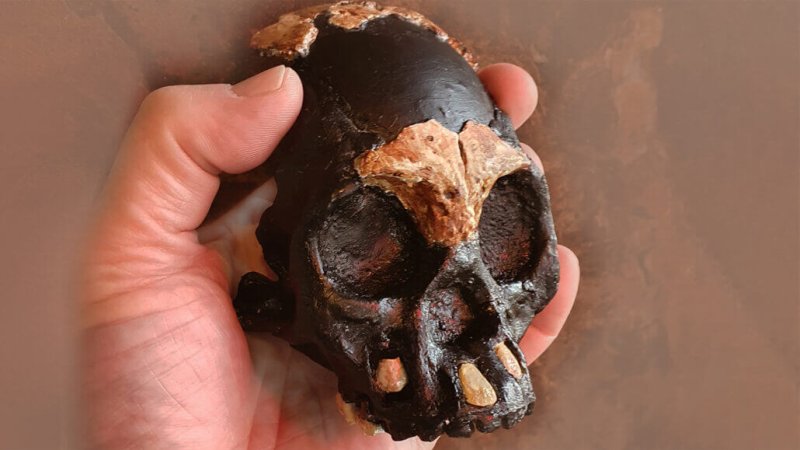
Mystery envelops Homo naledi child skull fragments found in South African cave

This view of the reconstructed skull, held by a human hand, provides a sense of scale. Credit: Science News

Named “Leti,” this is the first known skull belonging to a Homo naledi child—a fossil that’s shedding new light onto this mysterious group of extinct humans.

The skull fragments, all 28 of them, were found in a tight passage measuring just 5.9 inches (15 cm) wide and 31.5 inches (80 cm) long. So narrow was this passage that researchers had to lie flat and perform a “superman crawl” to pull themselves through, the AFP reports.

Mis- and disinformation are distorting science and public policy. Subscribe to our Daily and Weekly Digests for incisive coverage of ‘disruptive’ innovations in AI, agricultural biotechnology, food, chemicals, nuclear energy, vaccines, and other disruptive innovations.

How Leti’s skull ended up on that spot remains a mystery.

“However, there is no visible predator or scavenger damage on any parts of the skull, nor is there any evidence that suggests that the sediments surrounding Leti have been moved by water or other means that may have resulted in the depositing of the skull into this remote location,” [anthropologist Juliet] Brophy told me. “Therefore, we hypothesize that Leti was placed in the passage by another individual.”


The reason for such a particular placement may have something to do with the way ancient peoples treated the dead. Early hominins are known to have placed bodies deep inside of caves, either as some kind of death ritual or to keep them away from animals.


This is an excerpt. Read the original post here.

Related Articles

Infographic: Global regulatory and health research agencies on whether glyphosate causes cancer

Infographic: Global regulatory and health research agencies on whether glyphosate causes cancer

Does glyphosate—the world's most heavily-used herbicide—pose serious harm to humans? Is it carcinogenic? Those issues are of both legal and ...

Most Popular

ChatGPT-Image-Mar-10-2026-01_39_01-PM
Viewpoint—“Miracle molecule” debunked: Why acemannan supplements don’t work
ChatGPT-Image-Sep-17-2026-12_28_43-PM
Vitamin D, omega-3 fish oil and glucosamine supplements could cause brain damage 
ChatGPT-Image-Sep-17-2026-10_17_15-AM
Viewpoint: Why are the less intelligent more likely to be conservative—and smarter people more socially liberal?
Screenshot-2026-09-10-at-12.20.19-PM
'Jet fuel didn't melt the steel': 9/11 conspiracy theories debunked
Eating Nuts Adds up to Longer Life x
For millions with peanut allergies, Nurtured Nuts’ CRISPR gene-edited peanuts could ease the fear of accidental exposure
ChatGPT-Image-Sep-15-2026-12_15_00-PM
Viewpoint: Women, depression and empathy: Explaining the gender gap in views about child-murderer Lindsay Clancy
glp menu logo outlined

Get news on human & agricultural genetics and biotechnology delivered to your inbox.