Does the absence of agricultural biotechnology lead to a greener world? Would widespread adoption of organic practices provide enough food to feed a fast-growing global population?
The questions surrounding production techniques are ongoing. What’s best to feed the most people, safely and sustainably, and what do consumers want to buy?
It’s a polarizing subject, with both sides having strong opinions on what’s better for the globe’s growing population and the planet itself.
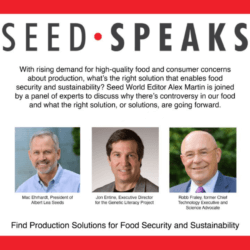
Seed Speaks recently spoke with experts Dr. Robb Fraley, Jon Entine and Mac Ehrhardt. Each discussed how GMOs and organic agriculture can come together to support the industry and improve global agriculture.
“We’re starting to see opportunities for connectivity,” says Fraley, former chief technology officer of Monsanto. “I’ve talked to farmers who are a conventional farmer on one side of their farm and on the other they’re meeting market needs through organic production. There’s common ground that brings them together.”
Consumer drivers
When it comes to consumer trends, Ehrhardt, president of Albert Lea Seeds in Minn., says his company made a switch in 2017 to primarily organic and non-GMO seeds. He says this was the fastest growing part of his business.

“We had exactly one customer our first year selling organic seed, but now, it makes up roughly half our business,” he says. “According to Mercaris [an organic and non-GMO data service], there will be around 9.3 million harvested organic acres in 2021 in the U.S., and that represents only about 1% of the harvest acres in the U.S. So, that’s a tiny sliver of U.S. ag in terms of acres, but it’s really punching above its weight in the grocery store.”
Sales of organic products in the U.S. topped $62 billion in 2020 and 90% of those sales were food.
“Organic is what people tend to buy when they have a choice,” he says.
Organic seed sales, however, aren’t on the aggressive upward path you might expect, Ehrhardt adds. USDA allows organic farmers to plant non-GMO, untreated seed in addition to certified organic, curtailing some growth.
“Many organic farmers still choose to do that,” he says. “We estimate there’s around half a million acres of organic corn in the U.S., and roughly 250,00 of those acres are probably planted with conventional, untreated seed.”
Dispelling the GMO misconceptions
When it comes to uncertainty about GMOs, Entine, executive director of the Genetic Literacy Project, noted that discussions over the sustainable direction of agriculture have become divided, much like the rest of our society.




“The organic movement has been absolutely essential to reforming many outdated and unsustainable practices in agriculture, particularly as it comes to focusing on soil health, but it also has become a lifestyle and advocacy area,” Entine says. “Many organic promoters demonize conventional agriculture, particularly genetically modified crops, and the coming generation of gene edited crops, even though the sustainability benefits of the biotech farming revolution are considerable.”
When it comes to dispelling the misconceptions, Entine says education is imperative.
“We’re promoting [new technology such as GMO and gene editing] through education and fighting against disinformation by promoting dialogue,” he says.
The biggest issue with GMOs? Consumer perception.
“There’s two issues — the first being public perception and the second being science,” Entine says. “There’s this huge misconception by the public that they’re doing something good from an environmental point of view by buying organic food. It’s really an advertising advantage and a marketing advantage, but the focus on sustainable choices are much more nuanced and complex.”
Coming together
While there’s a lot to do to change the public perspective of both GMOs and organic agriculture, the experts agree, there is a way to come together, acknowledge the differences and refocus on what are the most sustainable choices regardless of how the seeds are produced.
“The real strength of U.S. agriculture is that we have a lot of diverse production systems and a lot of diverse crops,” says Fraley. “One thing we should celebrate as aa real success is during the entire COVID experience. We had ample food supply in this country. We need to celebrate the importance of a strong domestic production system.”
And as for the future? Fraley wants to see how gene editing could play into organic agriculture.
“I think gene editing could be a bridge point to really consider how these advance biology tools help breeders make decisions,” he says. “Those are benefits that could benefit both the organic production system and a conventional system. I see opportunities for the world to come together.”
Alex Martin is a writer for European Seed.
A version of this article was originally posted at European Seed and is reposted here with permission. European Seed can be found on Twitter @EuropeanSeed