The social history of the concept of the mixed-race mestizo

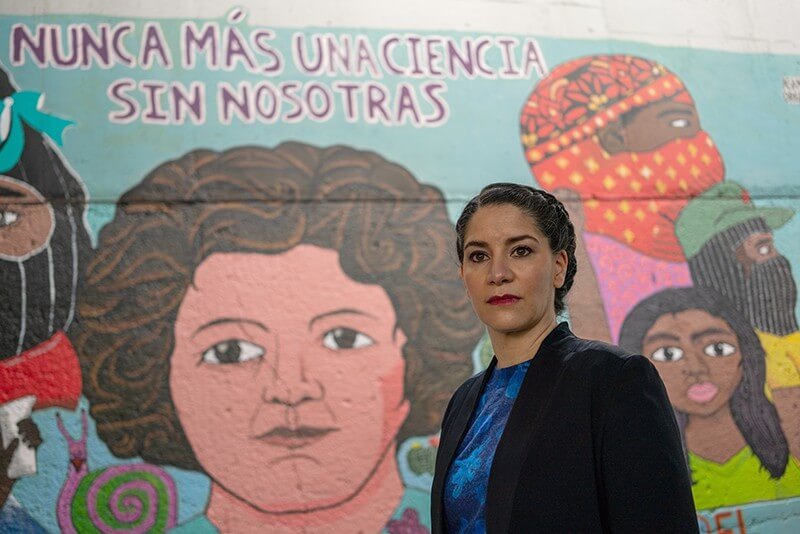
Vivette García Deister is an ethnographer of science at UNAM. The mural says “Never again a science without us” in Spanish. Credit: Stephania Corpi Arnaud for Nature

In Mexico [most people] think of themselves as mestizos, a term that emerged during the colonial period to explain the blend of ethnicities — especially between Indigenous peoples and the Spanish colonizers.

The process of fusion, referred to as mestizaje, has been so intense that a lot of Mexicans say it no longer makes sense to talk about race or racism. The idea of a post-racial society drew important support from early genetic research in the twentieth century and modern human genomic studies, which show that most humans come from a mix of different ancestries.

This unifying vision took hold across Latin America, shaping public policies and conceptions about race. 

But like all other race-based labels, the mestizo is a social construct, not a well-defined scientific category of people who share similar genetic characteristics.


Follow the latest news and policy debates on sustainable agriculture, biomedicine, and other ‘disruptive’ innovations. Subscribe to our newsletter.

Some call for banishing the mestizo label in human genetics and adopting much more specific terms not connected with colonial concepts. Others say that the mestizo idea is not as problematic as critics argue.

One thing is clear, says Vivette García Deister, an ethnographer of science at UNAM, who has studied how mestizo ideology has influenced genetic studies in Mexico. “There’s no easy solution.”


This is an excerpt. Read the original post here. 

{{ reviewsTotal }}{{ options.labels.singularReviewCountLabel }}
{{ reviewsTotal }}{{ options.labels.pluralReviewCountLabel }}
{{ options.labels.newReviewButton }}
{{ userData.canReview.message }}

Related Articles

Infographic: Global regulatory and health research agencies on whether glyphosate causes cancer

Infographic: Global regulatory and health research agencies on whether glyphosate causes cancer

Does glyphosate—the world's most heavily-used herbicide—pose serious harm to humans? Is it carcinogenic? Those issues are of both legal and ...

Most Popular

Screenshot-2026-04-23-at-11.00.36-AM
Regulators' dilemma: Thalidomide, Metformin, and the cost of getting drug approvals wrong
Picture1-5
Science Disinformation Gap: The transatlantic battle over social media and censorship
ChatGPT-Image-May-13-2026-11_56_08-AM
After slashing global health aid by $19 Billion, Trump moves to tap $2.1 billion more—to cover shutdown costs
ChatGPT-Image-May-12-2026-08_39_41-PM
GLP podcast: Big Pharma, Big Ag, Big Food—health harming industries or life-saving innovators?
Screenshot-2026-02-20-at-10.48.04-AM
Deepfakes raise profound ethical questions in science
Picture1-1
Cooling the planet with balloons: Could a geoengineering gamble slow global warming?
ChatGPT Image May 10, 2026, 08_16_59 PM 2
Overmedicalization? RFK Jr.’s antidepressant crackdown raises conflict questions over his fee stake in Wisner Baum, the tort firm built on suing drug makers
Screenshot-2026-05-01-at-1.29.41-PM
Viewpoint: What happens when whole grains meet modern food manufacturing? Labels don’t tell the whole story.
ChatGPT-Image-Apr-13-2026-02_20_22-PM
Viewpoint: Misinformation infodemic? Why assessing evidence is so challenging 
S
As vaccine rejectionism spreads, measles may be taking a more dangerous turn
Screenshot-2026-05-12-at-9.58.31-PM
'He seems fine': Marty Makary out as FDA commissioner
glp menu logo outlined

Get news on human & agricultural genetics and biotechnology delivered to your inbox.