Rothamsted scientists have engineered a plant to produce a range of vital chemicals used in the manufacture of common everyday items, the majority of which are usually obtained from fossil fuels.
The class of chemicals – a group of molecules called 4-VPs (vinyl phenols) – are widely used in the manufacture of products such as food and make up – and even includes a plastic used in television and mobile phone screens.
The breakthrough came when researchers altered a metabolic pathway in the oilseed plant camelina and diverted it to make derivatives of these potentially useful products instead.
This is the first time this has been achieved in plants, and the crop has already been tested successfully in the field – a vital step in producing the volume of chemicals needed by manufacturers.
Using crops to produce the raw materials for industry could reduce our reliance on petrochemicals, which would help the move to net zero, says the study’s lead author, Dr Guillaume Menard.
“It’s amazing just how many everyday products are made from, or contain, chemicals extracted from crude oil and its derivatives. We all know the issues around the continued extraction and use of fossil fuels, but turning camelina plants into ‘green factories’ to make substitutes for these petrochemical compounds is a great sustainable alternative.”
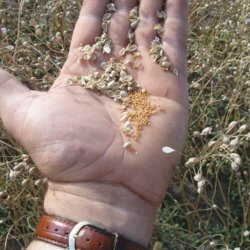
Camelina is an emerging oilseed crop that is increasingly being used to produce a range of speciality food and non-food products in Europe and North America.
Writing in the journal Metabolic Engineering, the researchers explain how they inserted a gene into the camelina plants so they expressed a tailored bacterial enzyme in the developing seed.
This redirected the plant’s usual metabolic pathways so rather than producing sinapine from the chemical, hydroxycinammic acid, they instead produced the 4-VP molecules, either in a free form or attached to plant sugars.



4-VP molecules have a whole range of applications within industry, with most of them being commonly used flavour and aroma compounds for food and cosmetic products.
One of them, 4-vinly guaiacol has a clove like taste and aroma, whilst 4-vinylsyringol – also known as Canolol – can be used as a food preservative.
4-vinyl phenol is used to make PVP, or polyvinylphenol, a plastic which is an integral part of most modern LCD screens. Such TFT (thin film transistor) screens display sharper and brighter images, and process movement more smoothly, than standard LCD screens.
The team were impressed by the accumulation of these 4-VP derivatives, with the bacterial gene driving a 95% reduction in sinapine content in seeds of both glasshouse and field-grown camelina.
The quantity of 4-VP derivatives produced was more than twice that of sinapine in wild type seeds, said the research team’s leader, Professor Peter Eastmond.
“This is a great start, but the ultimate goal is to get the plants to manufacture all the 4-VP molecules in their industrially useful free form.
“We anticipate that step may be doable with more conventional breeding methods.”