Rachel Baxter uses many of the usual tools of athleticism when she gets ready for a pole vaulting competition: track shoes, spandex shorts, and a 14-foot fiberglass Essx pole that enables her to push an incredible amount of torque and tension through her joints and ligaments to hurl her body through the air.
But the graduate student is equipped with something a bit more unusual.
An ankle monitor captures her every move, collecting data on her speed and timing as she sprints to the target. This information not only helps her perfect the number of strides before the jump, but also helps her in the lab.
Baxter, a Virginia Tech pole vaulter, is working with Jay Williams, a professor of human nutrition, foods, and exercise, to study gait symmetry, impact forces, and speed differences among pole vaulters.
Baxter is one of a handful of Virginia Tech athletes who are both pursuing the science of sport in the lab and earning kudos on the field. This year, Baxter became the first pole vaulter to win a national title at Virginia Tech.
To conduct Baxter’s graduate research, a group of pole vaulters – eight women and five men – wear ankle monitors with special speed trap sensors. To test the data collection, Baxter uses the sensors on herself, but that data is not used in the research.
“I was curious about what the data would show from me in practice and meets. I’ve been able to see how I progress, what the data looks like on good jumps, and where I came up short,” said Baxter, of Orange County, California. “Dr. Williams wanted to expand his sports science research to track and field. He’s been fantastic to work with on this project so far.”
At the first meet of the season, Baxter’s marks were mostly the same — she hit the same run times with the same number of steps. With this data, she can make sure she optimizes her steps and her speed to get the highest possible clear.
“Our goal is to use the data on these variables and combine it with the athletes’ results to help pole vault athletes maximize their potential,” Baxter said. “I’m excited to see where this research goes as we get the project fully up and running.”
Elsewhere on the field is Becca Mammel, a Ph.D. candidate in the Department of Human Nutrition, Foods, and Exercise who connects athletics with genetics to strengthen the human body. Mammel competes in the hammer throw and discus and recently chose Virginia Tech through the transfer portal.

When she first arrived in Blacksburg, Mammel worked with Williams by strapping sensors to her wrist, back, and feet to check her acceleration and foot placement on throws that pushed her joints to the limit.

Portions of her research helped Mammel make tiny adjustments to her throwing style, such as placing her foot down faster to maximize her potential. While she is still working with Williams on this research, Mammel had the realization that she is a lab scientist at heart. The Tecumseh, Michigan, native now works with Siobhan Craige, an assistant professor in the Department of Human Nutrition, Foods, and Exercise.
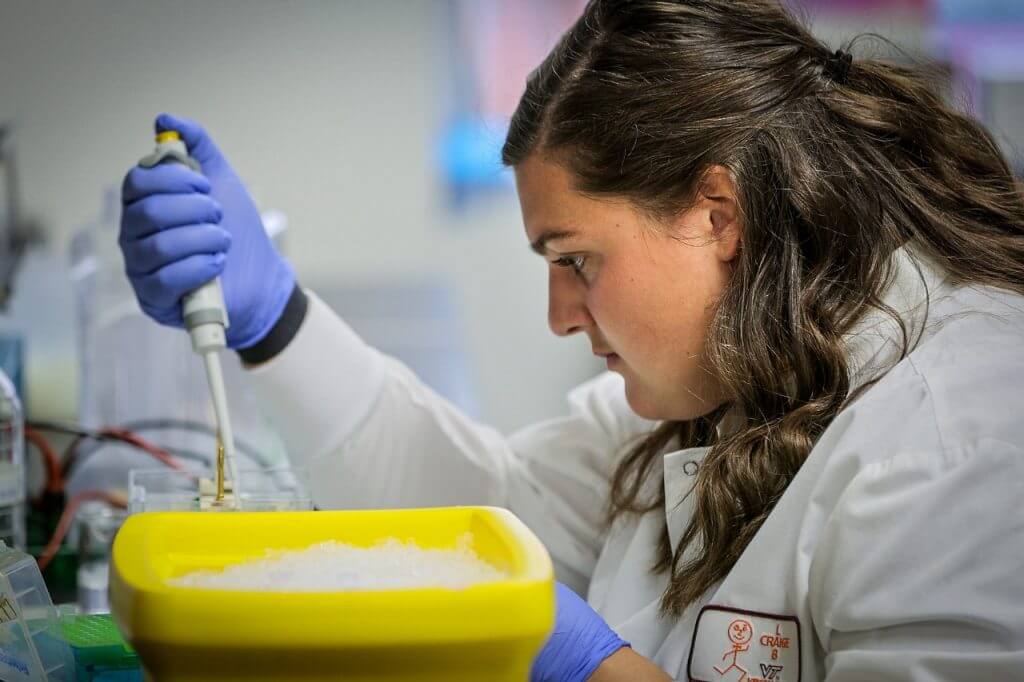
In the Craige Lab, they study how the skeletal muscle adapts to exercise as many of these adaptations to exercise are protective against diseases, furthering the science of sport.
Mammel’s initial projects include working with a senior graduate student identifying pathways that are activated immediately after a bout of acute endurance-type exercise. They are investigating mitochondrial metabolism. Mitochondria, the powerhouses of the cell, have a massive impact on metabolism. Her project has identified a specific protein that increases the production of signaling molecules called reactive oxygen species.
These signaling molecules are required for some of the mitochondrial adaptive responses to exercise. In particular, Mammel has been helping Craige identify the molecular mechanisms that drive improved mitochondrial metabolism with exercise.
In the future, Mammel is interested in looking at how the different cell types in the skeletal muscle communicate with each other, and she plans to look at how the vascular cells communicate with the skeletal muscle cells in both endurance-type exercise and resistance-type exercise.
“In practice, I want to get faster, more explosive, and improve my technique. The main way to do that is to improve my fitness and get stronger. How do I become a stronger athlete? By building more muscle mass and learning how to move my body better. In my research, I work for the same thing but from a different perspective,” Mammel said.
Instead of blindly lifting in the weight room or running, Mammel takes a more scientific approach to working out by looking at skeletal muscle, how it grows, adapts, and what happens when the related pathways change.
“As my knowledge in science is growing, I am starting to change the way I look at working out,” Mammel said. “I’ve learned our bodies have different systems that are active when doing different exercises, and it’s important to know which you are training. As a thrower, I need my muscles to be explosive, a high-intensity short-duration activity. I should train my ATP-CP system — my explosive system — and not my oxidative, slow system,” Mammel said.