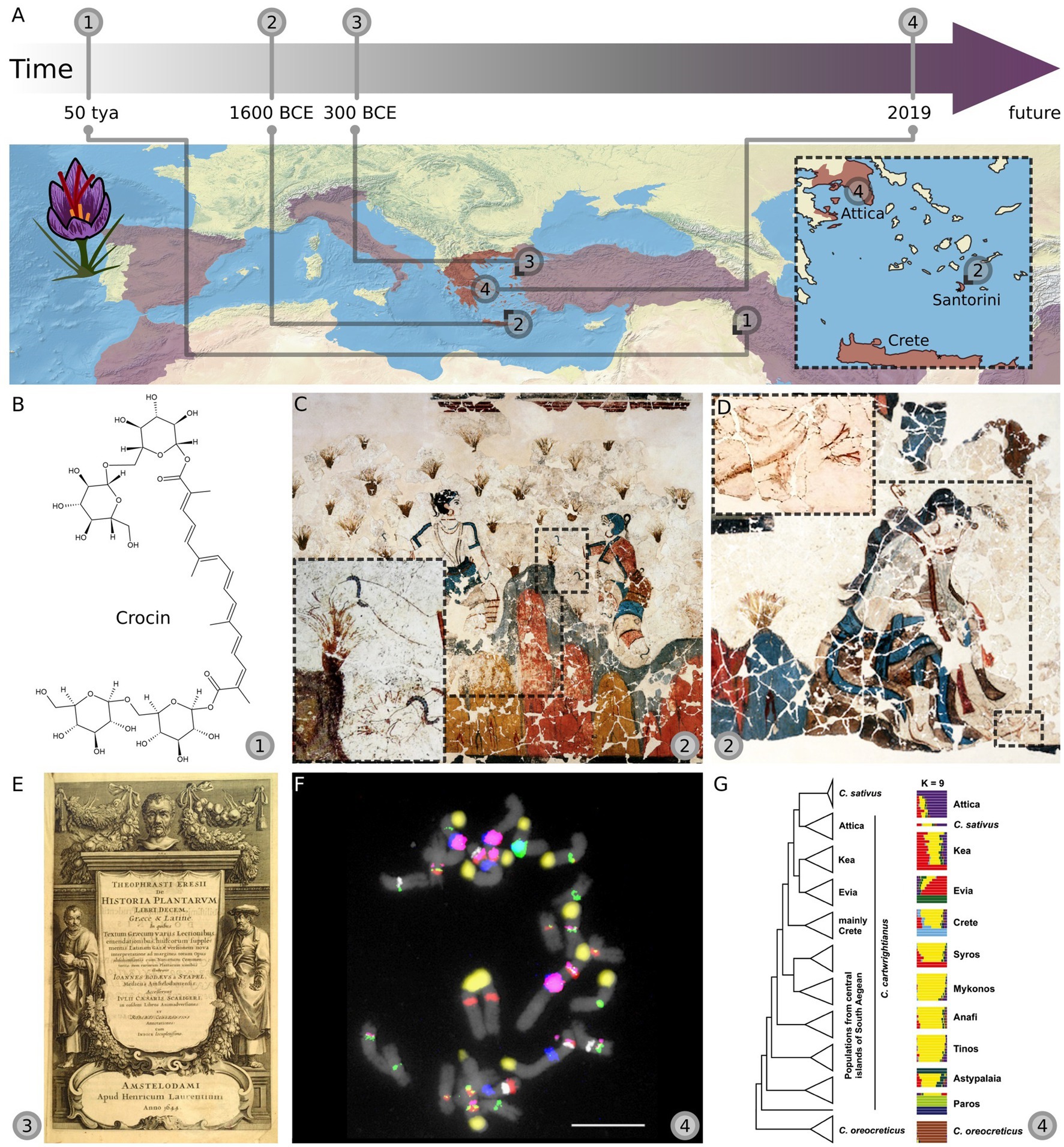
Saffron, the world’s most expensive spice, is extracted from the flowers of the saffron crocus, Crocus sativus. It has been grown for thousands of years in the Mediterranean region. But when and where was saffron first domesticated by our ancestors? In a review in Frontiers in Plant Science, researchers conclude that lines of evidence from ancient art and genetics converge on the same region.
“Both ancient artworks and genetics point to Bronze Age Greece, in approximately 1700 BCE or earlier, as the origin of saffron’s domestication,” said Ludwig Mann, one of the leading authors and a PhD student at Technische Universität Dresden, Germany.
The authors argue that artworks from the Minoan civilization of ancient Greece are likely the oldest to depict domesticated saffron. For example, the dense patches of crocus flowers on the fresco ‘The Saffron Gatherers’ from the island of Santorini (approximately 1600 BCE) suggest cultivation. Another fresco on the same island, ‘The Adorants’, shows flowers with long, dark-red stigmas which overtop dark violet petals, typical of domesticated saffron.
…



An origin in Bronze Age Greece agrees with results from genetic studies from 2019, which showed that C. cartwrightianus, which only occurs in mainland Greece and Crete, is saffron’s closest wild relative.