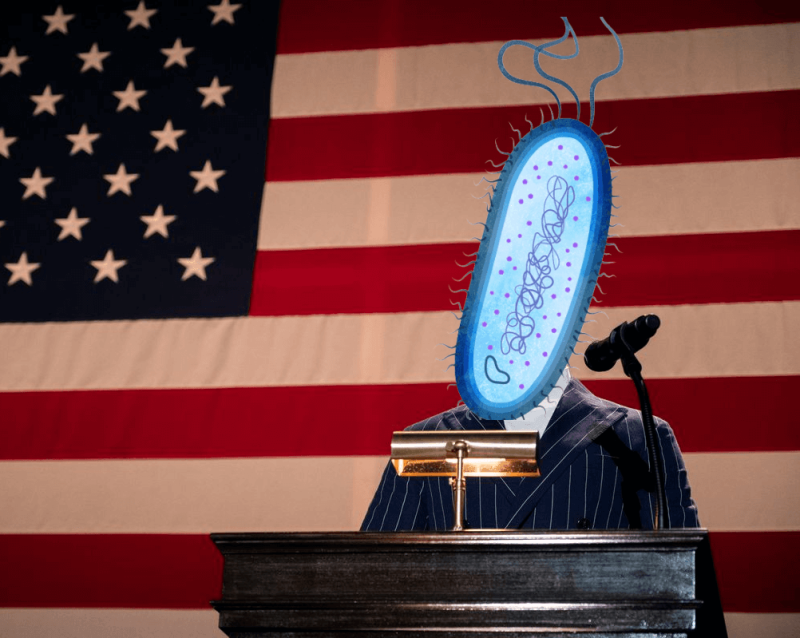
I’ve long noted fundamental similarities between bacteria and politicians. It might seem an odd comparison, but both groups are highly opportunistic and will do almost anything to survive.
Bacteria are amazingly adept at survival. If you cultivate them in growth medium with modest amounts of an antibiotic and examine the genetics of the ones that aren’t killed, you find mutations of various kinds. For example, some will cause the bacterial cell wall to become impermeable to the drug, or that make the intracellular target resistant to it, or that rapidly metabolize and get rid of the drug. Radical genetic changes enable bacteria called extremophiles to adapt to hostile environments, such as in conditions of extreme temperature, acidity, alkalinity, high pressure, or the absence of oxygen.
Likewise, politicians adapt to circumstances. Although many are sincere and can be consistent in their viewpoints, at least as many pander, reverse positions, make promises they have no intention of keeping, and sometimes implement policies that their constituents want but that are unwise or even injurious. Welcome to the COVID-19 pandemic.
Whitewashing COVID infections?
A startling example of trying to put lipstick on a pig and claim victory is the Biden administration giving up on sound scientific responses to the still-persisting pandemic. As revealed in investigative reporting by Rachel Levy of Politico, in recent months administration officials privately discussed how many daily COVID-19 deaths would be acceptable to the public in order “to declare the virus tamed.” According to Levy:
One of the three people involved in the conversations last year said it was an effort to gauge what the American public would “tolerate.”
“Five hundred [deaths] a day is a lot. You still have 9/11 numbers in a week,” the person said. “People generally felt like 100 [a day] or less, or maybe 200, would be OK.”
With fewer than 200 people dead per day, the person added, hospitals wouldn’t be overrun and infection rates would be comparatively low, allowing Americans to live closer to pre-pandemic times with less threat of infection.
“When you spread 100 to 200 [deaths] around the country, then it’s minimal around your [geographic] area,” the person said.
In the end, it looks as though the administration political operatives settled on a higher number. In spite of worsening COVID numbers caused by the highly transmissible Omicron BA.5 subvariant, the federal government has been largely Missing in Action for weeks.
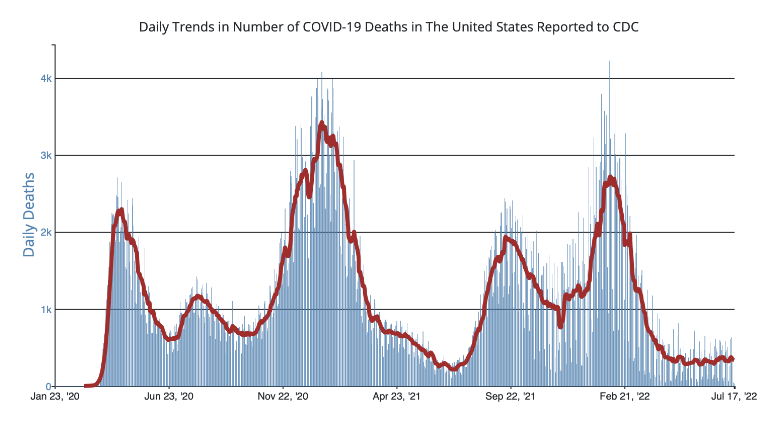
As of July 17th, according to the CDC, the 7-day moving average number of deaths was 336. COVID-19 hospitalizations have been increasing steadily for the past two months. Sixty-five percent of all new infections are the new variant. And the agency said that most of the country was reporting moderate to high SARS-CoV-2 levels in wastewater. Around 42% of sites were seeing some of the highest levels for those sites since December 2021.
Are we at a new peak for this variant? The number of U.S. cases of COVID-19 is difficult to estimate because, as the Washington Post has noted:
The size of [the current BA.5] wave is unclear because most people are testing at home or not testing at all. The Centers for Disease Control and Prevention in the past week has reported a little more than 100,000 new cases a day on average. But infectious-disease experts know that wildly underestimates the true number, which may be as many as a million, said Eric Topol, a professor at Scripps Research who closely tracks pandemic trends.
Topol’s speculation suggests the possible impact of a major complication of COVID infection: long COVID, or “post-COVID conditions,” the persistence for weeks, months, or years of post-infection symptoms that can affect many organs and be extremely debilitating. The numbers are difficult to pin down, because of inconsistencies in definition and reporting, but here is the CDC’s most recent statement:
Estimates of the proportion of people who had COVID-19 that go on to experience post-COVID conditions can vary:
- 13.3% at one month or longer after infection
- 2.5% at three months or longer, based on self-reporting
- More than 30% at 6 months among patients who were hospitalized
If Topol’s speculation is even close to correct, we could be seeing tens of thousands of new cases of long COVID every day, which would be catastrophic, not only for individuals but also, long-term, for businesses (because of absenteeism) and our healthcare system.
A physician who is a senior executive for one of the nation’s largest healthcare insurers told me that they are seeing claims for COVID-infected patients who need long-term support on ECMO (extracorporeal membrane oxygenation), an apparatus similar to an operating room heart-lung machine, whose hospital bills run into the tens of millions of dollars.

The inescapable conclusion is that we need to redouble our efforts to prevent COVID infections, not decide arbitrarily on metrics to pretend that the threat of the pandemic is over and it’s time to “move on.”
The measures should include:
- Mask and vaccine mandates (including boosters) for airports, flights, public transportation, and indoor public events at which large numbers of people are congregating
- Realistic, science-based quarantine and isolation recommendations — five days isolation after onset of symptoms is not sufficient for many patients
- The CDC’s definition of “fully vaccinated” should include two boosters for everyone over the age of five years
- An aggressive public-private effort to improve ventilation in buildings
- Frequent, strategic testing (e.g., before boarding planes or cruise ships or attending events at which crowds will congregate indoors)
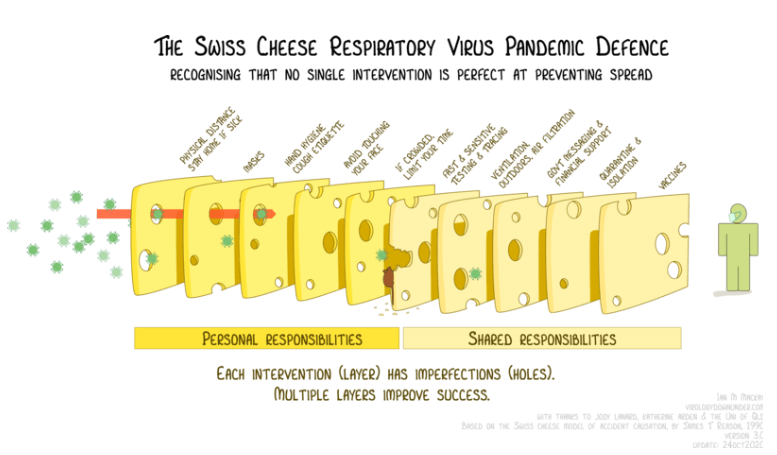
- Public Service Announcements by public health officials, politicians, and celebrities, all emphasizing the importance of the “Swiss Cheese Model of Prevention,” a graphic illustration of what can and should be done recognizing that no single intervention is sufficient to preventing spreading infections (below).
As George Washington University medical school Professor of Medicine and Surgery Jonathan Reiner tweeted on July 16th:
97% of the US now has high or substantial transmission. I doubt there’s ever been this much COVID blanketing the entire country during the pandemic. Still no push for any mitigation. This is what capitulation looks like.
(And keep in mind that every infection involves more virus replication, more mutants, and the opportunity for Darwinian evolution to select for new, more “fit” and more worrisome variants of concern.)
Dr. Lucky Tran, science communicator at Columbia University Medical Center, was more pointed, tweeting to CDC Director Rochelle Walensky on July 14th:
If you are serious about preventing more death and disability, why are you not pushing for a comprehensive layered public health strategy that includes strong mask policies?
The answer seems to be that Walensky, White House COVID coordinator Ashish Jha and their political bosses have taken the pulse of the public and refuse to act even though the data suggest quick and decisive intervention is appropriate A recent New York Times poll of registered voters found that fewer than 1 percent placed the pandemic as their top priority.
In the face of widespread pandemic fatigue, it seems that Walensky, Jha, and presidential advisor Dr. Anthony Fauci, who surely know better, have decided not to impose unpopular restrictions or deliver bad news to the public in an election year, but merely to whisper non-binding recommendations.
That is a cynical course of (in)action. Bitter medicine is needed to keep a bad situation from becoming even worse. But, thinking that it will help them survive politically, the bacteria-like politicians have other ideas.
Henry I. Miller is a physician and molecular biologist. He was a Research Associate at the NIH, the founding director of the FDA’s Office of Biotechnology, and a consulting professor at Stanford University’s Institute for International Studies. Find Henry on Twitter @HenryIMiller
Acknowledgment: The author thanks GLP’s Jon Entine for extensive helpful suggestions.