
Why Malthus was wrong
The flaw in this line of logic, which has resulted in Malthus being wrong for over 200 years, is that innovation isn’t factored into the discussions. When writing in 1798, Malthus incorrectly assumed that food production would be capped at existing levels and, as the global population increased, food resources would increase in scarcity leading to starvation, migration and potentially civil strife. This sense of doom is recognizable in much of the current environmental literature and advocacy. Much of the current sense of doom comes not from ignoring innovation, but in openly rejecting the contributions innovation is capable of.
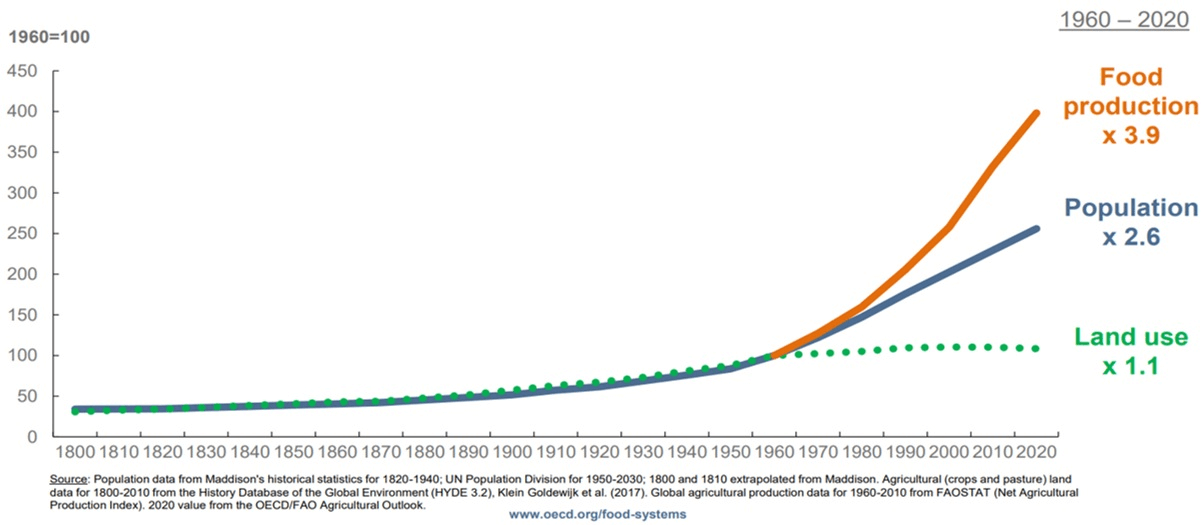
In part, Malthus was wrong due to his lack of awareness of more land being brought into food production, resulting in greater food production. This happened from 1800 to 1960. Beginning at this time, food production became decoupled from land increases due to innovation. As the figure below illustrates, innovations in food production have been tremendously successful.
Agriculture innovation drives solutions
Modern day sentiment pertaining to the open rejection of innovation as part of the solution to improved sustainability, biodiversity and food security was evident at COP-15, which was held in Montreal in December 2022. Meeting room negotiations and hallway conversations echoed with the phrase ‘regenerative agriculture’, which in most instances is a fancy word for organic food production, that rejects all forms of seed genetics, chemical and fertilizer technologies, and innovations.
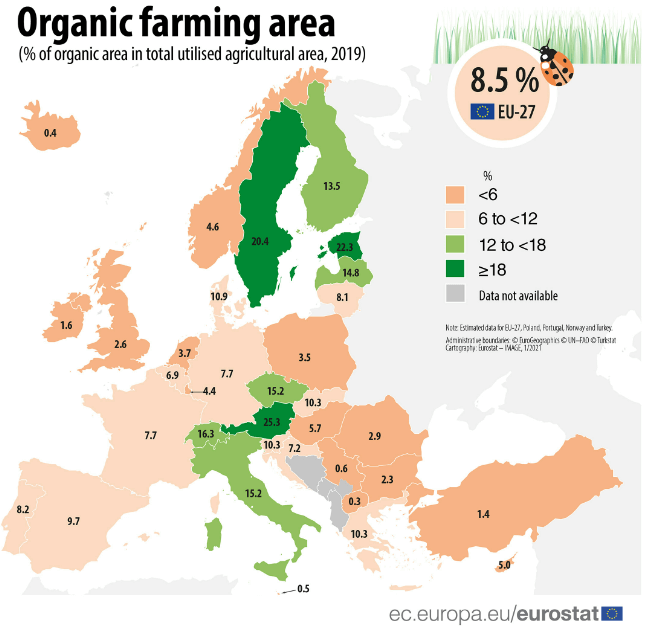
Environmental organizations have successfully lobbied within the European Union, as is evident by the recently launched Field to Fork Strategy, which calls for reduced chemical and fertilizer use and a tripling of organic production. Expert estimates have indicated that enacting this strategy will result in a decrease in food production within the EU of 12-20%. The Dutch government has gone so far as to announce it will put 3,000 farmers out of business, as it has concluded their farms are not environmentally sustainable enough. Many environmental organizations in Europe have already concluded that environmental sustainability takes precedence over economic prosperity or food security.



In addition to banning modern crop inputs, these same environmental organizations call for bans against modern plant breeding technologies that have proven their capability in improving environmental sustainability, improving food security, and financially benefiting farmers. Innovative plant breeding using gene editing, for which the two developers, Emmanuelle Charpentier and Jennifer Doudna, won the Nobel Prize in Chemistry, is demonstrating that plants can be modified to sequester more carbon and yield more. Plants capable of contributing to climate change mitigation and higher yields contribute to environmental sustainability improvements and increased food security. However, virtually all environmental organizations remain firmly opposed to the use of gene editing technologies for food production. This stems from these same organizations opposing the use of genetically modified crops in Europe. Since GM crops were commercialized in 1995, agricultural production has increased by 7% in Europe where GM crops are banned in all but Spain and Portugal; in the USA, where GM crops are widely adopted, it has increased by 38%.
Innovation is fully capable of safely contributing to increased sustainability, as has been widely proven over the past 60 years of increased food production, with only minimal increases in land use. Science, products, and technologies can contribute to improved environmental sustainability, reduced food insecurity, and greater farmer profitability. The question that society needs to ask is not, will you willingly live a less affluent lifestyle, but rather, will you allow innovation to live up to its full potential, free of political interference?
Stuart Smyth is an associate professor at University of Saskatchewan in the College of Agriculture and Bioresources. Stuart is also the Agri-Food Innovation & Sustainability Enhancement Chair at his school and writes about regulations, gene modification and supply chains. You can follow Stuart on Twitter @stuartsmyth66
A version of this article was posted at SAIFood and is used here with permission. You can check out SAIFood on Twitter @SAIFood_blog