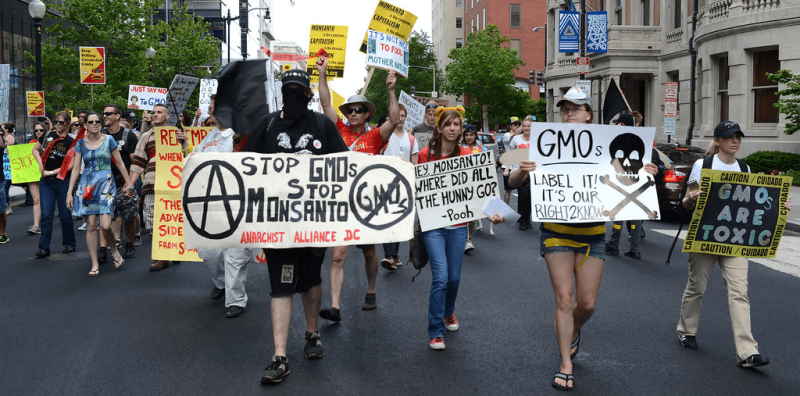
Cost of GMO bans: Global crop assessment finds GMO restrictions limit food production to ⅓ of potential, with poorer countries hit hardest

fedf b
Credit: Stephen Melkisethian/Flickr (CC BY-NC-ND 2.0)

How costly are GM bans? To find out, we calculate by how much yields would have been higher in 2019 had all bans on cultivation been lifted ten years before. The result… shows that GM bans mainly hurt Sub-Saharan Africa. Not only because the region is relatively poor and warm, but also because it grows substantial amounts of cotton and maize. Moreover, Sub-Saharan Africa and other low-income countries have large agricultural sectors, so the cost of GM bans relative to their total economies would be disproportionately larger than in richer countries.

At the global level, we find that cost of GM bans in terms of lost output was about US$69 billion in 2019. As our estimated realized gain was $39 billion, it follows that only one-third of the potential of the currently available GM varieties has been realized. The one-third is an average for the four crops, however. Without bans, the world would have produced 13 percent more cotton, 28 percent more maize, 26 percent more rapeseed, and 4 percent more soybean in 2019.

Follow the latest news and policy debates on sustainable agriculture, biomedicine, and other ‘disruptive’ innovations. Subscribe to our newsletter.

Were Europe to adopt GM crops, emissions could be cut by 33 million tonnes per year, most of which would come from reduced land use. Our results suggest that the scope for reducing emissions this way is even greater in developing countries, where the yield advantage of GM crops is larger. So although valid concerns about their environmental impact remain, our study reinforces the current scientific consensus that GM crops are net positive for the environment.
This is an excerpt. Read the original post here

{{ reviewsTotal }}{{ options.labels.singularReviewCountLabel }}
{{ reviewsTotal }}{{ options.labels.pluralReviewCountLabel }}
{{ options.labels.newReviewButton }}
{{ userData.canReview.message }}

Related Articles

Infographic: Global regulatory and health research agencies on whether glyphosate causes cancer

Infographic: Global regulatory and health research agencies on whether glyphosate causes cancer

Does glyphosate—the world's most heavily-used herbicide—pose serious harm to humans? Is it carcinogenic? Those issues are of both legal and ...

Most Popular

ChatGPT-Image-May-7-2026-12_16_37-PM-2
Viewpoint: Are cancer rates ‘skyrocketing’ as RFK, Jr. and MAHA claims? The evidence says mostly the opposite
Screenshot-2026-04-13-at-1.39.26-PM
Viewpoint: ‘Safer for children?’ Stonyfield yogurt under fire for deceptive organic marketing
Screenshot-2026-04-22-at-10.46.29-AM
Viewpoint: How to counter science disinformation? Science journalist offers 12 practical tips
png-pill-omega-Supp-fish-oil
Millions take omega-3 fish oil for brain health. New research suggests it may do the opposite.
ChatGPT Image May 14, 2026, 09_51_35 PM
Facebook swamped by hundreds of thousands of scam ads for illegal or dangerous medical products
Picture1-5
Science Disinformation Gap: The transatlantic battle over social media and censorship
Screenshot-2026-04-23-at-11.00.36-AM
Regulators' dilemma: Thalidomide, Metformin, and the cost of getting drug approvals wrong
ChatGPT Image May 12, 2026, 01_21_30 PM
How big health brands are funding online medical misinformation 
ChatGPT-Image-May-13-2026-12_43_37-PM-2
Longevity: Is cellular rejuvenation even possible?
glp menu logo outlined

Get news on human & agricultural genetics and biotechnology delivered to your inbox.