Breathing on Mars: AI-powered ‘robot chemist’ could analyze materials on other planets and figure out how to create oxygen

Breathing on Mars: ‘Robot chemist’ powered by artificial intelligence could figure out how to create oxygen on other planets
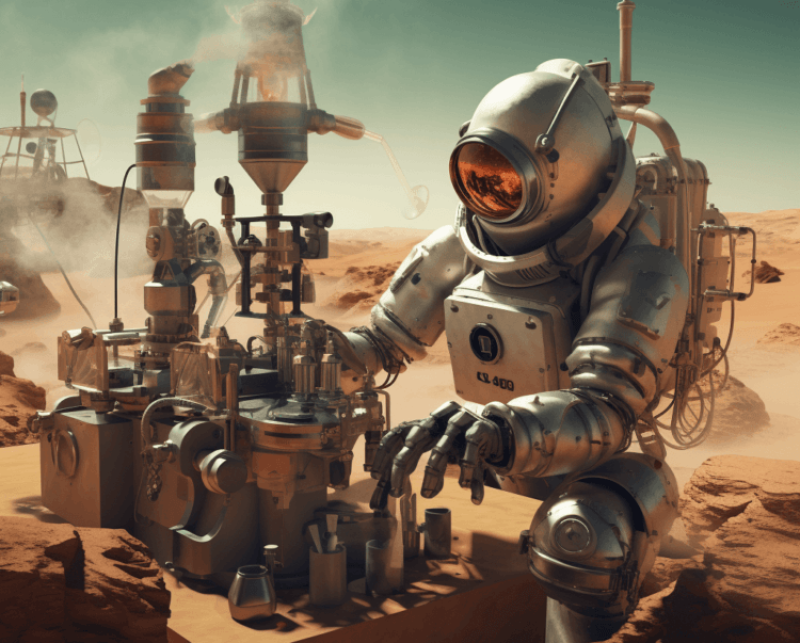
Credit: Midjourney/ Heenan

A robot chemist powered by artificial intelligence could solve the puzzle of providing oxygen to humans on Mars, according to the results of a new study.

The study, published in Nature Synthesis, found that an AI robot could quickly figure out how to cook up vital oxygen for survival compared to humans, who would take a lifetime to complete such a task.

The reason, according to the paper, is there are more than a million potential oxygen evolution reaction (OER) catalysts on Mars, which would give humans too many possibilities to work with when trying to create oxygen. Adding to the problem would be communication with Earth to solve the problems, with transmissions taking as long as 20 minutes to travel between the home planet and Mars.

Mis- and disinformation are distorting science and public policy. Subscribe to our Daily and Weekly Digests for incisive coverage of ‘disruptive’ innovations in AI, agricultural biotechnology, food, chemicals, nuclear energy, vaccines, and other disruptive innovations.

The study envisions that instead of the lifetime a human would consume with a trial-and-error method, AI robots could solve the puzzle within six weeks.

“Within six weeks, the AI chemist built a predictive model by learning from nearly 30,000 theoretical datasets and 243 experimental datasets,” the study reads.

According to a report in Universe Today, robot chemistry has made continued advances in recent years.


This is an excerpt. Read the full article here

Related Articles

Infographic: Global regulatory and health research agencies on whether glyphosate causes cancer

Infographic: Global regulatory and health research agencies on whether glyphosate causes cancer

Does glyphosate—the world's most heavily-used herbicide—pose serious harm to humans? Is it carcinogenic? Those issues are of both legal and ...

Most Popular

ChatGPT-Image-Mar-10-2026-01_39_01-PM
Viewpoint—“Miracle molecule” debunked: Why acemannan supplements don’t work
Screenshot-2026-09-17-at-1.07.08-PM
'We are dangerously addicted to antidepressants': Should we heed RFK Jr.’s sobering warning?
Woman_Vaping_Electronic_Cigarette_50687233623
Trump administration clears the way for speedy approvals of once-restricted tobacco vapes and pouches
ChatGPT-Image-Sep-25-2026-11_36_56-AM
Now AI almost started a war with China
ChatGPT-Image-Sep-2-2026-02_03_32-PM
How much of a problem is AI’s water use?
Screenshot-2026-09-24-at-1.24.47-PM
80% of Americans take (mostly useless) supplements for their health
ChatGPT-Image-Sep-27-2026-10_00_17-AM
Current and future RFK Jr. aides criticize his science-rejectionist vaccine views
ChatGPT-Image-Sep-21-2026-11_54_00-AM
Viewpoint: Activist environmental NGOs are turning from public funding to activist billionaires to support their campaigns. It won’t end well.
Screenshot-2026-09-16-at-10.27.33-AM
Viewpoint: SCOTUS poised to address First Amendment tension between mandatory vaccines, children’s health and religious freedom 
ChatGPT-Image-Sep-23-2026-01_52_03-PM
Viewpoint: 4 very real AI doomsday scenarios
Screenshot-2026-09-16-at-2.26.42-PM
Viewpoint: How to ecologically damage America’s forests: Ban glyphosate
glp menu logo outlined

Get news on human & agricultural genetics and biotechnology delivered to your inbox.