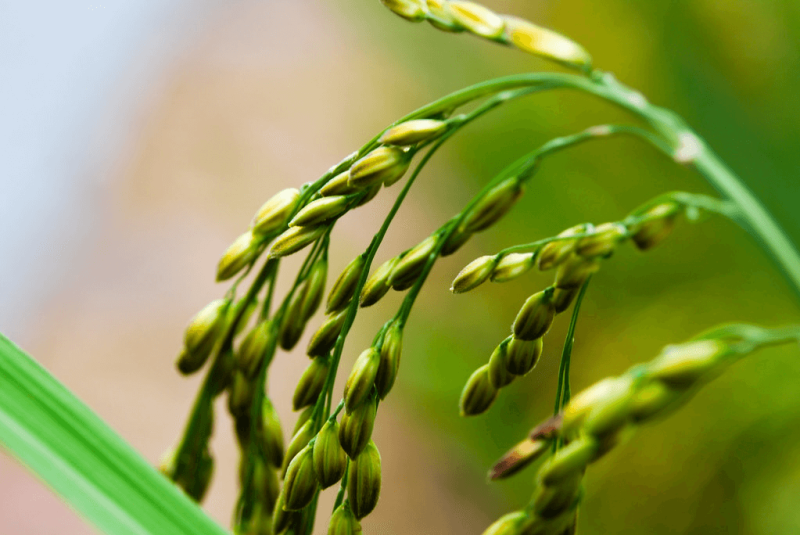
Next breakthrough CRISPR crop? Turning wild rice species into a domesticated crop

dcacae b
Credit: CIFOR/Flickr (CC BY-NC-ND 2.0)
[Jiayang] Li, a plant geneticist at the Institute of Genetics and Developmental Biology in Beijing, is working on a wild rice species from South America called Oryza alta. It produces edible, nutritious grains, but they cannot be harvested because the seeds drop to the ground as soon as they ripen. To tame the plant, Li and his colleagues need to remove this trait, known as seed shattering, and alter a few others.

…

The modification of this rice is one of a growing number of efforts to rapidly domesticate new crops using genome editing. Through this process, known as de novo domestication, transformations that took the world’s early farmers millennia could be achieved in just a handful of years. The work might improve the resilience of the global food supply: many wild relatives of staple crops have useful traits that could prove valuable when climate change puts stress on global agriculture. O. alta, for example, has “very sharp resistance to salt and to drought and to some very severe or very dangerous diseases”, says Li.

Mis- and disinformation are distorting science and public policy. Subscribe to our Daily and Weekly Digests for incisive coverage of ‘disruptive’ innovations in AI, agricultural biotechnology, food, chemicals, nuclear energy, vaccines, and other disruptive innovations.

But the technical challenges of de novo domestication are immense. Most wild plants are understudied, and without an understanding of their fundamental biology it is impossible to domesticate them by rewriting their genomes. Targeted gene editing, using tools such as CRISPR–Cas9, is a powerful approach, but it cannot fully replicate the thousands of mutations that have fine-tuned modern domestic crops for growing and harvest.


This is an excerpt. Read the original post here

Related Articles

Infographic: Global regulatory and health research agencies on whether glyphosate causes cancer

Infographic: Global regulatory and health research agencies on whether glyphosate causes cancer

Does glyphosate—the world's most heavily-used herbicide—pose serious harm to humans? Is it carcinogenic? Those issues are of both legal and ...

Most Popular

ChatGPT-Image-Mar-10-2026-01_39_01-PM
Viewpoint—“Miracle molecule” debunked: Why acemannan supplements don’t work
ChatGPT-Image-Sep-23-2026-02_36_39-PM
Viewpoint: After firing the entire National Science Board, Trump reshapes funding initiatives. Here’s the good and the bad.
generated-1790707585414
Facts & Fallacies podcast: America's health care system is broken. A doctor explains how to fix it
Screenshot-2026-09-17-at-1.07.08-PM
'We are dangerously addicted to antidepressants': Should we heed RFK Jr.’s sobering warning?
ChatGPT-Image-Sep-2-2026-02_03_32-PM
How much of a problem is AI’s water use?
Screenshot-2026-09-29-at-11.06.43-AM
Astrology, homeopathy, vaccine rejectionism, creationism: Why pseudoscience thrives as science advances
Screenshot-2026-09-25-at-9.24.04-AM
What constitutes a measles death? RFK, Jr. maneuvers to restrict definition to make pandemic seem less dire
ChatGPT-Image-Sep-22-2026-11_17_31-AM
The exploding controversy over AI’s built-in survival drive
Screenshot-2026-09-28-at-2.41.21-PM
Viewpoint: 7-OH controversy: An opioid is available over-the-counter–even at gas stations. Should we be concerned?
ChatGPT-Image-Sep-28-2026-11_51_41-AM
Energy-sucking data centers are unpopular across the political spectrum. Could moving them into space change the equation?
ChatGPT-Image-Sep-25-2026-11_36_56-AM
Now AI almost started a war with China
glp menu logo outlined

Get news on human & agricultural genetics and biotechnology delivered to your inbox.