Astrology, homeopathy, vaccine rejectionism, creationism: Why pseudoscience thrives as science advances

Science has never known more, yet pseudoscience keeps gaining ground. Astrology, homeopathy, creationism and vaccine rejectionism all make scientific-sounding claims that don’t hold up to the scientific method. University of Arizona astronomer Chris Impey set out to measure how far one branch of that family has spread, as reported by Chivumnovu Ogbonda for Meer. (Read about specific pseudoscience branches here.) He mined two centuries of Google Books data and two decades of Google Trends searches for a report in CAPjournal, “The truth is out there”: Tracking the rise of pseudoscience.

The stakes go beyond horoscopes. Astrology might seem harmless, Impey notes, “but in the health arena, misinformation and anti-scientific mindsets are dangerous and can be fatal.”

Mis- and disinformation are distorting science and public policy. Subscribe to our Daily and Weekly Digests for incisive coverage of ‘disruptive’ innovations in AI, agricultural biotechnology, food, chemicals, nuclear energy, vaccines, and other disruptive innovations.

His astronomy data tell a lopsided story. Use of the word “astronomy” in books peaked in 1964 and has since fallen 40%, while “astrology” has tripled since a low in 1916. In 2004, U.S. searches for astrology were twice as common as searches for astronomy. By early 2022, they were five times as common, and horoscope searches outnumbered astronomy 15 to one.

Real discoveries haven’t slowed the spread of pseudoscience. The many Earth-like exoplanets being discovered make intelligent alien life statistically likely, yet UFO sightings hit an all-time peak of 1,050 in April 2020, after the Pentagon released three Navy videos. Book references to angels and ghosts have more than quadrupled in 40 years. Since 2004, web searches for both have tripled relative to searches for science.
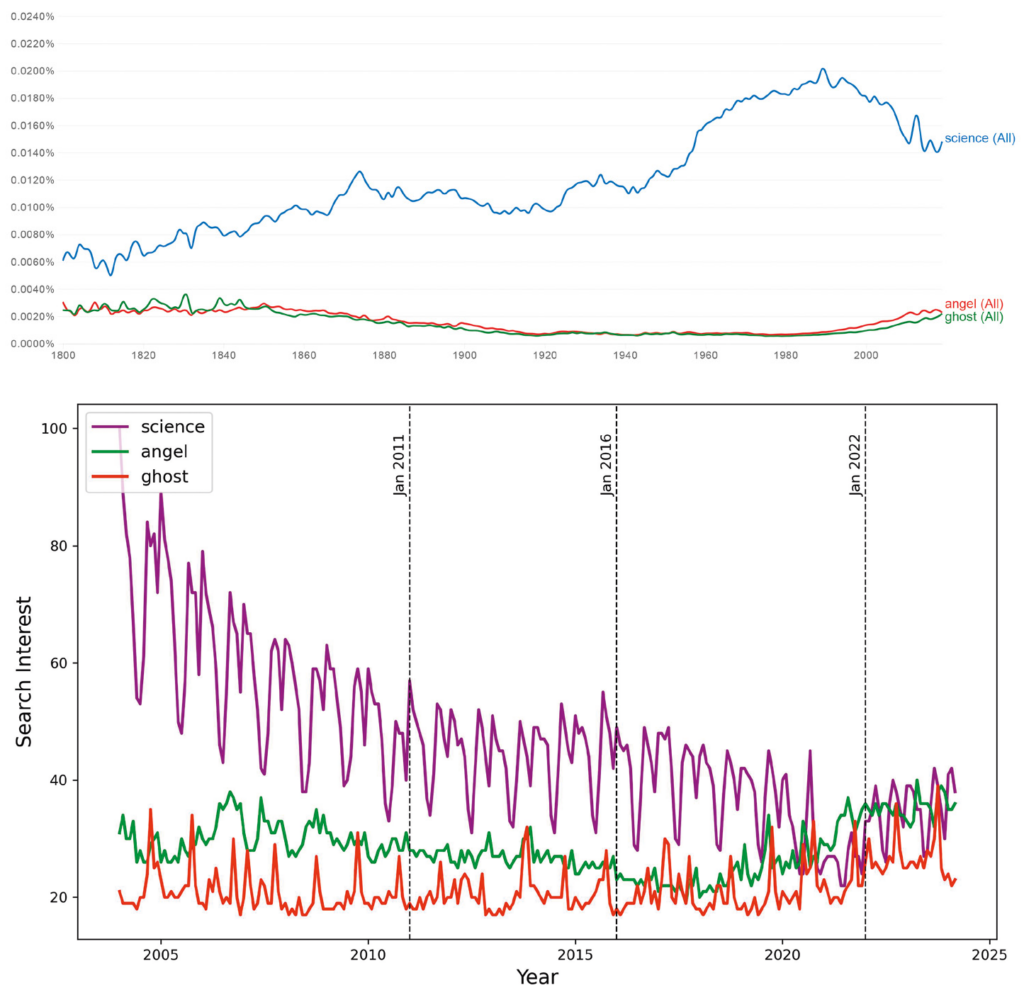
Top: The relative occurrence of the words science (blue), ghost (green), and angel (red) in Google Books shows a strong rise for ghost and angel in the past forty years. Bottom: The relative occurrence of the search terms science (purple), ghost (red), and angel (green) in Google Trends data. Dates with dashed vertical lines correspond to improvements in Google search methodology. Image Credit: Google

Part of the explanation is where people now get their information. The share of people turning to unvetted corners of the internet rather than reputable sources jumped from 9% in 2001 to 57% in 2018. “Educators and science communicators must operate in a world where they are not the gatekeepers of information,” Impey writes.

He calls book mentions and searches “imperfect proxies for interest and belief,” but sees a broader shift: “The rise in pseudoscience tracked in this paper has been accompanied by a more general decline in rationality in language.”


Read the original article here

Related Articles

Infographic: Global regulatory and health research agencies on whether glyphosate causes cancer

Infographic: Global regulatory and health research agencies on whether glyphosate causes cancer

Does glyphosate—the world's most heavily-used herbicide—pose serious harm to humans? Is it carcinogenic? Those issues are of both legal and ...

Most Popular

ChatGPT-Image-Mar-10-2026-01_39_01-PM
Viewpoint—“Miracle molecule” debunked: Why acemannan supplements don’t work
ChatGPT-Image-Sep-30-2026-01_11_07-PM
How U.S. teamed with Russia to block global human AI weapons oversight
ChatGPT-Image-Sep-21-2026-03_15_09-PM
Viewpoint: Chipotle-inspired lesson: 10,000 sick customers suggest that processed foods can be safer than fresh ones
ChatGPT-Image-Sep-29-2026-12_16_42-PM
Social media influencers are driving food misinformation across Europe
Screenshot-2026-09-29-at-11.06.43-AM
Astrology, homeopathy, vaccine rejectionism, creationism: Why pseudoscience thrives as science advances
Screenshot-2026-09-28-at-1.16.38-PM
Defying public perceptions, U.S. cancer deaths plunged 35% since 1991
generated-1790707585414
Facts & Fallacies podcast: America's health care system is broken. A doctor explains how to fix it
ChatGPT-Image-Jun-18-2026-04_15_29-PM
Viewpoint: Kennedy’s ‘bad science’: MAGA embrace bolsters HHS secretary’s influence and popularity
ChatGPT-Image-Sep-23-2026-02_36_39-PM
Viewpoint: After firing the entire National Science Board, Trump reshapes funding initiatives. Here’s the good and the bad.
Screenshot-2026-09-17-at-1.07.08-PM
'We are dangerously addicted to antidepressants': Should we heed RFK Jr.’s sobering warning?
glp menu logo outlined

Get news on human & agricultural genetics and biotechnology delivered to your inbox.