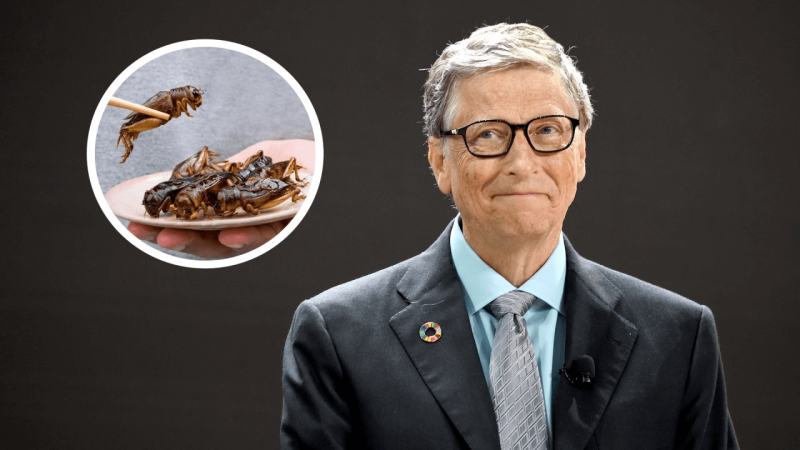
Bill Gates and bug-eating: Conspiracy theory claims billionaire wants to replace cattle industry with insect protein. What’s the truth?

bill gates advised eating crickets
Credit: Newsweek

“Bill Gates wants to get rid of the cattle industry, and have people eat his FAKE MEAT,” writes one commenter, adding, “Bill Gates wants us to eat bugs as well.” It’s a conspiracy theory that has picked up substantial steam in certain corners of the internet. But where did the Bill Gates bug-eating conspiracy come from, and how has the media been used to perpetuate it? In this explainer, we go back to the origins of the story that one of the world’s most famous billionaires wants to feed you insects.

Follow the latest news and policy debates on sustainable agriculture, biomedicine, and other ‘disruptive’ innovations. Subscribe to our newsletter.

Growing concerns about population growth and climate change, coupled with general fears of the new and unknown, all paved the way for cell-based meat and insect protein — and Gates’s involvement in both — to become perpetually intertwined.

[Pratt Institute political science professor Jan] Dutkiewicz tells Sentient Media that he doesn’t think anyone “seriously thinks insect protein can be made a major part of the human diet globally.” It’s just that “bugs are easy to frame as disgusting,” he says, “so this lets the culture warriors suggest ‘elites’ are trying to degrade them by doing this disgusting thing, which just happens to be a non-starter in the first place.”



Ultimately, bug-eating is used as a rhetorical and political tool, and Bill Gates is the straw man.


This is an excerpt. Read the original post here

{{ reviewsTotal }}{{ options.labels.singularReviewCountLabel }}
{{ reviewsTotal }}{{ options.labels.pluralReviewCountLabel }}
{{ options.labels.newReviewButton }}
{{ userData.canReview.message }}

Related Articles

Infographic: Global regulatory and health research agencies on whether glyphosate causes cancer

Infographic: Global regulatory and health research agencies on whether glyphosate causes cancer

Does glyphosate—the world's most heavily-used herbicide—pose serious harm to humans? Is it carcinogenic? Those issues are of both legal and ...

Most Popular

79d03212-2508-45d0-b427-8e9743ff6432
Viewpoint: The Casey Means hustle—Wellness woo opportunism dressed up as medical wisdom
Screenshot-PM-24
Viewpoint: The herbicide glyphosate isn’t perfect. Banning it would be far worse.
ChatGPT-Image-Mar-27-2026-11_27_05-AM
The myths of “process”: What science says about the “dangers’ of synthetic products and ultra-processed foods
Screenshot-2026-04-03-at-11.15.51-AM
Paraben panic: How a flawed study, media hype, and chemophobia convinced the public of the danger of one of the safest classes of preservatives
Screenshot-2026-05-01-at-11.56.24-AM
‘Science moves forward when people are willing to think differently’: Memories of DNA maverick Craig Venter
ChatGPT-Image-Mar-10-2026-01_39_01-PM
Viewpoint—“Miracle molecule” debunked: Why acemannan supplements don’t work
ChatGPT-Image-Mar-3-2026-01_17_14-PM
MAHA wellness influencers deride proven anxiety medications, tout lifestyle fixes
ChatGPT-Image-Apr-30-2026-12_21_05-PM-2
The tech billionaires behind the immortality movement
d-b
Blocked arteries, kidney stones, nausea, constipation, fatigue: Long list of health problems caused by too much vitamin D 
Screenshot-2026-04-30-at-12.49.48-PM
‘Alarming’: Nicotine’s wellness rebranding
glp menu logo outlined

Get news on human & agricultural genetics and biotechnology delivered to your inbox.