USAID’s funding freeze on blight-resistant GM potato research in Ethiopia could have grave consequences

ba e c
Credit: Alliance for Science

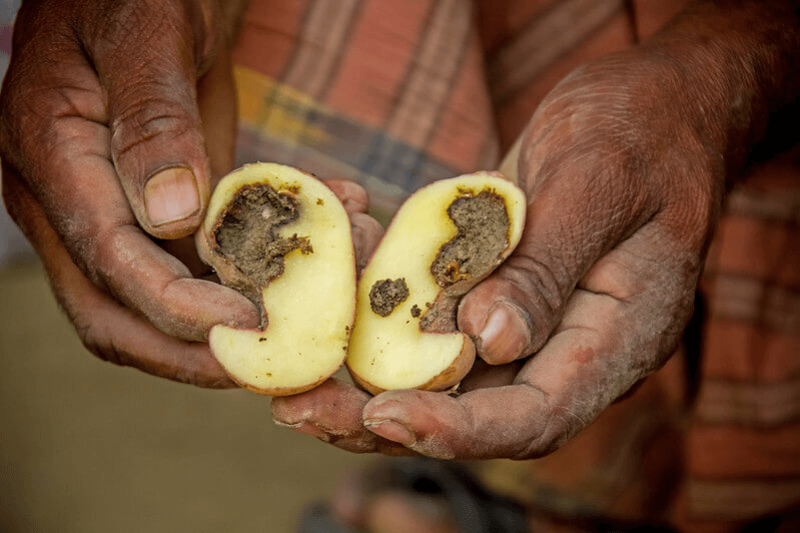
Researchers are left in limbo as they await funding for a genetically modified potato project that lost its financing as part of the US government’s suspension of non-humanitarian aid to Ethiopia.

The National Agricultural Biotechnology Research Center (NABRC) working with researchers at Michigan State University won a USD 13 million grant from the United States Agency for International Development (USAID) for a project in 2021.

The project was intended to create a late-blight resistant potato for agricultural production using genes from a wild species of potato. The genetically modified organism (GMO) project is headed by Tadesse Daba (PhD), country coordinator at Open Forum on Agricultural Biotechnology at NABRC.

The US government announced the suspension of all non-humanitarian aid to Ethiopia in 2021, a few months after fighting began between the Tigray People’s Liberation Front (TPLF) and the federal government.

Follow the latest news and policy debates on sustainable agriculture, biomedicine, and other ‘disruptive’ innovations. Subscribe to our newsletter.

Tadesse warns the potato project cut off could have grave consequences.

“Late-blight could attack all edible species of potato all over the world,” he said. “The devastation to production could be between 70 and 100 percent, which is why grant proposals were submitted from various countries.”


This is an excerpt. Read the original post here

{{ reviewsTotal }}{{ options.labels.singularReviewCountLabel }}
{{ reviewsTotal }}{{ options.labels.pluralReviewCountLabel }}
{{ options.labels.newReviewButton }}
{{ userData.canReview.message }}

Related Articles

Infographic: Global regulatory and health research agencies on whether glyphosate causes cancer

Infographic: Global regulatory and health research agencies on whether glyphosate causes cancer

Does glyphosate—the world's most heavily-used herbicide—pose serious harm to humans? Is it carcinogenic? Those issues are of both legal and ...

Most Popular

ChatGPT-Image-May-7-2026-12_16_37-PM-2
Viewpoint: Are cancer rates ‘skyrocketing’ as RFK, Jr. and MAHA claims? The evidence says mostly the opposite
ChatGPT-Image-May-13-2026-11_56_08-AM
After slashing global health aid by $19 Billion, Trump moves to tap $2.1 billion more—to cover shutdown costs
Screenshot-2026-04-22-at-10.46.29-AM
Viewpoint: How to counter science disinformation? Science journalist offers 12 practical tips
ChatGPT-Image-May-12-2026-08_39_41-PM
GLP podcast: Big Pharma, Big Ag, Big Food—health harming industries or life-saving innovators?
Screenshot-2026-04-23-at-11.00.36-AM
Regulators' dilemma: Thalidomide, Metformin, and the cost of getting drug approvals wrong
png-pill-omega-Supp-fish-oil
Millions take omega-3 fish oil for brain health. New research suggests it may do the opposite.
Screenshot-2026-02-20-at-10.48.04-AM
Deepfakes raise profound ethical questions in science
Picture1-5
Science Disinformation Gap: The transatlantic battle over social media and censorship
Picture1-1
Cooling the planet with balloons: Could a geoengineering gamble slow global warming?
Screenshot-2026-05-08-at-3.40.33-PM
Seeds of power: China turns to genetic engineering to become global superpower
ChatGPT-Image-May-12-2026-01_41_42-PM
Viewpoint: ‘Measles is a canary in the healthcare coal mine’: Challenging RFK, Jr.’s scare campaign
donut-decorated-with-e-food-additives-tablets
RFK, Jr. is targeting chemical food additives. What does science tell us?
Screenshot-2026-05-12-at-10.45.57-AM-2
Viewers of right-wing news sites are double as likely to view MMR vaccines suspiciously
glp menu logo outlined

Get news on human & agricultural genetics and biotechnology delivered to your inbox.