
Highlights
-
Current regulations do not permit GM food be labeled organic or GM content be used in certified organic products.
-
Despite the hype, organic products have remained a niche market which is artificially sustained by the willingness of the rich to pay more and the profit motive of the farmers.
-
Modernizing GM agriculture by AI-based environment-friendly robotics technologies and avoiding synthetic agrochemicals will ensure a ‘greener’ future.
-
Developing biofertilizer-responsive GM crops is imperative, and can be based on selective host-microbe interactions governed by chemotaxis signalling and quorum sensing
-
Novel GM/ GE varieties should be engineered for higher secondary metabolite biosynthesis , and enhanced secretion of useful root exudates (volatile organic compounds, organic enzymes, siderophores, small secreted proteins, and terpenes) for better microbial associations in the rhizosphere.
-
For those who fear ecological damage by GM crops, we should develop ‘trait reversible GM crops’, as it would help build confidence among those vacillating and overly cautious in applying the precautionary principle.
Sustainable farming on ever-shrinking agricultural land and declining water resources for the growing human population is one of the greatest environmental and food security challenges of the 21st century. Conventional, age-old organic farming practices alone, and foods based on costly cellular agriculture, do not have the potential to be upscaled to meet the food supply challenges for feeding large populations. Additionally, agricultural practices relying on chemical inputs have a well-documented detrimental impact on human health and the environment. As the available farming methods have reached their productivity limits, new approaches to agriculture, combining friendly, age-old farming practices with modern technologies that exclude chemical interventions, are necessary to address the food production challenges.
Growing genetically modified (GM) crops without [synthetic] chemical inputs can allow agricultural intensification with reduced adverse health and environmental impacts. Additionally, integrating high-value pleiotropic genes in their genetic improvement coupled with the use of modern agricultural technologies, like robotics and artificial intelligence (AI), will further improve productivity. Such ‘organic-GM’ crops will offer consumers healthy, agrochemical-free GM produce.
We believe these agricultural practices will lead to the beginning of a potentially new [synthetic] chemical-free GM agricultural revolution in the era of Agriculture 4.0 and help meet the targets of the United Nations Sustainable Development Goals (SDGs). Furthermore, given the advancement in the genome editing (GE) toolbox, we ought to develop a new category of ‘trait-reversible GM crops’ to avert the fears of those who believe in ecological damage by GM crops. Thus, in this article, we advocate farming with no or minimal chemical use by combining chemical-free organic farming with the existing biofortified and multiple stress-tolerant GM crops, while focusing on the development of novel ‘biofertilizer-responsive GE crops’ and ‘trait-reversible GE crops’ for the future.
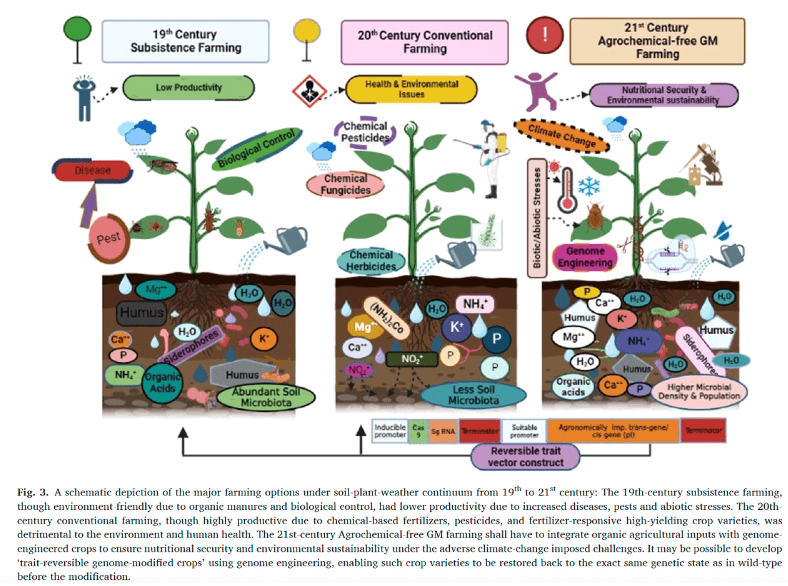



GE crops would be biofertilizer-responsive and suitable for chemical-free agriculture, unlike the earlier chemical fertilizer-responsive varieties of the green revolution. There is a considerable potential of developing such GM crop varieties by expressing genes related to secondary metabolite biosynthesis for enhanced plant defense, and also, genes that can promote beneficial microbial associations in the rhizosphere.
…
This can be achieved by presenting concrete scientific evidence of the benefits of GM produce to the public, quashing the decades-long negative propaganda, and lobbying of lawmakers. Only then would we be able to harness the benefits of a potentially new ‘agrochemical-free GM agricultural revolution’. Undoubtedly, such farming practices will increase productivity, they will also reduce land and air pollution, providing a cleaner and healthier environment for future generations.