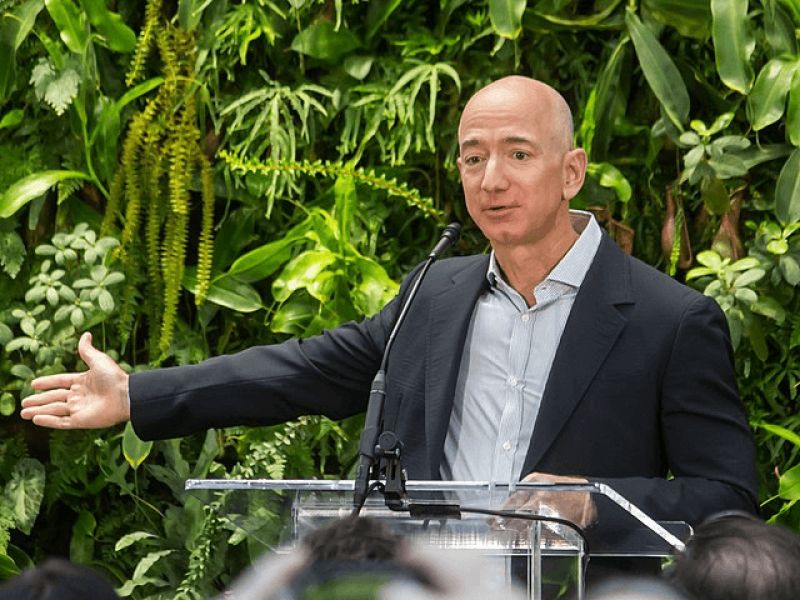
Amazon founder Jeff Bezos invests $30 million in alternative proteins

Credit: Seattle City Counci via CC-BY-2.0

In recent years, billionaires like Bill Gates, Jeff Bezos, Mark Zuckerberg, and others have taken an interest in farmland and food production. Of those, the charity run by Amazon founder and Washington Post owner Bezos’ charity has zeroed in on plant-based and lab-grown meat alternatives.

Most recently, Bezos’ charity awarded North Carolina State University $30 million, to be divided over five years to create a Bezos Center for Sustainable Protein.

In a news release, NC State says that the center will become a “biomanufacturing hub for dietary proteins that are environmentally friendly, healthy, accessible and affordable.”

Follow the latest news and policy debates on sustainable agriculture, biomedicine, and other ‘disruptive’ innovations. Subscribe to our newsletter.

The Research and Development team will focus on innovating the materials used in protein extraction and fermentation. They aim to enhance manufacturing processes for sustainable protein products, making them more efficient and cost-effective using advanced biotechnology and manufacturing methods. Additionally, the team will train faculty and students on innovation, intellectual property, and commercialization strategies, facilitating the transfer of new technologies to the industry.

This isn’t the only facility Bezos hopes to open at universities to improve meat alternative options — in total, Bezos’ philanthropic arm, Bezos Earth Fund says it will donate $60 million to establish research centers. In March, Bezos Earth Fund Vice Chair Lauren Sánchez indicated that the Bezos Centers for Sustainable Protein was just part of the Bezos Earth Fund’s $1 billion commitment to food transformation.


{{ reviewsTotal }}{{ options.labels.singularReviewCountLabel }}
{{ reviewsTotal }}{{ options.labels.pluralReviewCountLabel }}
{{ options.labels.newReviewButton }}
{{ userData.canReview.message }}

Related Articles

Infographic: Global regulatory and health research agencies on whether glyphosate causes cancer

Infographic: Global regulatory and health research agencies on whether glyphosate causes cancer

Does glyphosate—the world's most heavily-used herbicide—pose serious harm to humans? Is it carcinogenic? Those issues are of both legal and ...

Most Popular

d-b
Blocked arteries, kidney stones, nausea, constipation, fatigue: Long list of health problems caused by too much vitamin D 
Screenshot-PM-24
Viewpoint: The herbicide glyphosate isn’t perfect. Banning it would be far worse.
79d03212-2508-45d0-b427-8e9743ff6432
Viewpoint: The Casey Means hustle—Wellness woo opportunism dressed up as medical wisdom
ChatGPT-Image-Mar-27-2026-11_27_05-AM
The myths of “process”: What science says about the “dangers’ of synthetic products and ultra-processed foods
ChatGPT-Image-Apr-30-2026-12_21_05-PM-2
The tech billionaires behind the immortality movement
ChatGPT-Image-Apr-30-2026-05_00_48-PM
Wellness grifter physician turned wellness influencer out as surgeon general nominee
ChatGPT-Image-Mar-10-2026-01_39_01-PM
Viewpoint—“Miracle molecule” debunked: Why acemannan supplements don’t work

Sorry. No data so far.

glp menu logo outlined

Get news on human & agricultural genetics and biotechnology delivered to your inbox.