Podcast:
Podcast: Play in new window | Download
Subscribe: RSS
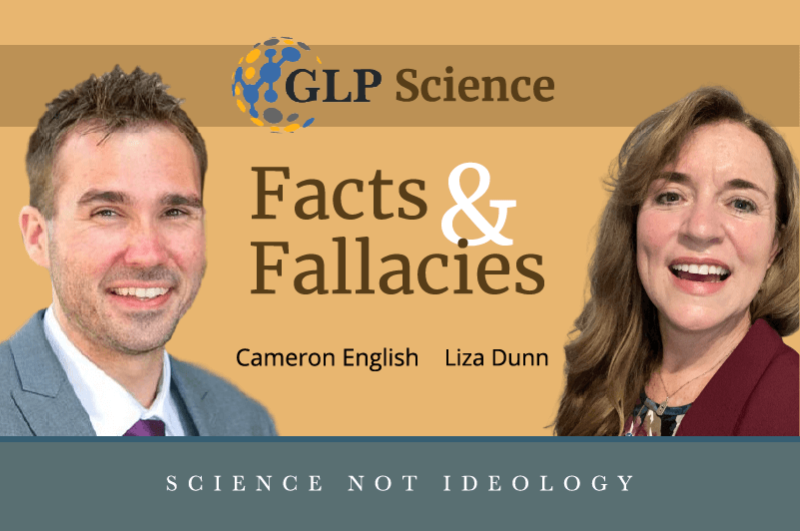
Join hosts Dr. Liza Dunn and GLP contributor Cameron English on episode 273 of Science Facts and Fallacies as they break down these latest news stories:
The press frequently reports that processed foods, and “ultra-processed foods” (UFPs) in particular, are uniquely harmful. Studies have linked these cheap, convenient products to various maladies, while the food industry insists that UFPs are safe to consume in moderation, and that all processed foods are being painted with too broad a brush; they are lobbying to prevent additional regulation of its products. It’s a compelling story, but the available evidence has raised questions about this tidy narrative. Are ultra-processed foods as harmful as some claim? Let’s examine the science.

“Many of the ways we grow, manufacture and consume food,” the World Economic Forum says, “are causing a dual crisis of human and environmental health.” As a result, its time to radically remake our food system by switching to renewable energy, limiting our electricity consumption and developing synthetic proteins to replace many of the animal products we rely on to feed ourselves. The proposal is bold and sweeping, but is it ready for prime time? A careful look at the evidence indicates that these plans are neither feasible nor beneficial from a public health or environmental perspective.
The public is increasingly relying on AI-generated search results to answer a wide variety of questions. While platforms like ChatGPT are undoubtedly useful for this purpose, they can’t always be trusted to pull information from reliable sources. Indeed, about one-third of the time, these chatbots supply answers based on information published by demonstrably fake websites designed to mislead readers, according to one recent analysis. How do we make our way through this morass of digital nonsense to find the truth?
Dr. Liza Dunn is a medical toxicologist and the medical affairs lead at Bayer Crop Science. Follow her on X @DrLizaMD
Cameron J. English is the director of bio-sciences at the American Council on Science and Health. Visit his website and follow him on X @camjenglish