Video: From thought to movement — Mind-controlled prosthetic feels like a part of the wearer’s body

Credit: Rehabilitation Institute of Chicago

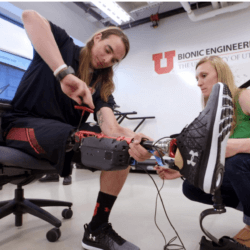
A new neural interface connects a bionic limb to nerve endings in the thigh, allowing the limb to be controlled by the brain. The new device, which is described [July 1] in Nature Medicine, could help people with lower-leg amputations feel as if their prosthesis is part of them.

Follow the latest news and policy debates on sustainable agriculture, biomedicine, and other ‘disruptive’ innovations. Subscribe to our newsletter.

Getting the neural interface hooked up to a prosthetic takes two steps. First, patients undergo surgery. Following a lower leg amputation, portions of shin and calf muscle still remain. The operation connects shin muscle, which contracts to make the ankle flex upward, to calf muscle, which counteracts this movement. The prosthetic can also be fitted at this point. Reattaching the remnants of these muscles can enable the prosthetic to move more dynamically. It can also reduce phantom limb pain, and patients are less likely to trip and fall.

In step two, surface electrodes measure nerve activity from the brain to the calf and shin muscles, indicating an intention to move the lower leg. A small computer in the bionic leg decodes those nerve signals and moves the leg accordingly, allowing the patient to move the limb more naturally.
This is an excerpt. Read the full article here

{{ reviewsTotal }}{{ options.labels.singularReviewCountLabel }}
{{ reviewsTotal }}{{ options.labels.pluralReviewCountLabel }}
{{ options.labels.newReviewButton }}
{{ userData.canReview.message }}

Related Articles

Infographic: Global regulatory and health research agencies on whether glyphosate causes cancer

Infographic: Global regulatory and health research agencies on whether glyphosate causes cancer

Does glyphosate—the world's most heavily-used herbicide—pose serious harm to humans? Is it carcinogenic? Those issues are of both legal and ...

Most Popular

Screenshot-2026-04-13-at-1.39.26-PM
Viewpoint: ‘Safer for children?’ Stonyfield yogurt under fire for deceptive organic marketing
Screenshot-2026-04-22-at-10.46.29-AM
Viewpoint: How to counter science disinformation? Science journalist offers 12 practical tips
ChatGPT-Image-May-7-2026-12_16_37-PM-2
Viewpoint: Are cancer rates ‘skyrocketing’ as RFK, Jr. and MAHA claim? The evidence says mostly the opposite
Picture1-14
When superbugs threaten vulnerable children: Can AI help solve antibiotic resistance?
ChatGPT-Image-May-12-2026-08_39_41-PM
GLP podcast: Big Pharma, Big Ag, Big Food—health harming industries or life-saving innovators?
Screenshot-2026-04-23-at-11.00.36-AM
Regulators' dilemma: Thalidomide, Metformin, and the cost of getting drug approvals wrong
ChatGPT-Image-May-7-2026-12_32_36-PM
Viewpoint: The state of U.S. vaccine policy? Dismal nationally, but some states are stepping up.
Picture1-1
Cooling the planet with balloons: Could a geoengineering gamble slow global warming?
bigstock opioids on chalkboard with rol
GLP podcast: 'Safe injection sites': enabling drug addiction or saving lives?
ChatGPT-Image-May-7-2026-01_23_27-PM-2
Viewpoint: Will AI democratize personalized cancer treatment or fuel medical misinformation?
Defense_Secretary_Ash_Carter_tours_the_Microsoft_Cybercrime_Center_in_Seattle_March_3_2016
How criminals are using AI to target social media users and steal their money and confidential data
RFKjr-Tech-Vax-Misinfo
As U.S. officials spread medical misinformation, scientists fact check online
glp menu logo outlined

Get news on human & agricultural genetics and biotechnology delivered to your inbox.