
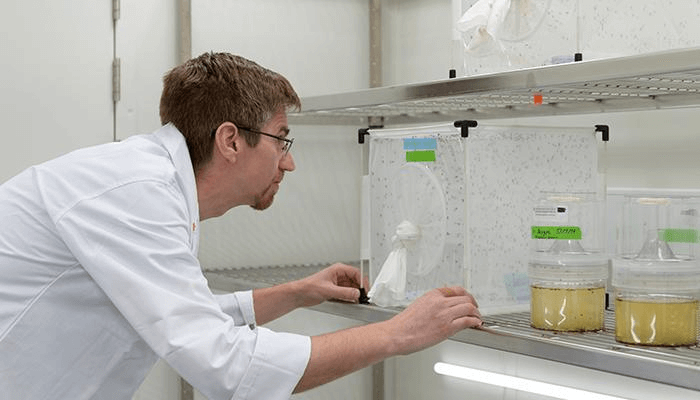
A new study published recently in Communications Biology by Macquarie University researchers envisions a future where these bioengineered flies play a pivotal role in waste management and sustainable biomanufacturing. This approach not only addresses multiple United Nations Sustainable Development Goals (SDGs) but also reimagines the role of insects in industrial processes.
Waste dilemma
Dr. Kate Tepper, a synthetic biologist and Postdoctoral Research Fellow at Applied BioSciences, Macquarie University, is the lead author of the paper. “One of the major hurdles in creating circular economies is producing high-value products from waste,” Tepper explains. And waste is abundant—between 40 to 70 percent of global organic waste ends up in landfills, contributing roughly five percent of the world’s annual greenhouse gas emissions.
Municipal biosolids, the organic by-products from sewage treatment, offer a partial solution as they can replace synthetic fertilizers, helping to close nutrient cycles. But Tepper points out a growing concern: the presence of toxic ‘forever chemicals’ such as PFAS in waste, which pose serious environmental and health risks.
In developing nations, the problem takes on a different form. Organic waste, often dumped in open areas, contaminates drinking and irrigation water, attracts pests, spreads disease, and degrades natural habitats. Additionally, burning leftover crop parts, a common practice among farmers, leads to air pollution.
Enter the black soldier fly. These insects are already used in waste management, consuming organic waste and transforming it into insect biomass, which is then processed into feed for pets, poultry, and fish. However, the Macquarie team believes genetic engineering could vastly expand their utility.
Engineering the future
The proposed genetic modifications could allow black soldier fly larvae to not only process waste more efficiently but also produce industrial enzymes and specialized lipids. These enzymes, used in livestock, textiles, food, and pharmaceuticals, represent a global market worth billions of dollars annually. Moreover, the flies could generate biofuels and lubricants, offering a sustainable alternative to fossil fuel-derived products.

Dr. Tepper highlights another intriguing possibility: “Even the fly-poo, or ‘frass,’ could be enhanced to create pollutant-free fertilizer, ensuring that contaminants are not reintroduced into our food supply.”
Dr. Maciej Maselko, senior author of the study and head of an animal synthetic biology lab at Macquarie University, believes that insects like the black soldier fly represent the next frontier in synthetic biology. Unlike genetically engineered microbes, which require sterile environments and refined nutrient inputs, these flies can thrive on unprocessed waste. “We can feed black soldier flies straight, dirty trash rather than sterilized or thoroughly pre-processed,” Maselko says. The flies consume large volumes of waste more quickly than microbes, making them efficient biomanufacturers.
The researchers propose a roadmap for developing better genetic engineering tools for key insects. They also emphasize the importance of containment strategies to prevent escapees from surviving in the wild.
From lab to market
Macquarie University has already taken steps toward commercializing this technology. In partnership with members of the research team, the university has filed patent applications related to black soldier fly biomanufacturing, which is being advanced through a spin-out company, EntoZyme.
Dr. Tepper is optimistic about the potential of genetically engineered insects. “If we want a sustainable circular economy, the economics of that have to work,” she says. By creating economic incentives to adopt sustainable technologies—such as engineering insects to extract more value from waste products—this transition could happen more swiftly.
In a world struggling with waste and pollution, the humble black soldier fly might just be the unsung hero we need.
A version of this article was originally posted at SynBioBeta and is reposted here with permission. Any reposting should credit both the GLP and original article.